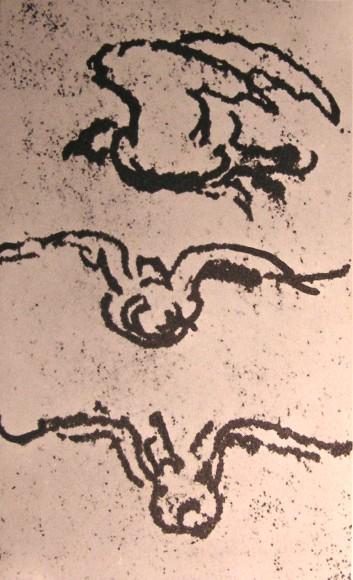
Drawings of a Bird in Flight – A Study in Motion and Observation
Leonardo da Vinci’s “Drawings of a Bird in Flight,” created around 1500, transcends mere depiction; it embodies the very spirit of Renaissance humanism—a profound fascination with understanding the natural world through meticulous observation and artistic representation. This striking black and white photograph captures a preparatory sketch from one of Da Vinci's numerous notebooks, offering a glimpse into his relentless pursuit of knowledge and beauty intertwined. The painting itself showcases three birds in flight, each rendered with remarkable accuracy and dynamism, demonstrating Da Vinci’s mastery of anatomical detail combined with an intuitive grasp of aerodynamics.
- Subject Matter: The central focus is undeniably avian movement—a subject that captivated Da Vinci throughout his life. He meticulously studied bird anatomy, dissecting specimens to gain insight into their musculature and skeletal structure, informing his artistic depictions with scientific precision.
- Style & Technique: Characteristic of Da Vinci’s style, the drawing employs a masterful blend of hatching and shading techniques. These delicate lines create subtle gradations of tone, conveying depth and volume—essential elements in capturing the illusion of three-dimensional space within a two-dimensional surface. The artist's attention to detail is palpable; every feather appears to quiver with movement, reflecting Da Vinci’s unwavering commitment to realism.
Historical Context – Renaissance Curiosity and Artistic Innovation
Da Vinci’s “Drawings of a Bird in Flight” emerged during the High Renaissance—a period marked by an unprecedented flourishing of artistic creativity fueled by humanist ideals. Artists like Da Vinci sought to emulate classical art forms while simultaneously pushing boundaries, exploring new perspectives and techniques. The observation of nature was considered paramount, serving as inspiration for both scientific inquiry and artistic expression. This sketch exemplifies this ethos, representing a pivotal moment in the history of art and demonstrating Da Vinci’s pioneering role in advancing anatomical understanding.
- Influence: Da Vinci's meticulous drawings served as a foundational element for subsequent artists exploring flight—particularly those attempting to realize his ambitious Ornithopter designs.
- Symbolism: Birds, universally recognized symbols of freedom and aspiration, resonate deeply within the artwork’s narrative. They represent not only physical movement but also spiritual transcendence—a core concept prevalent in Renaissance thought.
Emotional Impact – Capturing Transient Beauty
Beyond its technical brilliance, “Drawings of a Bird in Flight” possesses an undeniable emotional resonance. The artist’s ability to convey the fleeting grace of avian motion speaks to a deeper appreciation for the ephemeral nature of beauty—a hallmark of Renaissance art. Viewing this drawing evokes contemplation and wonder, prompting viewers to consider the interconnectedness between observation, understanding, and artistic creation. It stands as a testament to Da Vinci's enduring legacy as one of history’s greatest thinkers and artists.
A Reproduction Worth Admiring
ArtsDot.com offers exceptionally detailed reproductions of Leonardo da Vinci’s “Drawings of a Bird in Flight,” allowing you to experience the artistry and scientific precision of this iconic masterpiece firsthand. Explore our curated collection today!