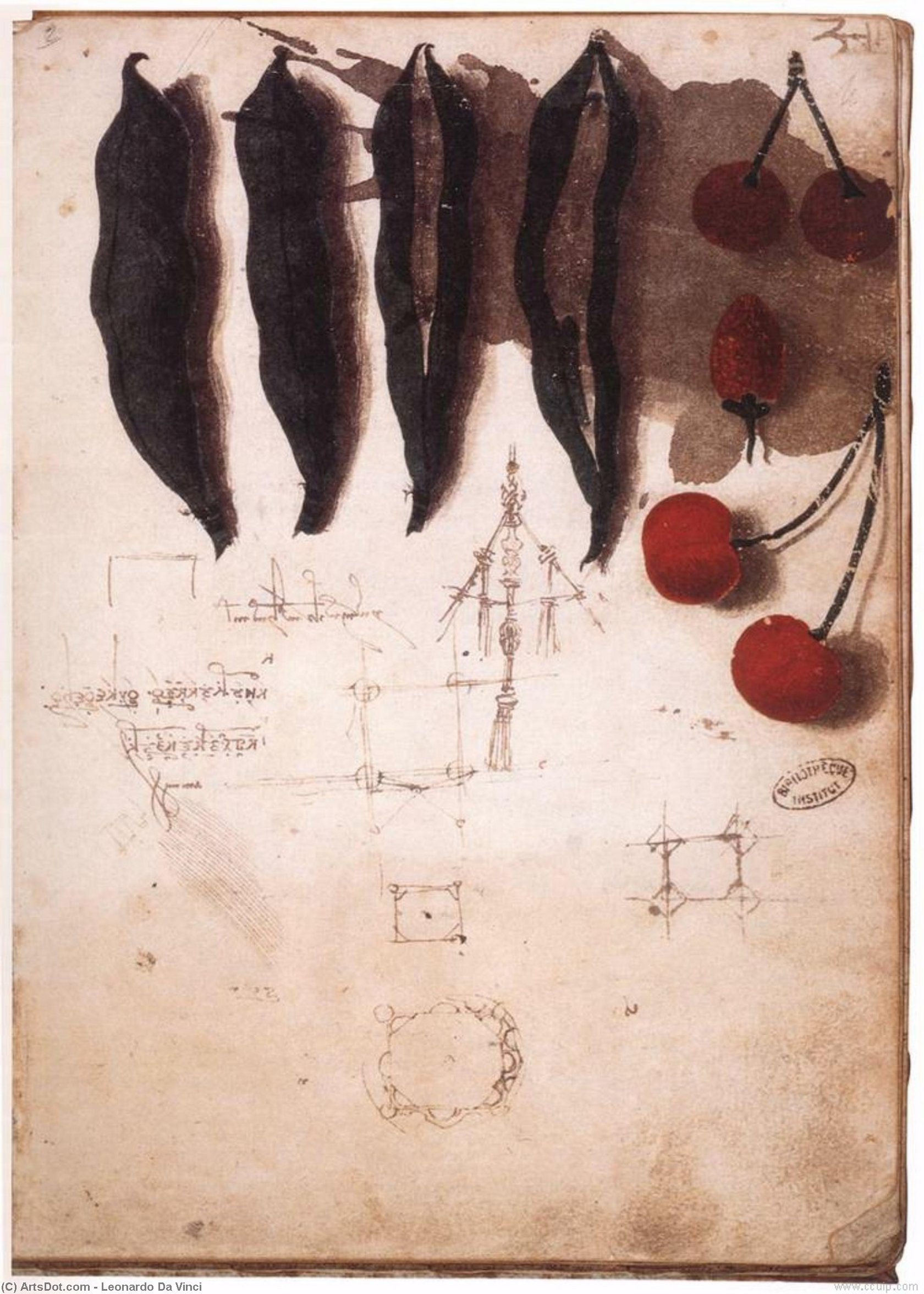
Fruit, Vegetables and Other Studies: A Glimpse into Leonardo's Scientific Mind
Leonardo da Vinci’s Fruit, Vegetables and Other Studies (c. 1487) is far more than a simple still life; it represents a pivotal moment in the history of art and science. Housed within the Institut de France in Paris, this pen drawing, measuring an impressive 235 x 176 cm, offers a rare window into Da Vinci’s meticulous observational skills and his groundbreaking approach to understanding the natural world. It's a testament to his belief that accurate representation stemmed from rigorous scientific inquiry.
Composition and Technique: Precision in Penmanship
The composition is deceptively simple yet profoundly complex. A variety of fruits – apples, oranges, bananas – and vegetables – carrots – are meticulously rendered on the page, alongside a clock indicating the time. Da Vinci employed a technique characterized by precise lines and delicate hatching to capture the textures and forms with remarkable accuracy. The use of brown ink on paper allows for subtle gradations of tone, creating an illusion of depth and volume. The inclusion of geometric shapes scattered across the page suggests preliminary studies related to proportion and structure, further highlighting Da Vinci’s scientific approach. This wasn't merely about depicting objects; it was about understanding their underlying forms and principles.
Historical Context: The Renaissance Embrace of Observation
Created during the High Renaissance, Fruit, Vegetables and Other Studies reflects a broader shift in artistic priorities. The Renaissance championed humanism and empirical observation, encouraging artists to move beyond purely symbolic representations towards a more realistic depiction of the world. Da Vinci embodied this spirit perfectly. While earlier art often used fruits and vegetables symbolically (e.g., grapes representing communion), Da Vinci’s work focuses solely on their physical characteristics. This shift marked a significant departure from medieval artistic conventions, paving the way for future generations of artists to embrace realism and scientific accuracy.
Symbolism and Emotional Impact: Abundance, Mortality, and Scientific Curiosity
Beyond its technical brilliance, the artwork carries subtle symbolic weight. The abundance of fruit suggests fertility and prosperity, while the inclusion of decaying elements hints at the fleeting nature of life – a common theme in Renaissance art reflecting an awareness of mortality. However, the dominant impression is one of intellectual curiosity. Da Vinci wasn't simply celebrating the beauty of these objects; he was dissecting them, analyzing their forms, and striving to understand their essence through careful observation. The drawing evokes a sense of quiet contemplation and invites viewers to appreciate the intricate details of the natural world – a testament to Da Vinci’s enduring legacy as both an artist and a scientist.
Da Vinci's Broader Oeuvre: A Polymath's Exploration
Fruit, Vegetables and Other Studies is but one facet of Leonardo da Vinci’s extraordinary genius. His explorations extended far beyond the realm of art, encompassing anatomy, architecture, engineering, and more. Consider these other notable works:
- Studies of central plan buildings: Demonstrating his architectural prowess.
- Study of a central church: Further illustrating his design capabilities.
- Design for the Adoration of the Magi: Showcasing his compositional skills and narrative storytelling.
These works, also available as high-quality reproductions, exemplify Da Vinci’s diverse artistic endeavors and his profound contributions to human knowledge.