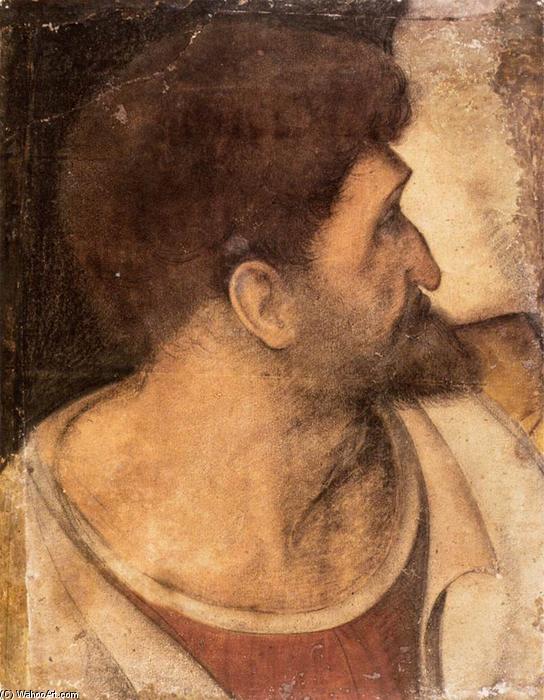
A Portrait of Remorse: Unveiling Leonardo’s ‘Head of Judas’
Leonardo da Vinci's charcoal drawing, “Head of Judas,” is more than just a portrait; it’s a profound meditation on betrayal, guilt, and the very nature of human emotion. Housed within the walls of the Musées de Strasbourg, this intimate study offers an unparalleled glimpse into the artist’s masterful technique and his ability to distill complex psychological states onto paper. Measuring a substantial 562 x 435 cm, the scale itself speaks to the importance Leonardo placed on capturing not just a likeness, but the essence of his subject – Judas Iscariot, the apostle who famously betrayed Jesus Christ.
The drawing’s power lies in its stark simplicity and unsettling realism. Da Vinci employs charcoal with an almost brutal honesty, rendering the folds of Judas's beard, the downward cast of his gaze, and the subtle lines etched around his eyes with a precision that borders on forensic. There is no attempt to idealize or romanticize; instead, we confront a man consumed by regret, a figure stripped bare of pretense. The choice of charcoal itself – a medium known for its immediacy and ability to capture texture – perfectly complements the raw emotional intensity of the image.
- The Subject: Judas Iscariot, a central figure in Christian theology, embodies betrayal and remorse. Da Vinci’s depiction isn't one of overt villainy but rather a poignant portrayal of inner turmoil – a man wrestling with his actions and their consequences.
- Technique: Da Vinci’s mastery is evident in the meticulous rendering of facial features, particularly the subtle shading that defines the contours of Judas’s face and the texture of his beard. The use of charcoal allows for incredible detail and contrast, creating a sense of depth and realism.
- Composition: The composition is strikingly simple – a close-up portrait focusing entirely on the subject's head and shoulders. This intensifies the viewer’s engagement with Judas’s expression and invites contemplation.
A Renaissance Master at Work
Leonardo da Vinci was, of course, far more than just a painter; he was an inventor, scientist, architect, and engineer – a true polymath of the Renaissance. “Head of Judas” exemplifies his multifaceted genius, showcasing not only his artistic skill but also his deep understanding of human anatomy and psychology. The drawing is considered one of many preparatory studies for *The Last Supper*, a monumental fresco in Milan’s Santa Maria delle Grazie church. These smaller, more intimate sketches served as crucial stepping stones in Da Vinci's creative process, allowing him to experiment with different compositions, expressions, and techniques before committing them to the larger mural.
Interestingly, the drawing itself is a testament to Da Vinci’s experimental approach to art. He utilized charcoal on red prepared paper – a technique that unfortunately proved unstable over time, contributing to the deterioration of *The Last Supper*. This fragility underscores the importance of preserving and studying these preparatory drawings, which offer invaluable insights into Da Vinci's working methods.
Symbolism and Interpretation
Beyond its technical brilliance, “Head of Judas” is laden with symbolic meaning. The red robe worn by the figure immediately draws attention to his betrayal – a color often associated with sin and sacrifice in Christian iconography. However, Da Vinci doesn’t simply portray Judas as a villain; he captures the weight of his guilt and remorse. The downward gaze suggests introspection and regret, inviting the viewer to empathize with the man's plight. Some scholars have suggested that Da Vinci was exploring themes of redemption and forgiveness through this portrait, subtly challenging conventional notions of morality.
Furthermore, the drawing’s placement within the broader context of *The Last Supper* is significant. Judas’s head becomes a focal point of attention amidst the reactions of the other apostles, highlighting his role as the catalyst for the drama and tragedy that unfolds in the painting.
Exploring Da Vinci's Legacy
Leonardo da Vinci’s “Head of Judas” stands as a powerful testament to his artistic genius and his profound understanding of the human condition. Alongside other remarkable works such as *Female Head* (Galleria degli Uffizi) and *Heads of Sts Thomas and James the Greater* (Ackland Art Museum), this drawing offers a window into the mind of one of history’s greatest artists. For those seeking to delve deeper into Da Vinci's world, or to experience the beauty and artistry of his masterpieces firsthand, ArtsDot provides exceptional hand-painted reproductions that capture the essence of these iconic works. Explore our collection today and bring a piece of Renaissance brilliance into your home.