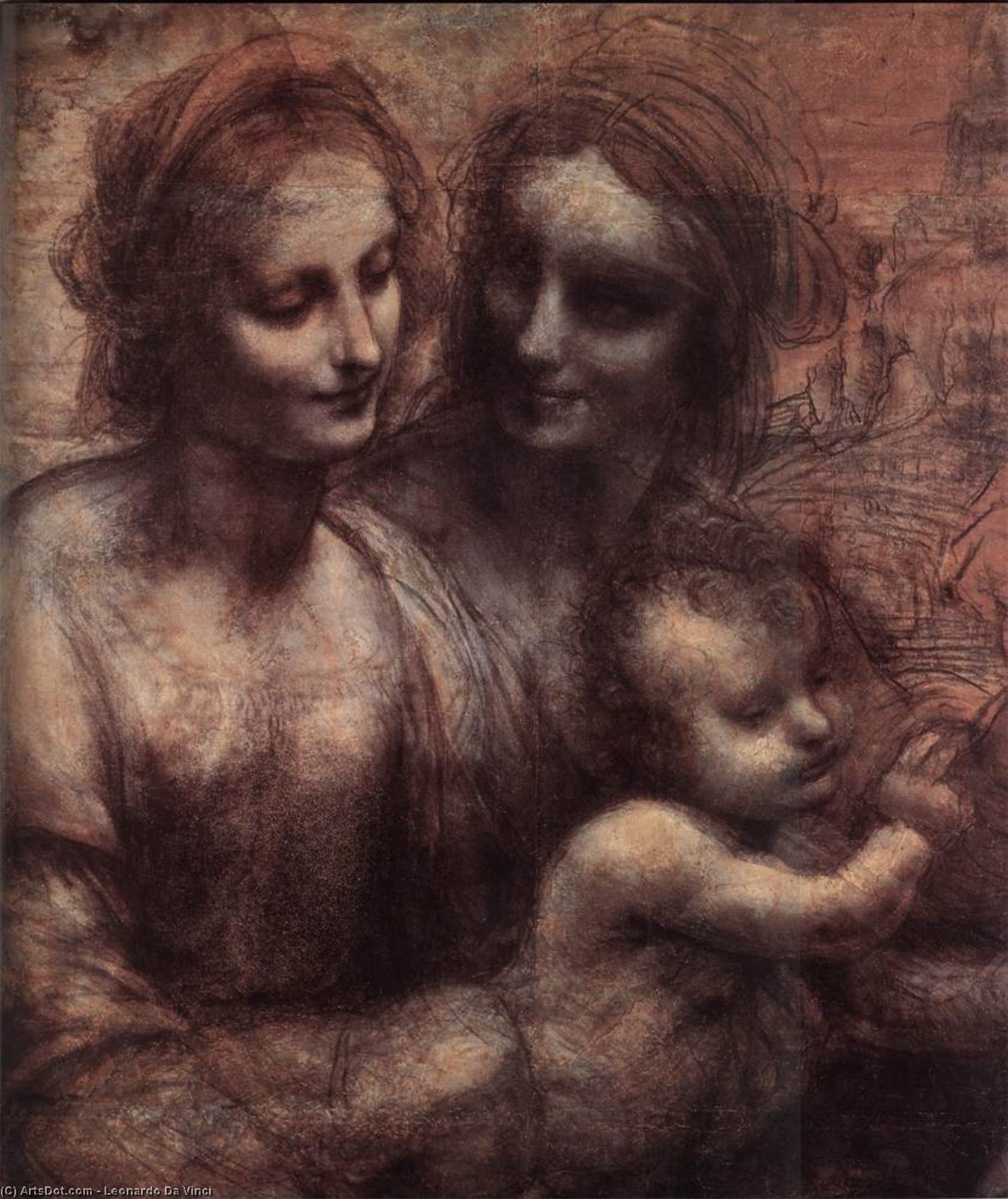
A Tender Embrace: Leonardo’s ‘Madonna and Child with St Anne and the Young St John’
Leonardo da Vinci's charcoal drawing, “Madonna and Child with St Anne and the Young St John,” is more than just a depiction of a holy family; it’s a profound meditation on motherhood, faith, and the intricate dance between generations. Created around 1507 during his second Milanese period, this intimate scene, now housed in the National Gallery in London, reveals the artist's unparalleled ability to capture not only physical likeness but also the subtle nuances of human emotion – a skill that continues to resonate with viewers centuries later. The drawing’s power lies in its quiet intensity, a testament to Leonardo’s mastery of sfumato and his profound understanding of the psychological depth within seemingly simple subjects.
The composition itself is remarkably dynamic. At the heart of the scene stands Mary, cradling her infant Jesus with an expression of serene devotion. Her gaze is directed slightly off-camera, inviting us into a private moment of connection. Beside her, Saint Anne observes with a gentle, knowing smile – a portrait of maternal grace and wisdom. Adding to the narrative depth are two figures in the background: a young St John, his curiosity palpable as he gazes towards an unseen point, and another figure whose identity remains subtly ambiguous. This layering of relationships creates a rich tapestry of interconnectedness, suggesting a lineage of faith and experience.
Leonardo’s technical prowess is immediately evident in the drawing's execution. He employed charcoal with meticulous detail, heightened with white chalk to create subtle gradations of tone and texture. The masterful use of sfumato – a technique he perfected throughout his career – softens the edges of the figures, lending them an ethereal quality and blurring the boundaries between light and shadow. This creates a sense of volume and roundness, making the subjects appear remarkably lifelike, almost as if they might step out from the page. The delicate rendering of fabric, particularly Mary’s veil, further demonstrates Leonardo's attention to detail and his deep understanding of material textures.
Historical Context: Milanese Innovation
“Madonna and Child with St Anne and the Young St John” emerged during a pivotal period in Leonardo’s artistic development. His time in Milan (1482-1499) was marked by experimentation and innovation, as he sought to push the boundaries of traditional painting techniques. This drawing represents a departure from the more rigid conventions of the High Renaissance, embracing a looser, more expressive style. It's believed that this piece may have been conceived as a preliminary study for a larger painting commissioned by King Louis XII of France – a commission that ultimately remained unfulfilled. Despite its unfinished state, the drawing stands as a significant example of Leonardo’s evolving artistic vision during this formative period.
The subject matter itself—a depiction of the Virgin Mary with her mother and grandson—was a popular theme in Renaissance art, often imbued with religious symbolism. However, Leonardo imbues this scene with a uniquely intimate quality, focusing not on grand theological pronouncements but rather on the quiet beauty of familial connection. The inclusion of St John, a figure associated with prophecy and martyrdom, adds another layer of complexity to the composition, hinting at the future destiny of Christianity.
Symbolism and Emotional Resonance
Beyond its technical brilliance, “Madonna and Child with St Anne and the Young St John” is rich in symbolic meaning. The veil worn by the women represents modesty and piety – a hallmark of Renaissance depictions of the Virgin Mary. Mary’s gaze off-camera suggests introspection and a connection to something beyond the earthly realm. The young St John's inquisitive expression embodies childhood wonder and a nascent faith. The pomegranate, often associated with fertility and abundance, is subtly implied through the folds of Mary’s robe – a quiet reminder of the promise of new life.
The emotional impact of this drawing is profound. It evokes a sense of tenderness, serenity, and timeless beauty. Leonardo masterfully captures the essence of maternal love, conveying not just the physical act of nurturing but also the deep spiritual connection between mother and child. The scene resonates with viewers on a deeply personal level, reminding us of the enduring power of family and faith.
Reproductions Available: Bringing Da Vinci Home
For art enthusiasts seeking to experience the beauty and artistry of Leonardo da Vinci’s “Madonna and Child with St Anne and the Young St John” firsthand, ArtsDot.com offers exquisite handmade oil painting reproductions. Each reproduction is meticulously crafted by skilled artists who have painstakingly studied the original drawing, ensuring an unparalleled level of accuracy and detail. These reproductions allow you to bring this iconic masterpiece into your own home, celebrating its timeless beauty for generations to come.
Explore our selection of high-quality reproductions at ArtsDot.com and discover the perfect piece to enhance your collection or create a truly inspiring space.
Further Exploration:
For more information on Leonardo da Vinci’s works and other famous artists, visit ArtsDot.com.