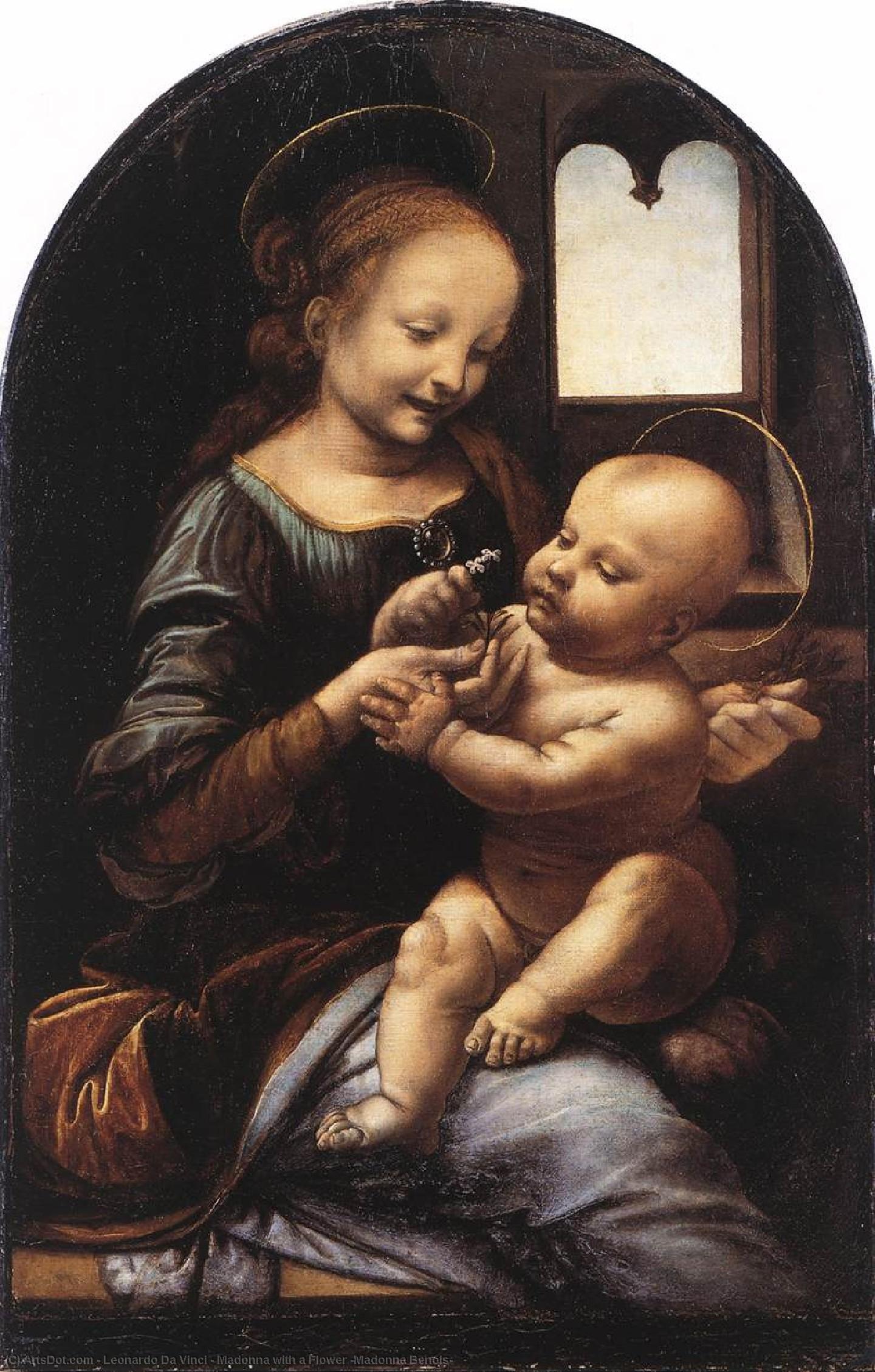
Madonna with a Flower (Madonna Benois): A Glimpse into Leonardo's Early Genius
Leonardo da Vinci’s Madonna with a Flower, also known as the Madonna Benois, is an early masterpiece that offers a captivating window into the artist's burgeoning talent. Created around 1478, this oil on canvas painting (33 x 49 cm) showcases Leonardo's developing mastery of composition and his innovative approach to depicting the Virgin Mary and Christ Child. It stands as one of the earliest independent works attributed solely to Leonardo, marking a significant departure from his apprenticeship under Andrea del Verrocchio.
Historical Context and Creation
The Madonna Benois emerged during the Early Renaissance in Florence, a period characterized by a renewed interest in classical art and humanism. Leonardo began working on this piece likely in October of 1478, possibly alongside another Madonna painting, the Madonna with the Carnation from Munich. The work’s significance lies in its independence; it represents Leonardo's first solo artistic endeavor, demonstrating his ability to move beyond the influence of his master and forge his own path. Preliminary sketches for the painting are preserved at the British Museum, providing valuable insight into Leonardo’s creative process.
Composition and Artistic Technique
The composition of the Madonna Benois is remarkably intimate and naturalistic. The Virgin Mary tenderly holds the Christ Child, who reaches out towards a flower offered by his mother. Unlike earlier depictions that often portrayed the Madonna in a regal or distant manner, Leonardo presents her as a young woman engaged in a moment of maternal affection. Leonardo’s use of oil paint allowed for subtle gradations of tone and delicate details, contributing to the painting's soft and luminous quality. The composition demonstrates an early adoption of sfumato, a technique characterized by blurred outlines and softened transitions between light and shadow – a hallmark of Leonardo’s later works. The background is simple, drawing attention to the figures and enhancing their emotional impact.
Symbolism and Emotional Resonance
Beyond its aesthetic beauty, the Madonna Benois is rich in symbolism. The flower held by Mary is believed to represent both innocence and a premonition of Christ’s future sacrifice – a subtle foreshadowing of his crucifixion. The child's gesture of reaching for the flower further emphasizes this duality. Leonardo masterfully captures a sense of tenderness, serenity, and maternal love, creating an emotionally resonant image that transcends its religious subject matter. The painting evokes feelings of warmth, peace, and quiet contemplation.
Legacy and Current Location
The Madonna Benois profoundly influenced subsequent generations of artists, most notably Raphael, who drew inspiration from its composition for his own celebrated Madonna of the Pinks. Today, this invaluable work resides in the esteemed Hermitage Museum in St. Petersburg, Russia, where it continues to captivate viewers with its beauty and historical significance. Its presence within the museum's collection underscores its importance as a cornerstone of Renaissance art.