Leonardo da Vinci’s Anatomical Study: A Window into Renaissance Thought
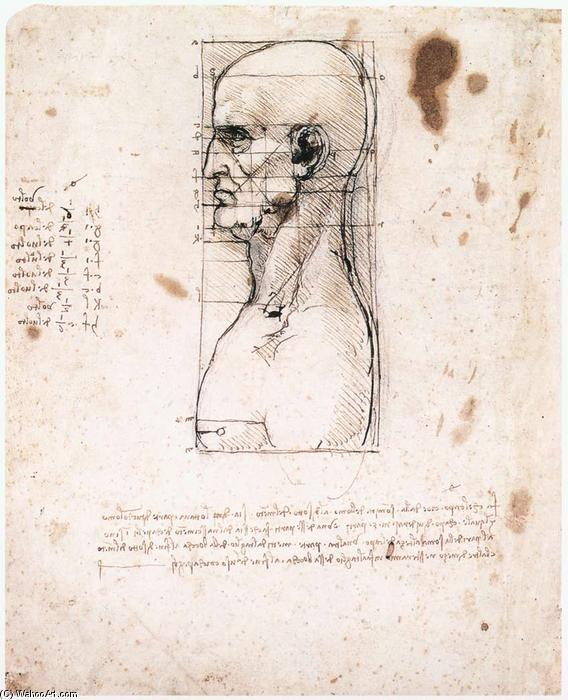
The painting “Male head in profile with proportions,” attributed to Leonardo da Vinci himself, stands as a remarkable testament to the artist's unparalleled understanding of human form and his profound engagement with the intellectual currents of the High Renaissance. Executed around 1490, during a period when Da Vinci was meticulously studying the principles of anatomy – a pursuit deeply intertwined with his artistic ambitions – this work transcends mere portraiture; it’s an intensely focused investigation into the very essence of human representation. Measuring 280 x 222 cm and currently housed within the Gallerie dell'Accademia in Venice, Italy, the painting immediately draws the viewer into a world of meticulous detail and serene contemplation.
- Technical Mastery: Da Vinci’s mastery is evident in his application of *sfumato*, a technique he perfected to create an almost ethereal quality. The blurred background isn't simply a backdrop; it actively directs the eye, intensifying the focus on the subject’s face and contributing to a remarkable sense of volume and depth. Notice how the subtle gradations of light and shadow sculpt the contours of the head, imbuing it with a lifelike presence.
- Proportional Precision: The painting's title itself – “Male head in profile with proportions” – highlights its primary purpose: an exploration of human anatomy. Da Vinci’s studies during this period were directly influenced by the artistic canons of body proportions, as evidenced by works like his iconic Vitruvian Man. This head is a microcosm of those investigations, demonstrating a deep understanding of how elements relate to one another within the human form.
The Renaissance Ideal: Harmony and Balance
Created during the High Renaissance – a period defined by its emphasis on realism, harmony, and balance – this piece embodies the era’s core artistic values. The Renaissance was fueled by a renewed interest in classical Greek and Roman art and philosophy, leading to a desire to represent the human form with unprecedented accuracy and beauty. Da Vinci's work reflects this shift, moving beyond stylized representations towards a more naturalistic approach. The composition itself is carefully balanced, reflecting the humanist ideals that were central to Renaissance thought – an emphasis on human potential and achievement.
“The word canon (from Ancient Greek κανών (kanṓn) 'measuring rod, standard') was first used for this type of rule in Classical Greece…”
This quote from the Wikipedia search highlights the importance of established rules and standards in Renaissance art. Da Vinci wasn’t simply creating a portrait; he was engaging with centuries-old traditions of artistic representation.
Symbolism and the Human Condition
While seemingly straightforward, the painting carries subtle symbolic weight. The profile view itself is a common convention in Renaissance portraiture, often signifying dignity and contemplation. The subject’s serene expression invites viewers to consider questions about human existence – mortality, beauty, and the relationship between the physical and spiritual realms. Da Vinci's meticulous rendering of the face suggests an attempt to capture not just a likeness, but also something of the individual’s inner character.
A Legacy Endures
“Male head in profile with proportions” is more than just a beautiful painting; it’s a pivotal work in art history. Da Vinci's anatomical studies profoundly influenced generations of artists and scientists, shaping our understanding of human form and inspiring countless works of art. Its enduring appeal lies not only in its technical brilliance but also in its ability to connect us with one of the greatest minds of all time – a man who sought to unlock the secrets of both nature and the human spirit. A hand-painted reproduction offers an unparalleled opportunity to experience this masterpiece firsthand, bringing Da Vinci’s genius into your home or studio.