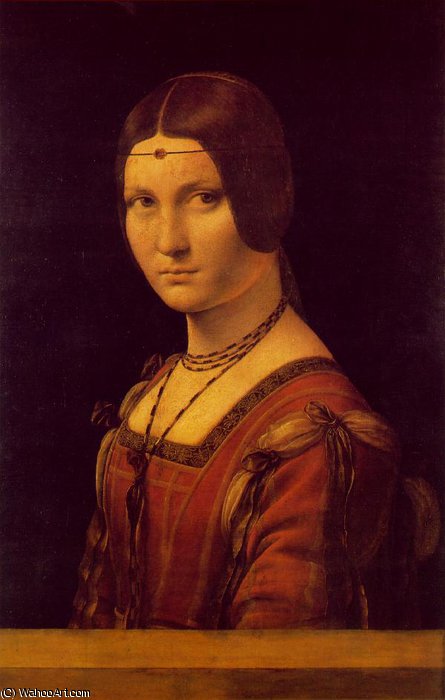
Portrait of a Lady from the Court of Milan, called
Explore Leonardo da Vinci (1452-1519): Renaissance genius behind Mona Lisa & The Last Supper! Discover his sfumato technique, anatomical studies & groundbreaking inventions.
The Enigma of a Silent Dialogue
To stand before Leonardo da Vinci’s La Belle Ferronnière is to enter into a silent, profound conversation with history. This portrait, a jewel of the High Renaissance, captures more than just the likeness of a Milanese noblewoman; it captures a moment of suspended animation. Through his revolutionary use of sfumato, Da Vinci dissolves the harsh boundaries of reality, allowing light and shadow to dance across the subject's features in an ethereal haze. This technique softens the contours of her face, imbuing her expression with a sense of deep, introspective mystery that seems to shift as the viewer moves. Her gaze, steady and slightly enigmatic, establishes an immediate, haunting connection, pulling the observer into her quiet world of contemplation.
A Symphony of Status and Soul
Beyond the technical mastery lies a rich narrative of Renaissance humanism and social prestige. The lady’s attire serves as a window into the opulence of the Court of Milan. Her crimson gown, heavy with the weight of nobility, is meticulously rendered to showcase the luster of pearls and the glint of fine jewelry. Yet, Da Vinci avoids the trap of mere ostentation; he uses these symbols of wealth not to glorify material excess, but to frame the subject's inner character. The contrast between the dark, shadowy background and the luminous textures of her clothing creates a dramatic tension that directs all focus toward her psychological depth. Every fold of fabric and every shimmering gem acts as a testament to an era where art sought to harmonize the physical splendor of the world with the intellectual pursuits of the human spirit.
Timeless Elegance for the Discerning Space
For the collector or interior designer, a reproduction of this masterpiece offers much more than mere decoration; it provides an anchor of sophistication and historical gravity. The painting’s balanced composition and muted yet powerful color palette allow it to integrate seamlessly into diverse environments, from classical studies to contemporary, minimalist galleries. It possesses a unique ability to command attention without overwhelming a room, lending an air of cultured tranquility to any setting. Bringing this piece into a home is an invitation to surround oneself with the enduring beauty of the Cinquecento, fostering an atmosphere where art, history, and emotion converge in a single, breathtaking image.