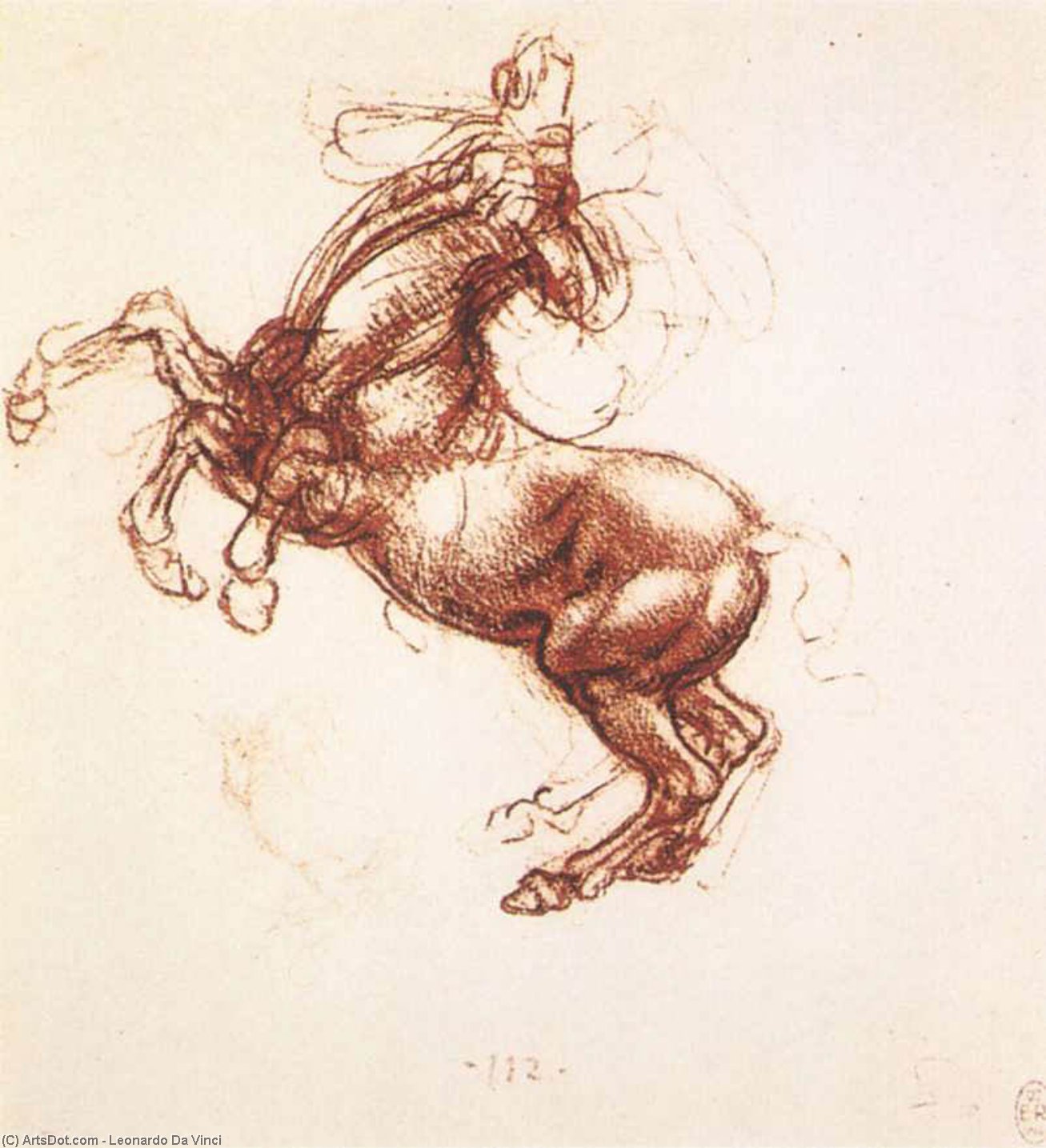
The Captivating "Rearing Horse" by Leonardo Da Vinci
The "Rearing Horse," housed within the esteemed Royal Library of Windsor, United Kingdom, stands as a testament to the unparalleled genius of Leonardo Da Vinci. This chalk drawing, meticulously crafted in 1503 and measuring an impressive 153 x 142 cm, offers a glimpse into the mind of one of history's most celebrated polymaths.
A Study of Movement and Anatomy
This artwork isn’t merely a depiction; it is a profound study. The "Rearing Horse" captures a moment of dynamic energy as a horse powerfully raises its head, with its front legs suspended in mid-air. The artist's choice of brown chalk lends an earthy quality to the animal, while the composition directs our gaze towards the left side where the horse’s body is positioned. The visible back legs on the right suggest a forward lean, emphasizing the motion. Da Vinci’s mastery lies not only in representing form but also in conveying movement with remarkable accuracy. His deep understanding of equine anatomy, honed through studies in both art and science, shines through every line. The drawing reveals his fascination with musculature, skeletal structure, and the mechanics of locomotion – a hallmark of Renaissance scientific inquiry.
Historical Significance and Context within the High Renaissance
The "Rearing Horse" is part of Da Vinci’s extensive collection of preparatory drawings, many now residing in the Royal Library of Windsor. These sketches were crucial to his artistic process, serving as explorations for larger works and demonstrating his meticulous approach. Created during the High Renaissance (roughly 1490-1527), a period characterized by renewed interest in classical art and humanism, Da Vinci’s work exemplified the era's innovative spirit. As a polymath – excelling in painting, engineering, science, and architecture – he embodied the ideal of the "Renaissance man." His notebooks, filled with observations and sketches, remain invaluable resources for understanding his creative process and intellectual pursuits.
Symbolism and Emotional Resonance
While seemingly straightforward as an anatomical study, the “Rearing Horse” evokes a sense of power, energy, and controlled force. The rearing pose itself is symbolic – representing strength, defiance, and potential unleashed. Da Vinci’s masterful use of chalk allows for subtle gradations of tone that create depth and volume, imbuing the horse with a palpable presence. Though lacking overt narrative elements, the drawing resonates with an emotional intensity born from its meticulous observation and skillful execution. The image speaks to the beauty and power of nature, reflecting Da Vinci’s profound respect for the natural world.
Relevance for Modern Art Enthusiasts & Reproduction Opportunities
The "Rearing Horse" continues to captivate audiences today, offering a window into Da Vinci's artistic process and his enduring fascination with movement and anatomy. For modern art enthusiasts, it serves as a reminder of the importance of studying the masters and appreciating the historical context that shaped their creations. At ArtsDot, we are dedicated to preserving this legacy by offering meticulously crafted, handmade oil painting reproductions of Da Vinci's "Rearing Horse." Our skilled artists faithfully recreate every detail, ensuring an authentic representation of this iconic masterpiece for art lovers and collectors alike.