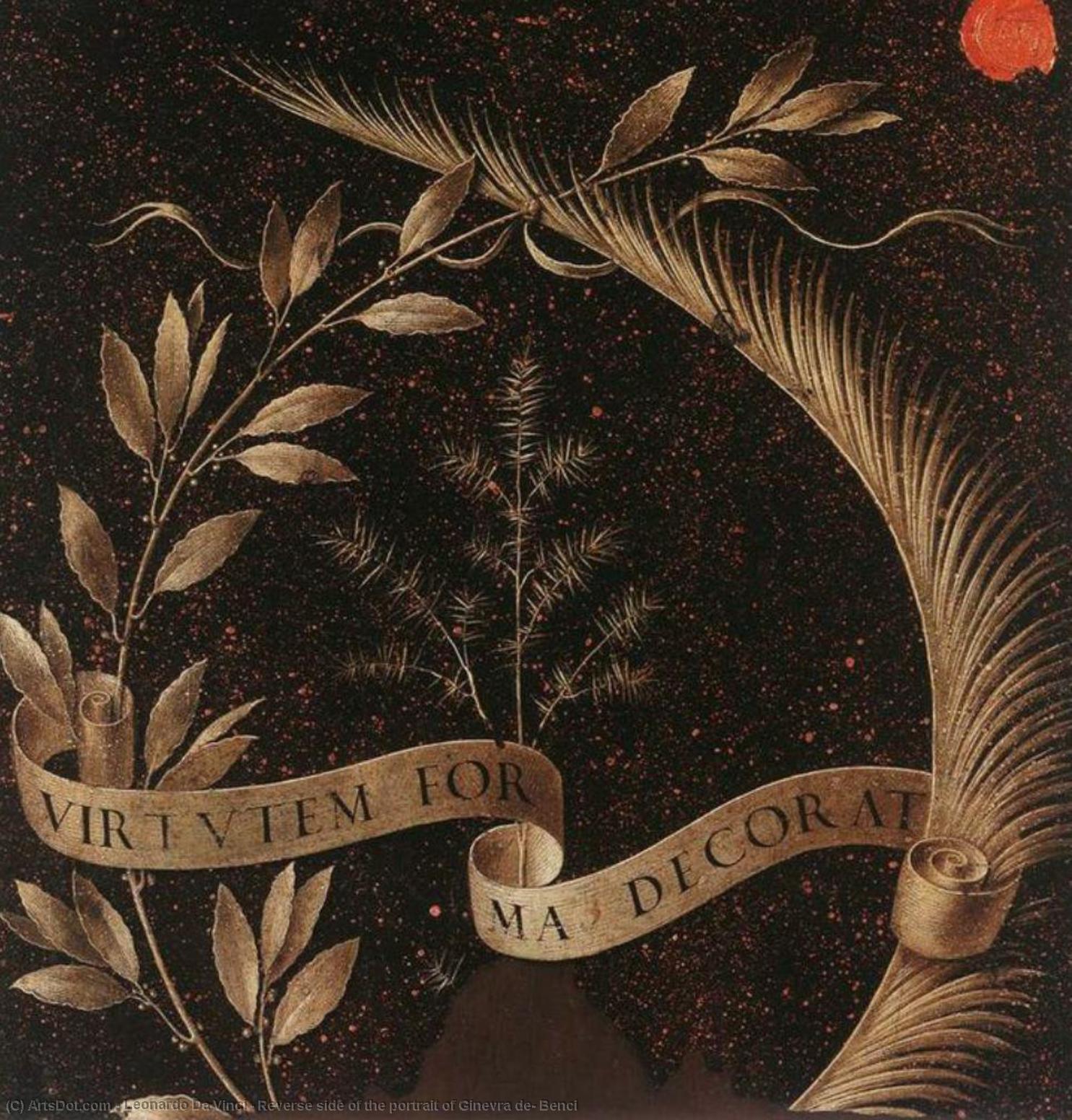
A Glimpse into the Enigma: Leonardo da Vinci’s Reverse Side of Ginevra de' Benci
This captivating artwork, the reverse side of Leonardo da Vinci’s portrait of Ginevra de’ Benci, offers a rare and intriguing departure from traditional portraiture. Executed around 1474, this monochrome drawing (38 x 36 cm) currently resides in the National Gallery of Art in Washington D.C., presenting not a likeness of the sitter, but a symbolic and deeply personal emblem. It’s a testament to Da Vinci's multifaceted genius – artist, scientist, and philosopher all rolled into one.
Decoding the Composition: Symbolism & Style
The composition is dominated by an elaborate banner displaying Latin text: “*Virtut Vitem For Ma Decorat*” (“Virtue overcomes difficulty for beautiful decoration”). This motto, likely a personal or family emblem of the Benci family, speaks to ideals of resilience and noble character. A crown atop the woman’s head – though not *of* Ginevra herself, but rather an allegorical figure – reinforces notions of status and virtue. The surrounding branches and foliage aren't merely decorative; they symbolize growth, life, and perhaps even the flourishing of the Benci family line. The style leans towards Mannerism, with its emphasis on elegant elongation and intricate detail, though it predates the full flowering of that movement. The overall effect is one of restrained grandeur and intellectual depth.
Technique & Artistic Mastery
Da Vinci’s skill shines through in the meticulous execution of this work. It appears to be created using drypoint etching – a technique where lines are incised directly into a plate, creating a velvety texture and subtle tonal variations. This method allows for an incredible level of detail, particularly evident in the rendering of the foliage and lettering. The monochrome palette focuses attention on form and symbolism rather than coloristic effects, demonstrating Da Vinci’s mastery of *chiaroscuro* even within this limited range. The flattened perspective prioritizes decorative elements and symbolic weight over realistic spatial representation.
Historical Context: Portraiture in the Renaissance
During the Renaissance, portraiture was evolving beyond simply recording physical likenesses. It became a vehicle for conveying social status, moral character, and intellectual pursuits. While portraits of women often emphasized beauty and marital prospects, Da Vinci’s work – even on the reverse of a panel – hints at something more profound. The Benci family were prominent Florentines, and commissioning such a detailed and symbolic piece speaks to their wealth, education, and desire for lasting legacy. This artwork exists within a period where humanist ideals were flourishing, emphasizing individual potential and civic virtue.
Emotional Resonance & Interior Design Considerations
The *Reverse Side of the Portrait of Ginevra de’ Benci* evokes a sense of quiet contemplation and intellectual curiosity. It's not an immediately “pretty” picture; its power lies in its subtlety and symbolic richness. For interior design, this artwork – or a high-quality reproduction – would lend itself well to spaces that prioritize sophistication and understated elegance. Its monochrome palette makes it versatile, complementing both modern and traditional settings.
Consider pairing it with neutral tones and natural materials to enhance its timeless appeal. It’s particularly suited for libraries, studies, or dining rooms where conversation and reflection are encouraged.
The artwork's intricate detail demands a well-lit space to fully appreciate its nuances.
Da Vinci’s Enduring Legacy
This piece serves as a powerful reminder of Leonardo da Vinci’s boundless creativity and intellectual curiosity. Alongside masterpieces like the *Mona Lisa* and *The Last Supper*, it demonstrates his commitment to pushing artistic boundaries and exploring the complexities of human experience. It is a testament to the Renaissance ideal – a celebration of art, science, and the enduring power of the human spirit.
- Artist: Leonardo da Vinci (1452-1519)
- Date: c. 1474
- Medium: Drypoint etching on panel reverse
- Dimensions: 38 x 36 cm
- Location: National Gallery of Art, Washington D.C.