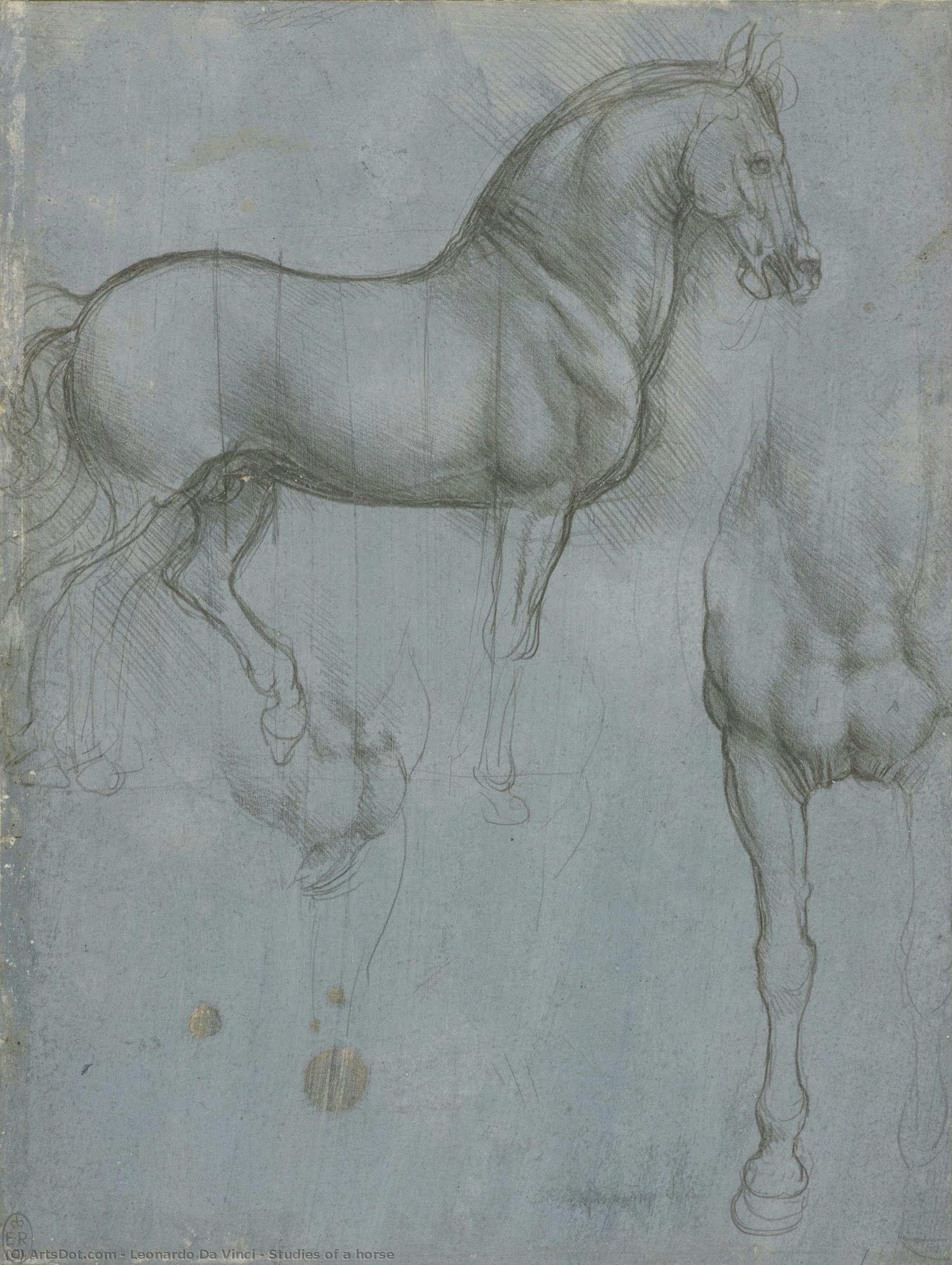
A Window into Leonardo’s Anatomical Obsession: Studying Horses
Leonardo da Vinci's artistic legacy transcends mere beauty; it resides in his relentless pursuit of understanding the natural world, a quest embodied most powerfully in his preparatory drawings—studies like “Studies of a Horse,” executed around 1490. This unassuming monochrome sketch offers an unparalleled glimpse into Da Vinci’s meticulous observation and masterful technique, revealing not just a depiction of equine anatomy but also a profound reflection on Renaissance ideals of scientific inquiry.
- Subject Matter: The drawing focuses entirely on the anatomical study of horses—a subject central to Da Vinci's fascination with naturalism. Unlike idealized representations common in his time, these sketches prioritize accuracy, capturing the musculature and skeletal structure of the animal with remarkable detail.
- Style & Technique: “Studies of a Horse” exemplifies Da Vinci’s signature style—precise, detailed, and driven by anatomical precision. Employing pencil or charcoal on paper, he utilized techniques honed through years of experimentation to achieve subtle tonal variations that convey volume and form. The drawing speaks volumes about Da Vinci's dedication to observation and his ability to translate scientific understanding into artistic expression.
- Composition & Perspective: The composition is deceptively simple yet remarkably effective. Multiple views—a full-length profile, a close-up of the chest and foreleg, and a smaller sketch offering another perspective—are interwoven to create depth and dimension within the two-dimensional space. Vertical lines serve as guides for proportion, reinforcing Da Vinci’s commitment to mathematical accuracy.
- Use of Lines & Texture: Delicate, flowing lines delineate muscle contours and skeletal structures, while hatching and crosshatching techniques build up tonal values with painstaking care. The resulting texture—created through controlled pressure applied to the pencil or charcoal—adds a palpable sense of materiality to the drawing, mirroring Da Vinci’s belief that art should strive for realism.
- Symbolic Significance: Beyond its scientific merit, “Studies of Horse” embodies Renaissance ideals of humanist inquiry. The horse itself represents strength, nobility, and vitality – qualities Da Vinci sought to capture not merely aesthetically but intellectually, reflecting his broader ambition to comprehend the universe through observation and reason.
Consider commissioning a high-quality reproduction of “Studies of Horse” to bring this iconic artwork into your home or studio. ArtsDot offers exceptional reproductions that faithfully preserve Da Vinci’s artistic vision, allowing you to appreciate the brilliance of Renaissance art firsthand.