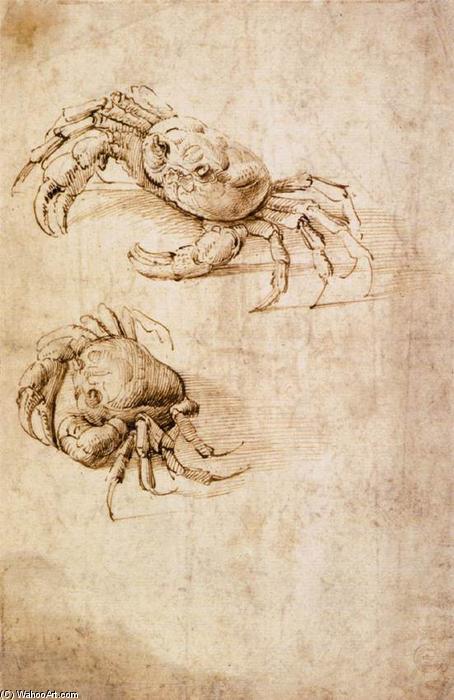
Studies of Crabs – A Delicate Observation of Renaissance Precision
Leonardo da Vinci’s “Studies of Crabs,” created in 1518 during his Florentine period, represents more than just a depiction of marine invertebrates; it embodies the humanist spirit and meticulous scientific inquiry that characterized the High Renaissance. This unassuming sketch—a testament to Da Vinci's boundless curiosity—offers a fascinating glimpse into his artistic process and reveals profound insights into his understanding of anatomy and observation.
The drawing itself is rendered in graphite on paper, showcasing Da Vinci’s mastery of sfumato – the subtle blending of tones that creates an illusion of depth and luminosity. Unlike grand frescoes or sculptures intended to convey monumental narratives, “Studies of Crabs” prioritizes accuracy and detail, reflecting Da Vinci's commitment to capturing the natural world with unparalleled realism. The artist’s hand delicately captures the contours of two crabs positioned on a sheet of paper bearing the marks of time—a subtle patina that speaks volumes about its provenance.
- Subject Matter: The drawing focuses intently on crustaceans – specifically crabs – presenting them in various poses, emphasizing their muscular structure and movement.
- Style: High Renaissance – characterized by balanced compositions, idealized forms, and a humanist emphasis on human anatomy and observation.
- Technique: Graphite sketching utilizing sfumato—a technique perfected by Da Vinci to achieve atmospheric perspective and subtle shading effects.
- Historical Context: Produced during Da Vinci’s prolific artistic output, “Studies of Crabs” aligns with the broader Renaissance fascination for scientific exploration and anatomical dissection, furthering humanist ideals.
Beyond its technical brilliance, “Studies of Crabs” holds symbolic significance within Da Vinci's oeuvre. The crab, often associated with resilience and adaptability—traits mirrored in Da Vinci’s own relentless pursuit of knowledge—serves as a microcosm of the natural world, inviting contemplation on the interconnectedness of form and function. It exemplifies Da Vinci’s belief that art should illuminate understanding.
For interior designers seeking inspiration or collectors desiring to acquire a stunning reproduction, “Studies of Crabs” transcends mere visual appeal. It embodies the essence of Renaissance artistry—precision, observation, and an unwavering dedication to capturing beauty in its simplest form. ArtsDot’s meticulous reproductions allow you to experience this masterpiece firsthand, bringing Da Vinci's genius into your home.