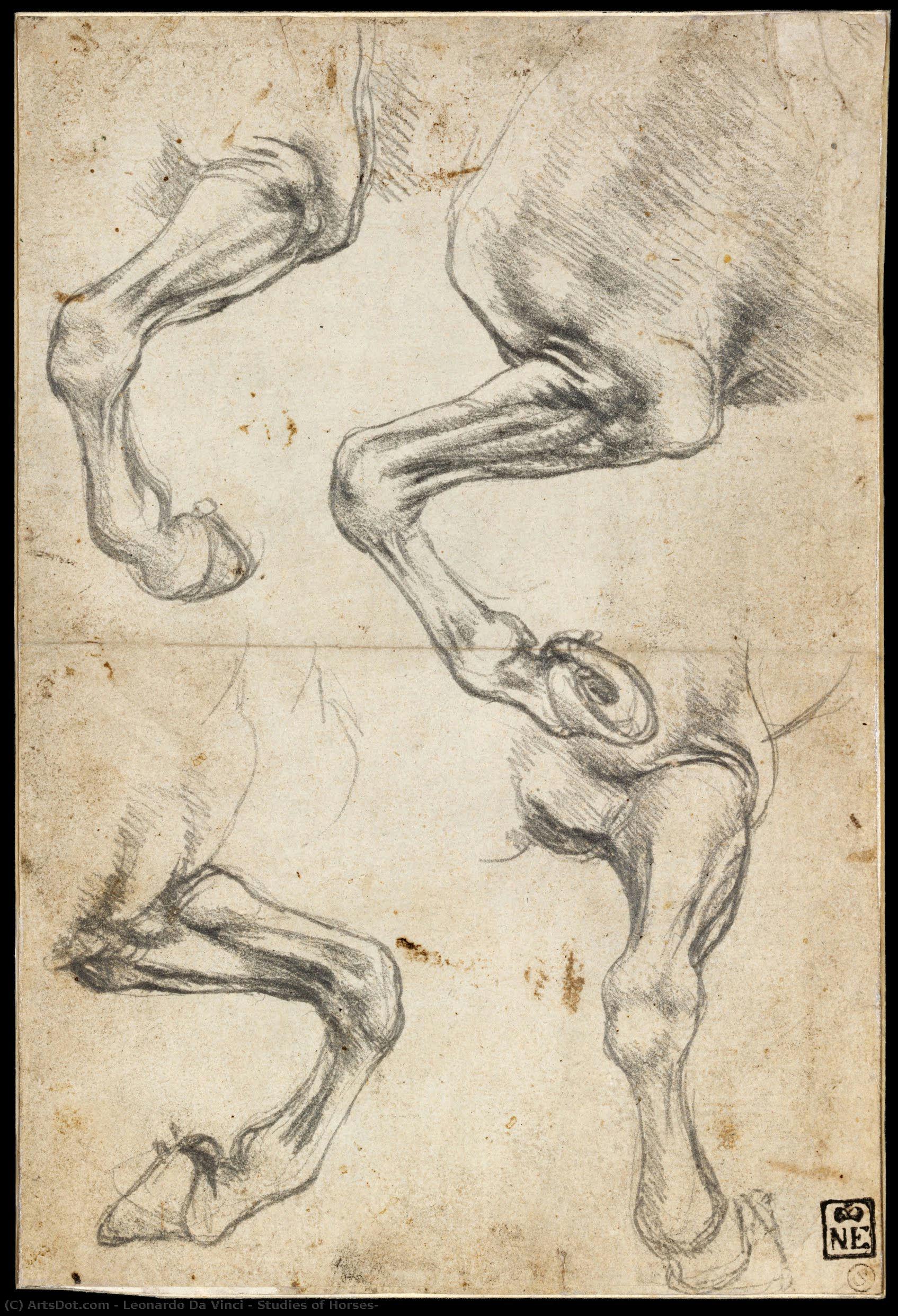
A Glimpse into Leonardo’s Obsession: “Studies of Horses”
The drawing before us – "Studies of Horses" by Leonardo da Vinci – isn't merely a depiction of an animal; it’s a profound meditation on form, movement, and the very essence of life. Created around 1490, during a period when Leonardo was meticulously planning his monumental equestrian statue for Ludovico Sforza, this sheet offers an unparalleled window into the mind of a genius consumed by observation. It represents far more than a preparatory sketch; it’s a testament to Leonardo's relentless pursuit of understanding – a desire to capture not just the outward appearance of a horse, but its internal mechanics, its vital energy, and ultimately, its spirit.
The drawing itself is deceptively simple in its execution. Executed with charcoal on paper, it’s a study in contrasts: the stark blackness of the lines against the creamy white of the support. Yet within this apparent austerity lies an astonishing level of detail. Leonardo doesn't shy away from rendering the intricate musculature beneath the horse’s skin – the powerful flexes of the legs as they prepare to move, the subtle curves of the neck and chest, the delicate structure of the ears. He captures not just the static pose, but the *potential* for movement, hinting at the dynamic force contained within the animal's form. The slightly elevated front legs, a key element in this particular study, are rendered with an almost impossible precision, demonstrating Leonardo’s deep understanding of equine anatomy and his ability to visualize the complex interplay of bones and tendons.
The Sforza Commission and the Quest for Ideal Form
This drawing is inextricably linked to the ambitious equestrian monument commissioned by Ludovico Sforza. Sforza, a powerful Duke of Milan, sought to create a symbol of his authority – a colossal bronze statue depicting himself alongside Francesco Sforza, his father. Leonardo was tasked with realizing this grand vision, and he approached it with characteristic intellectual rigor. The commission itself reflects the Renaissance fascination with classical ideals of beauty and power, but Leonardo wasn’t content to simply replicate existing models; he sought to surpass them through a radical understanding of nature.
The unrealized statue highlights the immense scale and complexity of the project – a testament to Leonardo's ambition. However, these preparatory drawings, including this one, reveal that his focus extended far beyond the final bronze form. He understood that a truly magnificent monument required an equally profound understanding of its subject: the horse. These studies were not simply technical exercises; they were explorations into the very nature of animal movement and anatomy, driven by Leonardo’s belief in the interconnectedness of art, science, and observation.
Leonardo's Method: Anatomy and Beyond
What distinguishes these “Studies of Horses” from mere sketches is Leonardo’s systematic approach. He didn’t simply draw horses; he dissected them – metaphorically, through relentless study and observation. He spent countless hours at the Milanese stables, meticulously documenting the animals' movements, their gait, their posture, and their reactions to various stimuli. This intimate knowledge informed every line on the page, imbuing the drawings with a remarkable sense of realism and vitality.
Furthermore, Leonardo’s interest extended beyond pure anatomy. He was fascinated by the horse’s psychology – its alertness, its responsiveness, its inherent grace. He sought to capture not just *how* the horse moved, but *why*. This holistic approach is evident in the subtle expressions captured on the horses' faces—a hint of curiosity, a flash of intelligence, a suggestion of power. The drawings are infused with an almost palpable sense of life, reflecting Leonardo’s profound respect for the animal kingdom.
A Timeless Masterpiece: Reproduction and Interpretation
Today, this drawing offers us a rare glimpse into the creative process of one of history's greatest artists. ArtsDot is proud to offer meticulously crafted hand-painted reproductions that faithfully capture the essence of Leonardo’s genius. Each reproduction utilizes archival quality materials and traditional techniques, ensuring that the rich detail and subtle nuances of the original drawing are preserved for generations to come.
Whether displayed in a grand salon or a private study, this artwork evokes a sense of timeless beauty and intellectual curiosity. It serves as a reminder of Leonardo’s boundless imagination and his unwavering commitment to understanding the world around him. Consider it not just a beautiful image, but an invitation to delve into the mind of a true Renaissance visionary – a window into the heart of artistic genius.