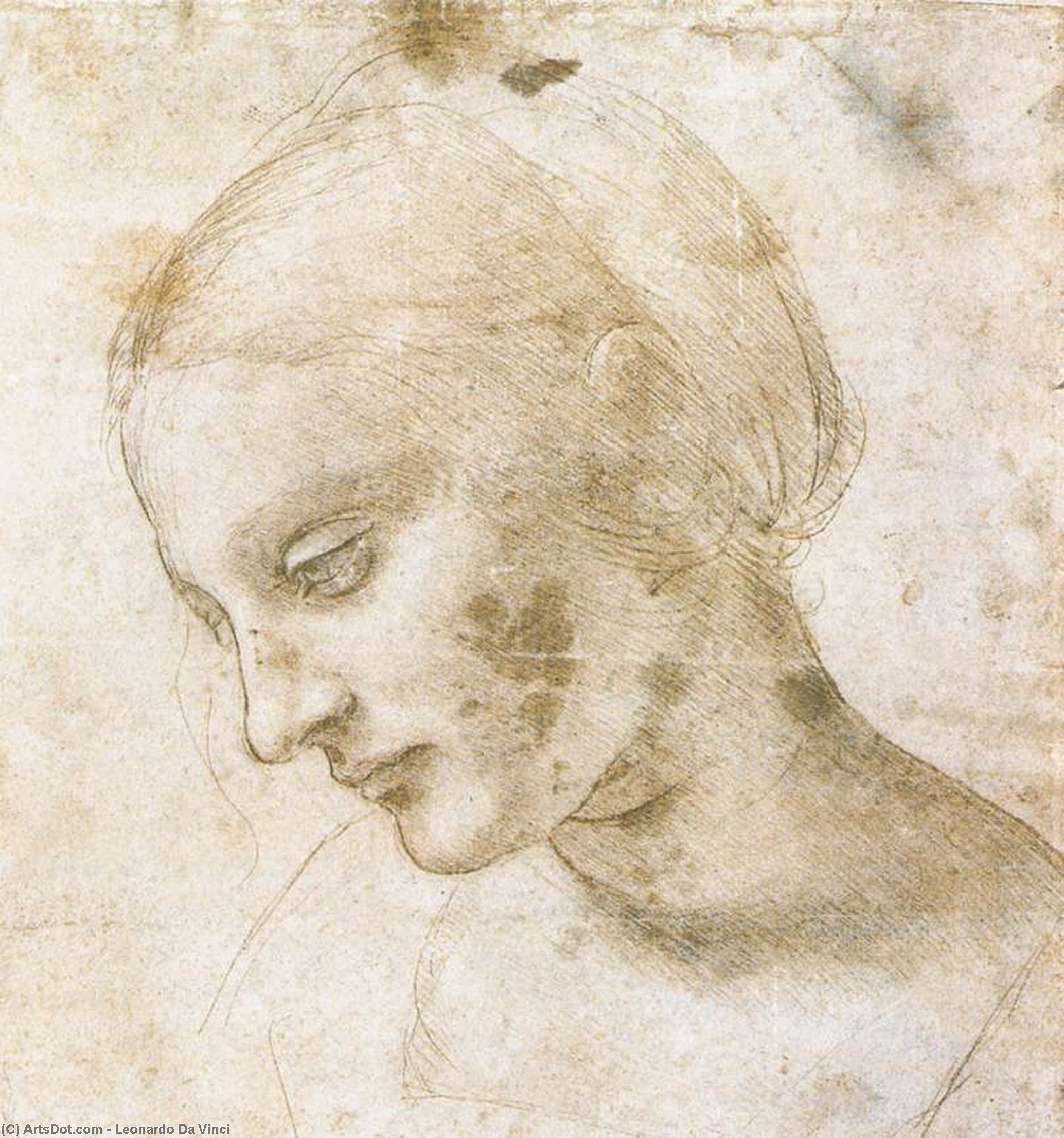
Study of a Woman's Head: A Glimpse into Leonardo da Vinci's Genius
Leonardo da Vinci, one of history’s most celebrated polymaths, left behind an extraordinary legacy of artistic and scientific exploration. Among his numerous masterpieces is the "Study of a Woman's Head," a silverpoint drawing on paper that offers a captivating glimpse into his meticulous observation of human form and expression. This work, housed in the Musée du Louvre, exemplifies Da Vinci’s mastery of technique and his profound understanding of anatomy and psychology.
Artistic Technique and Style: The Elegance of Silverpoint
The "Study of a Woman's Head" showcases Da Vinci’s skillful use of silverpoint, a drawing technique employing a thin silver stylus to create delicate lines on prepared paper. This method allowed for remarkable precision and subtle gradations in tone, capturing the nuances of light and shadow with exceptional finesse. The resulting image possesses an ethereal quality, enhanced by the soft sheen of the silver against the greenish-toned paper. Da Vinci’s hand is evident in every line, demonstrating a mastery of control and observation that set him apart from his contemporaries.
Subject and Expression: Contemplation and Serenity
The subject of this drawing is a woman depicted in a three-quarter profile, her gaze directed thoughtfully into the distance. Her hair cascades down her back, adding to an overall sense of grace and serenity. The expression on her face is one of quiet contemplation, inviting viewers to ponder her inner thoughts and emotions. Da Vinci’s ability to convey psychological depth through subtle facial cues is a hallmark of his artistic genius. This isn't merely a portrait; it's a study in human emotion and introspection.
Historical Context: Renaissance Innovation
Created around 1490, during Leonardo da Vinci’s time in Milan, the "Study of a Woman's Head" reflects the intellectual ferment of the High Renaissance. This period witnessed a renewed interest in classical art and learning, coupled with groundbreaking advancements in science and technology. Da Vinci embodied this spirit of innovation, seamlessly blending artistic skill with scientific inquiry. The drawing is believed to be a preparatory study for other works, possibly related to depictions of the Virgin Mary or other religious figures, highlighting its importance within his broader artistic practice.