Leonardo da Vinci, the renowned Italian polymath, is celebrated for his groundbreaking contributions to various fields, including art, science, and engineering. Among his numerous works,
"Study of Horses" stands out as a testament to his artistic prowess and meticulous attention to detail.
The Painting
"Cite Study of horses" by
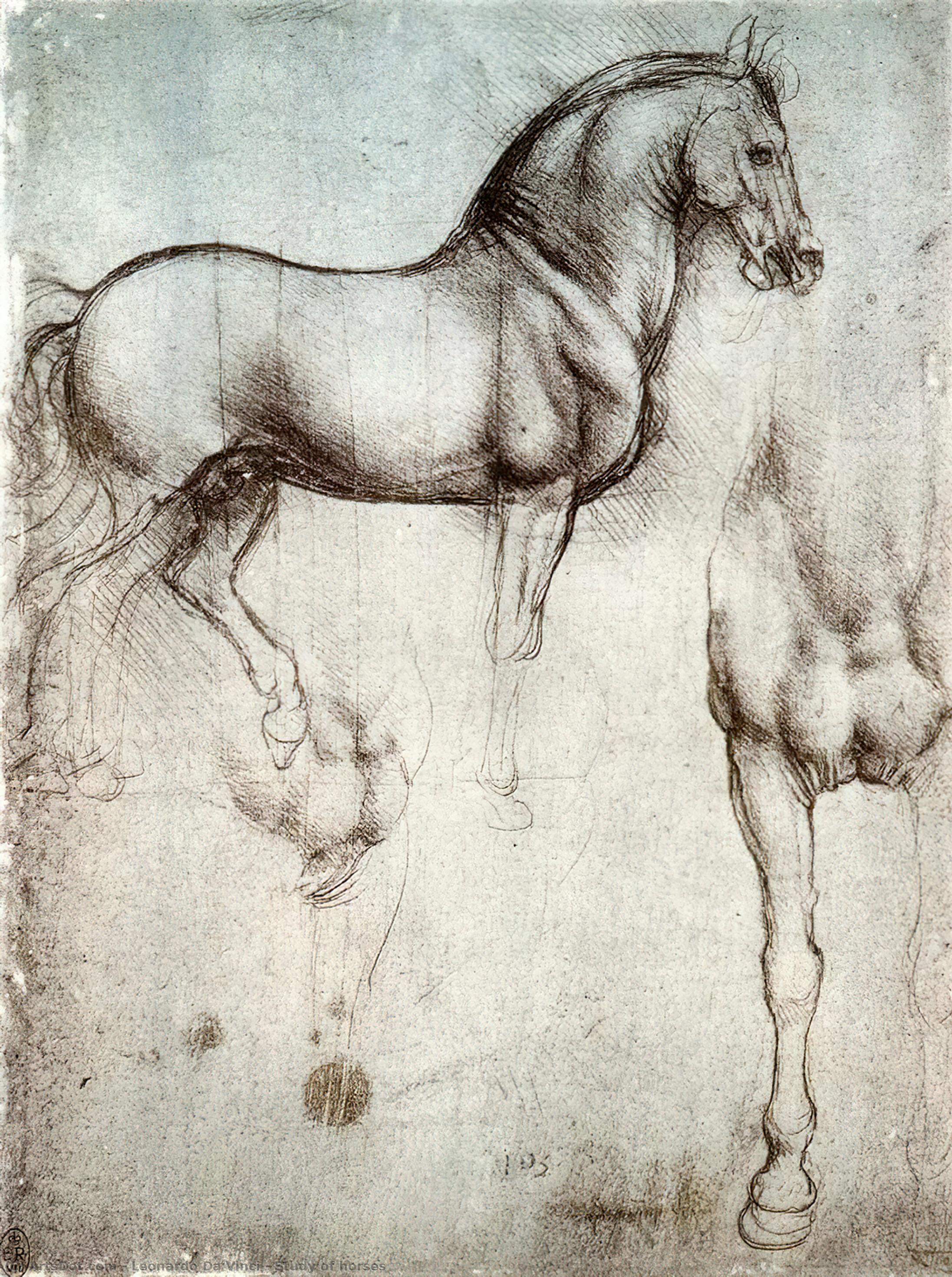
Leonardo Da Vinci is a silverpoint drawing created in 1490, measuring approximately 250 x 187 cm. The artwork is housed at the
Royal Library (Windsor, United Kingdom). This piece showcases two horses, one in the foreground and another in the background, each meticulously rendered with great detail.
Technique and Significance
Da Vinci employed the traditional drawing technique of silverpoint to create this masterpiece. Silverpoint involves using a metal point to draw fine lines on a prepared surface, often coated with gesso or Chinese white ground. This method allowed Da Vinci to achieve precise and delicate lines, which are characteristic of his work. The significance of "Study of Horses" lies in its demonstration of Da Vinci's deep understanding of equine anatomy. The drawing is believed to be part of his studies for an equestrian monument commissioned by Ludovico Sforza, the ruler of Milan. Although the project was eventually abandoned, these studies showcase Da Vinci's dedication to capturing the essence and movement of horses.
Artistic Evolution
Da Vinci's work on "Study of Horses" reflects his continuous pursuit of perfection in art and science. His detailed observations of nature and anatomy are evident in the precise rendering of the horses' muscles, bones, and movements. This drawing is a prime example of how Da Vinci's artistic skills evolved over time, influenced by his scientific inquiries.
Legacy
"Study of Horses" is not only an important work within Da Vinci's oeuvre but also a significant contribution to the Renaissance art movement. It exemplifies the fusion of art and science that characterized this period, showcasing the artist's ability to capture the beauty and complexity of nature.
Conclusion "Cite Study of horses" by
Leonardo Da Vinci is a masterpiece that highlights the artist's exceptional skill in capturing the essence of his subjects. This drawing serves as a testament to Da Vinci's innovative approach to art, blending scientific observation with artistic expression. For those interested in exploring more of Da Vinci's works and techniques,
Study of horses by Leonardo da Vinci is available on ArtsDot. Additionally, the
Wikipedia page on Leonardo da Vinci provides a comprehensive overview of his life and contributions to art and science.