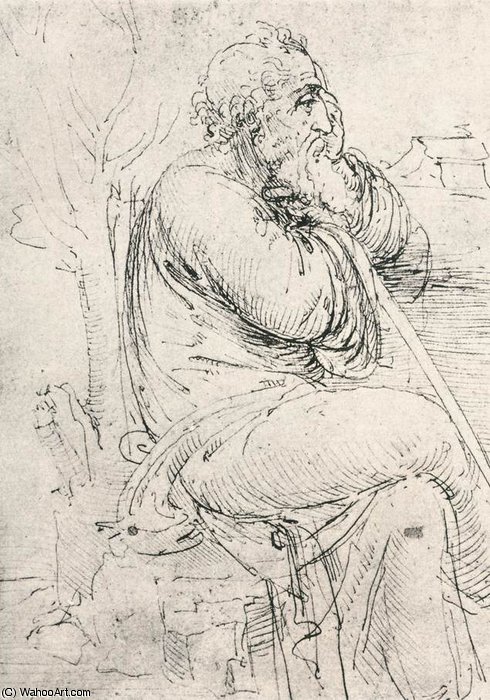
A Study in Observation: Leonardo da Vinci’s ‘Various Studies – Seated Old Man’
Leonardo da Vinci's “Various Studies – Seated Old Man,” created around 1498, stands as a cornerstone of Renaissance artistic practice—a testament to the artist’s unparalleled dedication to meticulous observation and expressive linework. More than just a portrait sketch, it embodies Da Vinci’s profound engagement with capturing fleeting moments of reality and distilling them into enduring visual representations.
- Composition & Narrative: The figure occupies a subtly asymmetrical position, lending dynamism to the image while simultaneously directing the viewer's gaze towards his face. Lines converge powerfully toward this focal point, suggesting contemplation or perhaps a quiet melancholy—a narrative conveyed through posture and gesture that speaks volumes about human experience.
- Color Palette & Technique: Remarkably monochromatic, utilizing variations in tonal value achieved solely through graphite strokes, the drawing prioritizes texture and form over color. Da Vinci’s masterful technique employs hatching and cross-hatching extensively to build up volume and create a palpable sense of surface detail. This deliberate restraint underscores the artist's focus on capturing essence rather than superficial appearance.
- Line Quality & Anatomy: The dominant element is undeniably line—a tool wielded with extraordinary precision. Lines delineate contours, define facial features with remarkable accuracy, and sculpt the drapery folds of clothing, demonstrating Da Vinci’s unwavering commitment to anatomical realism. The artist's meticulous attention to detail reflects the humanist ideals prevalent during the Renaissance.
- Historical Context & Symbolism: Produced during Da Vinci’s formative years in Florence—a period marked by intellectual ferment and artistic innovation—the study aligns perfectly with the broader stylistic trends of the High Renaissance. The depiction of an elderly man carries symbolic weight, representing wisdom gained through time, experience, and confronting mortality—themes central to humanist thought.
- Emotional Impact & Legacy: “Various Studies – Seated Old Man” transcends mere representation; it captures a psychological portrait imbued with subtle emotion. Its enduring appeal lies in its ability to resonate with viewers across centuries, prompting reflection on the passage of time and the complexities of human consciousness—a legacy cemented by Da Vinci’s unwavering pursuit of artistic excellence.
This preparatory drawing exemplifies Da Vinci's revolutionary approach to artmaking – prioritizing observation and expressive linework above all else. It serves as a poignant reminder that true artistry resides not merely in replicating the visible world but in conveying its underlying spirit.