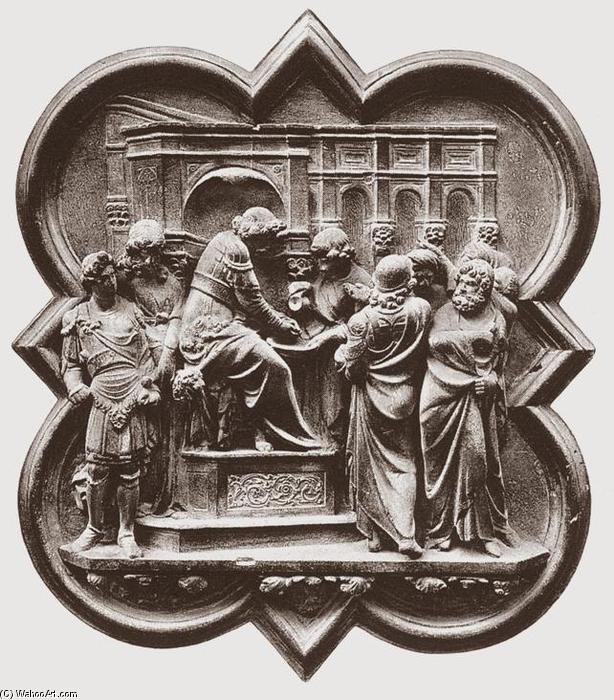
This monumental bronze relief sculpture portrays Pontius Pilate washing his hands before the crowd during Jesus Christ’s trial. Executed by Lorenzo Ghiberti in 1403-1424 for Florence's Baptistery, it exemplifies Renaissance realism and humanist ideals through intricate detail and masterful perspective—a testament to Ghiberti's unparalleled skill as a sculptor.
Lorenzo Ghiberti: The Sculptor Behind Florence’s Gates of Paradise
Lorenzo di Bartolo Ghiberti (1378 – 1455) stands as one of the titans of Early Renaissance sculpture, forever enshrined in art history thanks to his monumental contribution to Florence's Baptistery—specifically, the magnificent Gates of Paradise. Born near Florence into a family steeped in goldsmithing tradition, Ghiberti’s formative years instilled within him an unparalleled mastery of metalworking, shaping not only his craft but also his artistic vision. His apprenticeship under Bartolo di Michele wasn’t merely about honing technical skills; it fostered a profound understanding of humanist ideals and the burgeoning fascination with classical antiquity that would characterize the era.
- Early Career & Artistic Influences: Before tackling the Baptistery commission, Ghiberti cultivated his talent through diverse projects—painting frescoes in Rimini during a devastating plague outbreak and experimenting with sculptural techniques honed under Carlo I Malatesta’s patronage. These experiences exposed him to artistic currents circulating throughout Europe, informing his stylistic choices and broadening his intellectual horizons.
- The Baptistery Competition: The 1401 competition for the second set of bronze doors offered Ghiberti a singular opportunity to assert his genius. Facing stiff opposition from Brunelleschi—a rival whose architectural prowess was equally celebrated—Ghiberti prevailed, securing the commission and initiating what would become his magnum opus.
The Gates of Paradise: A Triumph of Technique & Symbolism
The Gates of Paradise represent a breathtaking achievement in bronze casting technique – a testament to Ghiberti’s innovation and unwavering dedication. Unlike the first set of doors, which employed a panelled design reminiscent of Byzantine mosaics, the second embraced a more ambitious approach: a series of rectangular panels adorned with intricately sculpted figures depicting scenes from the Old Testament. This stylistic shift signaled a decisive move away from medieval conventions toward the humanist ideals championed by artists like Filippo Brunelleschi and Donatello. Ghiberti’s workshop employed groundbreaking methods to achieve unprecedented levels of detail and realism, utilizing molds created using wax models—a technique that would revolutionize sculpture for decades to come.
- Wax Modeling & Mold Making: Ghiberti pioneered the use of wax modeling – a method where artists create detailed sculptures from wax, which are then encased in plaster to form molds. This process allowed for exceptional precision and facilitated the production of multiple casts simultaneously.
- Bronze Casting Innovation: The bronze casting itself was equally revolutionary. Ghiberti’s artisans employed cruciform furnaces—a technique that provided greater control over temperature—resulting in a smoother, more consistent surface finish than previous methods.
Narrative Depth & Emotional Resonance
Beyond its technical brilliance, the Gates of Paradise resonate profoundly with viewers due to their masterful storytelling and evocative depiction of biblical narratives. Each panel meticulously portrays key episodes from Genesis—the Creation, Adam and Eve’s Fall, Cain and Abel’s Murder—capturing not merely historical events but also conveying complex theological themes concerning sin, redemption, and divine justice. Ghiberti's figures are imbued with palpable emotion, reflecting the psychological depth characteristic of Renaissance art. The sculptor skillfully captures expressions of sorrow, fear, compassion, and triumph, inviting contemplation on humanity’s relationship with God and its moral responsibilities.
Legacy & Enduring Influence
Lorenzo Ghiberti's legacy extends far beyond the Baptistery itself. His workshop served as a crucible for artistic innovation, nurturing the talents of future masters like Donatello and Masolino—artists who would carry forward Ghiberti’s pioneering techniques and humanist sensibilities into subsequent generations. The Gates of Paradise continue to inspire awe and admiration today, serving as a poignant reminder of Florence's golden age and demonstrating the transformative power of art to communicate profound ideas and emotions across time. Michelangelo famously described them as “the most beautiful thing in Christendom,” cementing Ghiberti’s place among the greatest sculptors of all time.