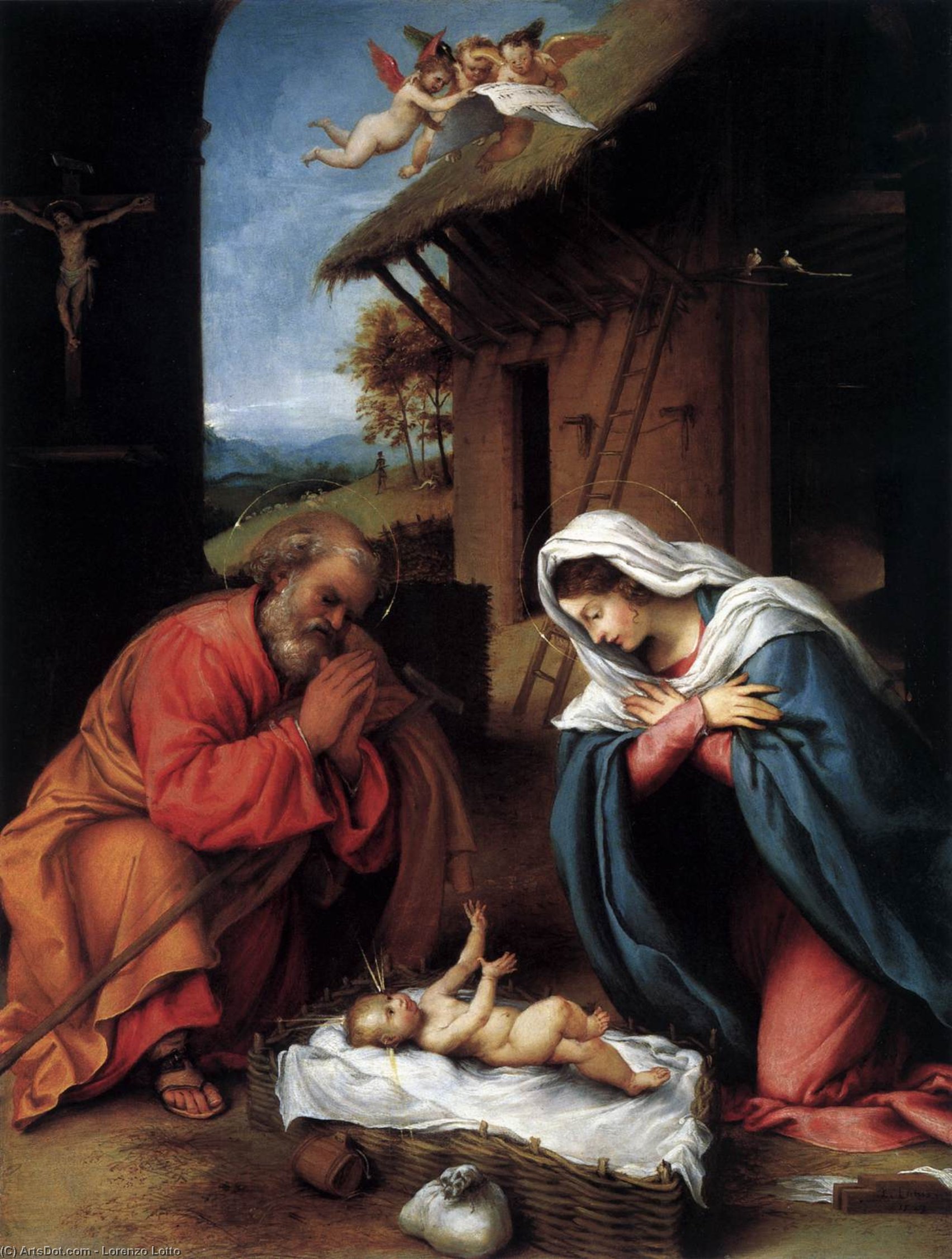
A Venetian Reverie: The Intimacy of Lorenzo Lotto’s Nativity
In the quiet corners of art history, few works capture the profound stillness of devotion quite like Lorenzo Lotto’s Nativity. Executed in 1523, this masterpiece serves as a window into a moment of divine intersection, where the celestial meets the earthly with breathtaking tenderness. Unlike the grand, sweeping narratives often found in High Renaissance altarpieces, Lotto invites us into a much more personal sanctuary. The scene is not one of crowded spectacle, but of a hushed, sacred intimacy. As we gaze upon Mary cradling the infant Jesus, flanked by the humble presence of Joseph, we are drawn into a world where every shadow and every glint of light feels heavy with spiritual significance. It is a painting that does not merely depict a biblical event; it invites the viewer to participate in a silent prayer.
The technical mastery behind this work lies in Lotto’s ability to manipulate light to evoke emotion. Utilizing the traditional Venetian technique of layering thin, translucent glazes of pigment onto gesso panels, the artist achieved a luminous depth that seems to glow from within. His palette is remarkably restrained, favoring muted ochres, deep browns, and soft blues that create an atmosphere of twilight contemplation. This subtle use of color avoids the ostentatious opulence of his contemporary Titian, opting instead for an understated realism. The textures—from the soft skin of the Christ child to the ruggedness of the background structure—possess a tactile quality that makes the scene feel remarkably present, as if one could reach out and touch the very fabric of this holy night.
Symbolism and the Soul of the Renaissance
Beyond its visual beauty, the Nativity is rich with symbolic layers that reward the contemplative eye. The setting, an outdoor space near a humble hut, serves as a poignant reminder of the lowliness of Christ's birth, grounding the divine in the reality of human struggle. Small, meticulously rendered details—a donkey resting to the side, a solitary bird perched above, or the presence of books—act as anchors for the viewer’s wandering gaze, connecting the cosmic event to the natural world. The interplay of light and shadow, or chiaroscuro, does more than define form; it symbolizes the arrival of light into a dark world, mirroring the theological essence of the Nativity itself.
For the modern collector or interior designer, this painting offers much more than mere decoration. It provides a focal point of profound psychological depth and emotional resonance. The "nervous" and eccentric energy that characterizes Lotto’s unique style—a precursor to the Mannerist movement—gives the work a restless, living quality that prevents it from feeling static. Whether placed in a sunlit gallery or a moody, private study, a high-quality reproduction of this work brings an air of sophisticated serenity and historical weight to any space. It is an invitation to slow down, to breathe, and to find beauty in the quietest moments of existence.