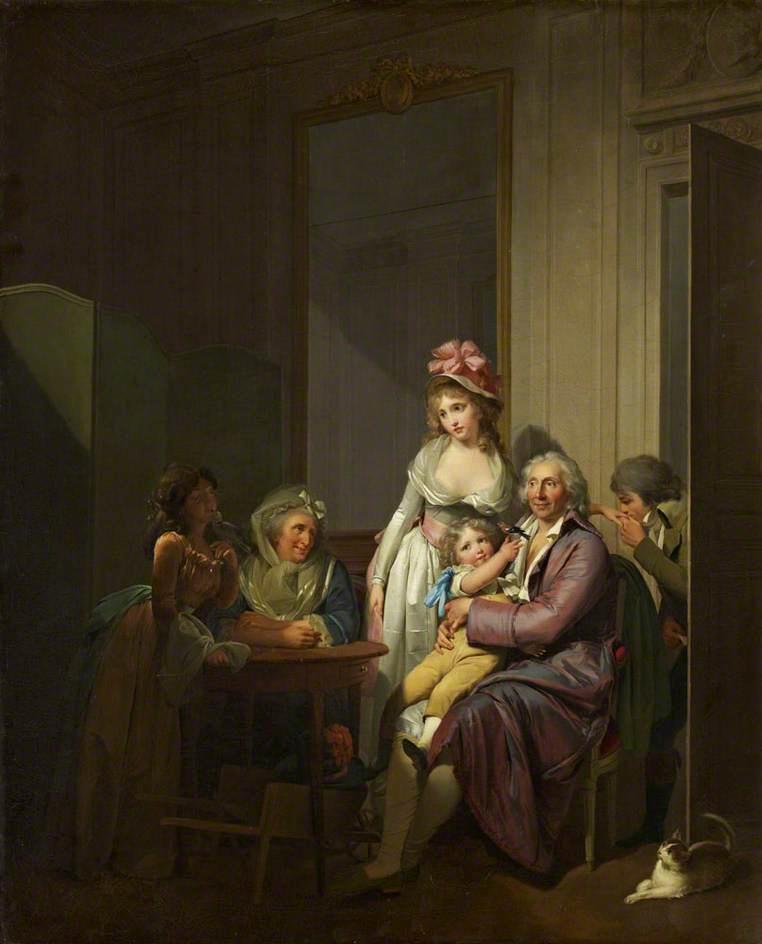
A tender Neoclassical scene of domestic tranquility by Louis Léopold Boilly captures a French bourgeois family around a dining table, offering a timeless glimpse into 1794 Parisian life for your private collection.
Discover Louis Léopold Boilly (1761-1845), the master of French portraiture & genre scenes! Explore his detailed depictions of 18th/19th century life.
Explore Scottish art at the National Gallery of Scotland! Discover masterpieces by renowned artists like Titian & Monet in a stunning neoclassical building on Edinburgh's Mound.
Family in an Interior by Louis Léopold Boilly
Louis Léopold Boilly’s “Family in an Interior” stands as a quintessential example of Neoclassical portraiture, capturing the elegance and moral seriousness characteristic of Parisian society during the late Enlightenment. Painted in 1794, shortly after the French Revolution, this artwork offers a glimpse into the domestic life of a bourgeois family—a subject favored by Boilly throughout his prolific career.
**Subject Matter and Composition:** The scene depicts a family seated around a dining table, bathed in soft light emanating from a window behind them. At the center is a woman holding her infant child, surrounded by several other individuals – presumably her husband and possibly children – creating a harmonious tableau of familial affection. A cat rests calmly on the floor near the fireplace, adding to the sense of tranquility and domestic comfort. The inclusion of a cup on the table subtly suggests a moment of convivial conversation and shared sustenance.
**Style and Technique:** Boilly’s masterful technique exemplifies the meticulous attention to detail that defined Neoclassical art. He employed oil paint on canvas with remarkable precision, layering colors delicately to achieve subtle gradations and capturing textures with astonishing accuracy. The artist skillfully blended portraiture with genre elements—a deliberate choice intended to portray not just likenesses but also the moral values considered important in upholding social order. Boilly’s use of chiaroscuro – dramatic contrasts between light and shadow – enhances the depth and realism of the scene, emphasizing the figures' expressions and creating a palpable atmosphere.
**Historical Context:** Created during a period of profound political upheaval, “Family in An Interior” reflects the anxieties and aspirations of the French bourgeoisie grappling with the aftermath of the revolution. Boilly’s depiction of a stable family unit served as a counterpoint to the turbulent events unfolding outside the home—a deliberate assertion of traditional values amidst societal transformation. The painting embodies the ideals of reason, order, and virtue championed by Enlightenment thinkers, aligning itself with the broader artistic movement's commitment to portraying idealized human subjects and harmonious social relationships.
**Symbolism:** Beyond its visual beauty, “Family in An Interior” carries symbolic significance. The woman cradling her child represents motherhood and nurturing—values considered paramount for upholding societal stability. The dining table symbolizes domestic harmony and shared responsibility. Even the cat embodies tranquility and contentment—a subtle reminder of the importance of simplicity and peace within the home. Boilly’s careful selection of elements contributes to a narrative that transcends mere representation, conveying profound moral lessons about family life and social virtue.
**Emotional Impact:** Viewing “Family in An Interior” evokes feelings of warmth, comfort, and serenity. The soft lighting, harmonious composition, and expressive faces convey an idealized vision of domestic bliss—a testament to Boilly’s ability to capture the essence of human emotion through meticulous artistic skill. It remains a captivating piece for interior designers seeking to infuse their spaces with elegance and sophistication, reminding us of the enduring power of art to inspire contemplation and celebrate the beauty of everyday life.