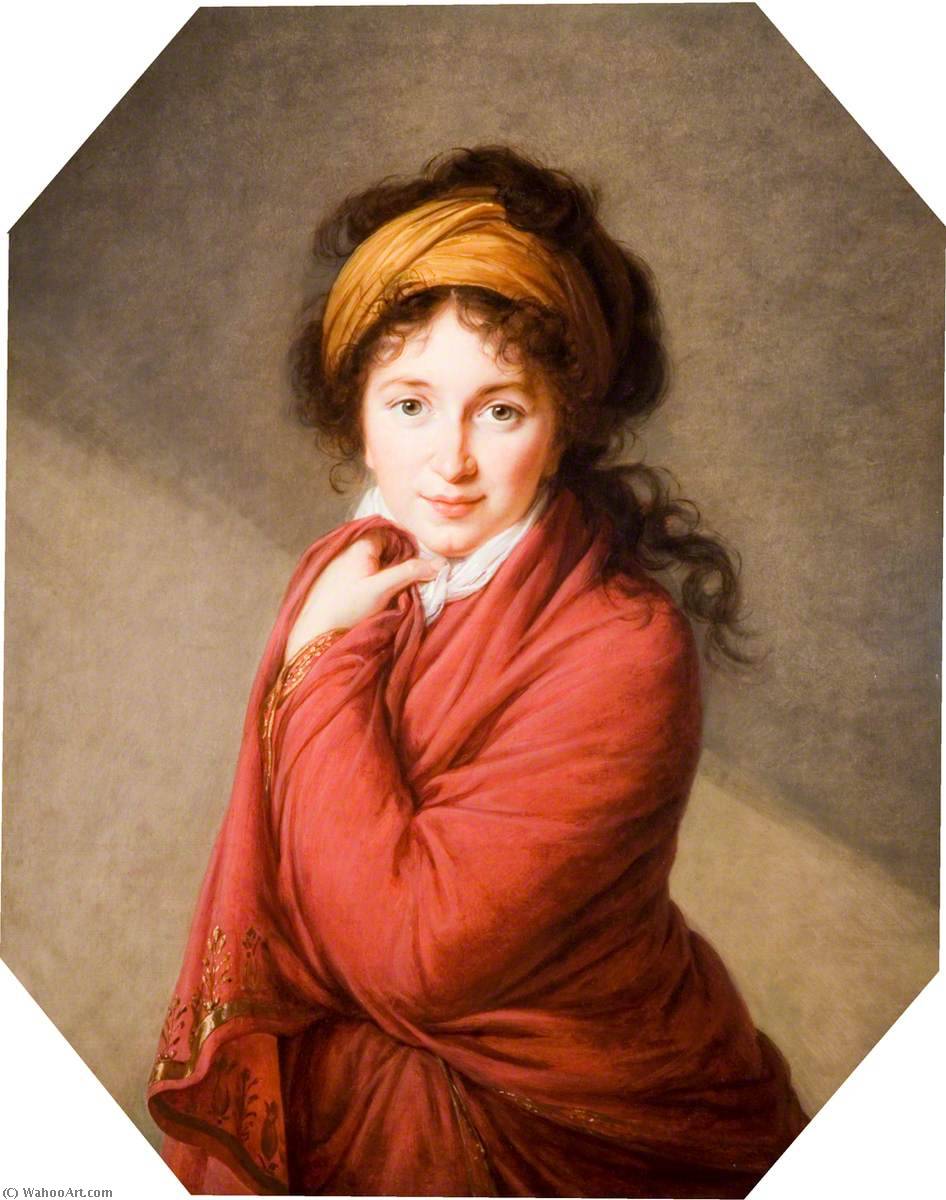
A Portrait of Grace: Countess Golovine by Louise Vigée Le Brun
The year is 1800, and within the opulent confines of a Parisian salon, Louise Élisabeth Vigée Le Brun captures the essence of Countess Golovine – a woman whose life, marked by both privilege and intrigue, unfolds before the artist’s brush. This captivating portrait isn't merely a likeness; it’s a carefully constructed tableau vivant, brimming with subtle gestures, nuanced expressions, and an undeniable air of aristocratic composure. Vigée Le Brun, already establishing herself as one of France’s most sought-after portraitists, masterfully employs the Rococo-Neoclassical style, blending the delicate elegance of the past with a newfound restraint that reflects the changing currents of the era.
The Countess herself is presented in a pose of quiet dignity. Dressed in a rich crimson gown – a color historically associated with power and royalty – she’s draped across a plush couch, her posture radiating an almost regal stillness. A delicate scarf, rendered in shades of cream and gold, gracefully encircles her neck, adding a touch of understated luxury. Her hands, resting lightly on the armrest, reveal the subtle curve of her fingers, hinting at both refinement and a hidden strength. The background, though subtly suggested with a glimpse of a clock and a couch, serves to enhance the Countess’s presence, drawing the viewer's eye directly to her face – an area where Vigée Le Brun’s skill truly shines.
Decoding the Details: Technique and Style
Vigée Le Brun’s technique is characterized by its remarkable ability to capture not just physical appearance but also the very spirit of her subjects. She utilizes a layered approach, beginning with thin washes of color to establish the overall tonal values before building up details with increasingly opaque layers of paint. This creates a luminous quality, particularly evident in the highlights that dance across the Countess’s skin and the folds of her gown. The artist's masterful use of chiaroscuro – the dramatic contrast between light and shadow – adds depth and volume to the portrait, imbuing it with a sense of three-dimensionality.
Notice the meticulous rendering of textures: the velvet of the couch, the sheen of the silk scarf, the delicate embroidery on the Countess’s gown. Vigée Le Brun's attention to detail is extraordinary, reflecting her deep understanding of materials and her ability to translate them onto canvas with breathtaking accuracy. The subtle variations in brushstroke – sometimes loose and expressive, other times precise and controlled – contribute to the overall dynamism of the composition.
A Glimpse into a Historical Context
Painted around 1800, this portrait offers a fascinating window into the world of French aristocracy during the early years of Napoleon’s reign. The Countess Golovine, likely a prominent figure in Parisian society, embodies the elegance and sophistication that defined the era. The portrait reflects the prevailing emphasis on beauty, refinement, and social status – values highly prized by the ruling class.
Furthermore, it's important to consider Vigée Le Brun’s own position as a female artist navigating a male-dominated art world. Her success was largely due to her patronage by influential figures like Marie Antoinette and later Napoleon Bonaparte, allowing her to establish herself as one of the most respected portraitists of her time. The Countess Golovine's image is thus not just a representation of an individual but also a testament to the challenges and triumphs faced by women artists in 18th-century France.
Symbolism and Emotional Resonance
Beyond its technical brilliance, the portrait holds layers of symbolic meaning. The Countess’s gaze, directed directly at the viewer, conveys a sense of self-assurance and intelligence. Her posture suggests both vulnerability and resilience – qualities that resonate deeply with viewers. The crimson gown, traditionally associated with power and royalty, subtly reinforces her social standing.
Ultimately, “Countess Golovine” is more than just a portrait; it’s an evocative representation of a woman caught between the constraints of her social position and the burgeoning spirit of change that was sweeping across Europe. It invites us to contemplate the complexities of identity, power, and beauty – themes that continue to resonate with audiences today. A high-quality reproduction captures this essence beautifully, bringing this remarkable portrait into any home or gallery space.