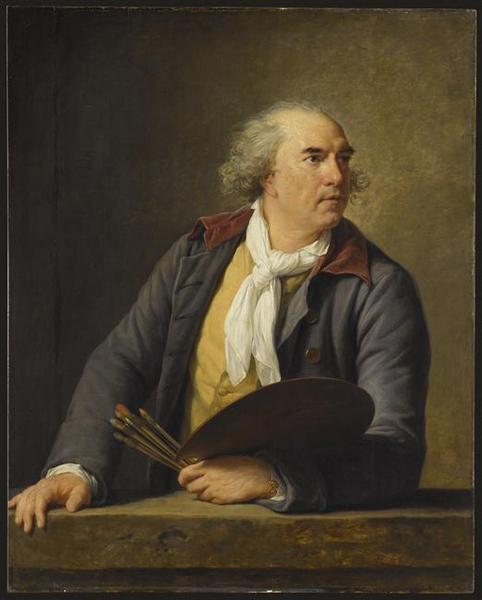
Admire 'Portrait of Hubert Robert' by Élisabeth Vigée Le Brun – a stunning Rococo masterpiece capturing the artist’s genius. Hand-painted reproduction available.
Élisabeth Vigée Le Brun was a celebrated 18th-century French portraitist renowned for her elegant depictions of royalty and aristocracy, capturing both likeness and personality with refined Rococo-Neoclassical style.
Explore the Louvre Museum in Paris! Home to iconic masterpieces like the Mona Lisa & Venus de Milo, journey through art history from ancient Egypt to Renaissance icons. Plan your visit today!
Louise Élisabeth Vigée Le Brun’s Portrait of Hubert Robert: A Window into Rococo Genius
This captivating portrait by Louise Élisabeth Vigée Le Brun offers a glimpse into the artistic world of the late 18th century, capturing not merely the likeness of Hubert Robert but also his intellectual spirit and professional dedication. Executed in oil paints on canvas during Vigée Le Brun’s prolific period—a time marked by unparalleled patronage from royalty—the artwork exemplifies the elegance and meticulous detail characteristic of Rococo art. It stands as a testament to Vigée Le Brun's mastery of capturing emotion and conveying subtle nuances within a formal framework.
Composition and Technique: Reflecting Classical Ideals
The portrait adheres to conventions established during the neoclassical era, prioritizing balance and harmony—a deliberate contrast to the exuberant ornamentation prevalent in earlier styles. Vigée Le Brun skillfully employs chiaroscuro – dramatic lighting – to sculpt Robert’s face and torso, highlighting textures of fabric and skin with remarkable precision. The placement of Robert's hand resting on a ledge is particularly noteworthy; it serves as both a compositional element and a symbolic gesture, suggesting contemplation and grounding him within his artistic milieu. Brushstrokes are soft yet purposeful, blending seamlessly to create an illusion of depth and luminosity—a hallmark of Vigée Le Brun’s technique.
Color Palette and Symbolism: Earthy Elegance
The color palette is subdued, dominated by earthy browns and greys that establish a grounding presence against Robert's paler attire. However, flashes of warm yellow illuminate his shirt and contribute to the overall warmth of the scene. A crisp white scarf provides striking visual contrast, emphasizing purity and refinement—values deeply ingrained in Rococo aesthetics. Beyond mere color choices, Vigée Le Brun’s use of pigments speaks volumes about her understanding of artistic symbolism. The palette itself embodies restraint and sophistication, mirroring Robert's intellectual pursuits. Furthermore, the painter’s tools – a palette and brushes – are prominently displayed, reinforcing his identity as an artist and symbolizing creativity itself.
Historical Context: Patronage and Artistic Identity
Painted during Vigée Le Brun’s ascendancy as a portraitist—particularly her association with Marie Antoinette—the artwork reflects the cultural landscape of Louis XVI's France. Royal patronage fueled artistic innovation and demanded exceptional skill in portraying subjects with dignity and grace. Vigée Le Brun skillfully captured Robert’s intellectual curiosity and contemplative gaze, conveying not just his physical appearance but also his inner life—a crucial element of portraiture during this period. The artwork serves as a valuable document of its time, illustrating the values and aspirations of the aristocracy while celebrating the achievements of one of France's most celebrated artists.
Emotional Impact: Capturing Essence Beyond Appearance
Ultimately, Vigée Le Brun’s Portrait of Hubert Robert transcends mere visual representation; it succeeds in conveying an emotional resonance that lingers with the viewer. The artist’s gaze—directed slightly to his left—suggests thoughtfulness and introspection, inviting contemplation about the complexities of artistic endeavor. Through her masterful technique and astute observation, Vigée Le Brun captures Robert's essence—his intellect, his passion for art—transforming him into an emblem of creative spirit within a gilded age.