A Moment of Suffering and Spiritual Resonance
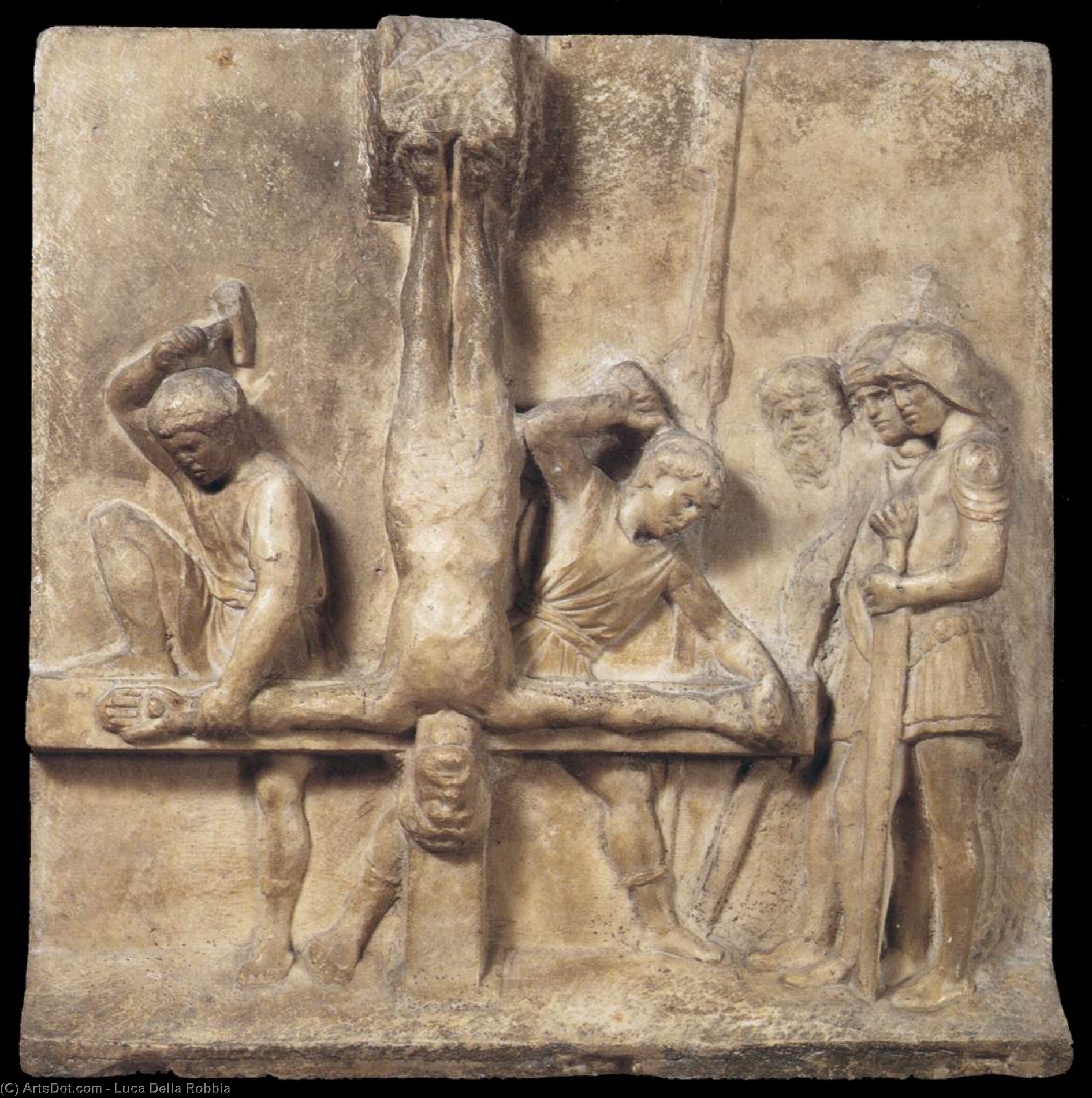
Luca della Robbia's 1439 painting, “Crucifixion of St. Peter,” is not merely a depiction of a grim historical event; it’s a profound meditation on sacrifice, faith, and the raw emotion of human suffering. Created during a pivotal period in Florentine art – a time when classical ideals were being reinterpreted through a distinctly Renaissance lens – this terracotta panel offers a remarkably intimate and emotionally charged portrayal of the saint's final moments. The work transcends simple narrative, inviting viewers to contemplate not just Peter’s physical agony but also his spiritual fortitude and the weight of his role as the first Pope.
The scene unfolds with stark simplicity: St. Peter, depicted in a posture of agonizing grace, is suspended from a cross. His body, rendered with an almost sculptural quality characteristic of della Robbia’s style, conveys both physical pain and a deep sense of resignation. Crucially, the artist avoids the dramatic, theatrical gestures often associated with depictions of Christ's crucifixion. Instead, Peter’s expression is one of quiet acceptance, his gaze fixed on some unseen point beyond the confines of the panel. This subtle shift in focus transforms the scene from a spectacle of violence into a deeply personal and contemplative experience.
The Florentine Workshop and Terracotta Innovation
Luca della Robbia’s genius lay not only in his artistic skill but also in his pioneering techniques within the Florentine terracotta workshop. Born in Florence around 1399, he inherited a legacy of craftsmanship deeply rooted in the city's rich tradition of sculpture and ceramics. Unlike the prevailing use of marble or bronze for religious figures, della Robbia embraced terracotta – a readily available and versatile material – and transformed it into a medium capable of astonishing detail, vibrant color, and remarkable durability. This innovation was particularly significant because it allowed for mass production while retaining a high degree of artistic quality.
The painting’s terracotta construction is integral to its impact. The slightly rough texture of the material lends an earthy realism to the figures, grounding them in a tangible reality. Furthermore, della Robbia's mastery of *sgraffito*, a technique involving scratching through a layer of slip to reveal underlying colors beneath, created subtle tonal variations and added depth to the forms. This meticulous attention to detail is evident in the rendering of Peter’s musculature, the folds of his drapery, and the texture of the wood of the cross itself.
Symbolism and Context within Renaissance Florence
The “Crucifixion of St. Peter” is deeply embedded within the religious and cultural context of 15th-century Florence. During this period, the Church held immense power and influence, and depictions of saints served as powerful reminders of Christian faith and morality. The choice to focus on St. Peter – the first Pope and a key figure in the foundation of the Roman Catholic Church – was particularly significant for Florence, which saw itself as the new center of Christendom.
The inclusion of elements like the knife (a symbol of martyrdom) and the two swords—one near Peter’s head and another close to Christ—add layers of meaning. These details underscore the brutality of Peter's death but also highlight his unwavering loyalty to Christ. The scene, therefore, becomes a potent allegory for faith, sacrifice, and the enduring power of spiritual conviction.
A Legacy of Beauty and Innovation
Luca della Robbia’s “Crucifixion of St. Peter” stands as a testament to his artistic vision and technical mastery. His innovative use of terracotta, combined with his profound understanding of human emotion and religious symbolism, created a work that continues to resonate with viewers centuries later. The painting's intimate scale and emotionally charged depiction set it apart from grander, more overtly dramatic works of the era, offering instead a quiet yet powerful meditation on faith, suffering, and the enduring legacy of St. Peter.