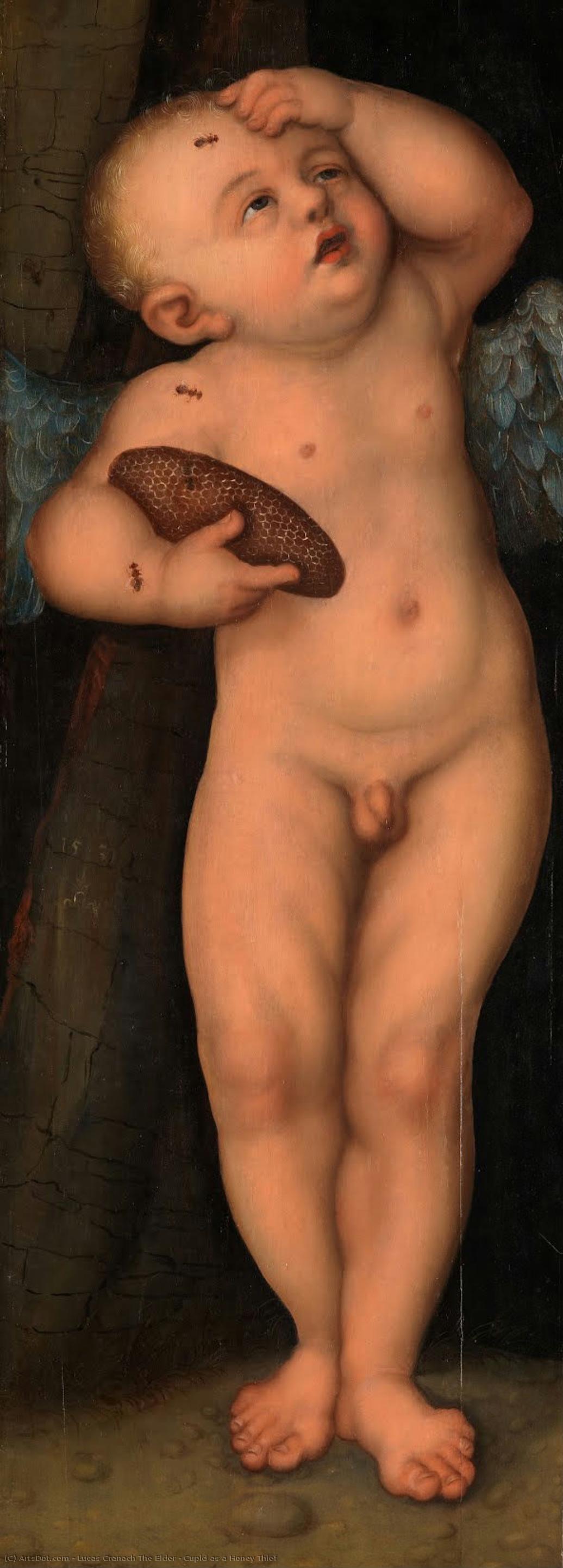
Lucas Cranach's "Cupid as a Honey Thief": A Portrait of Mischief and Reformation
Lucas Cranach the Elder’s “Cupid as a Honey Thief,” painted in 1531, is more than just a charming depiction of a baby; it’s a window into the tumultuous heart of the German Renaissance. This captivating work, currently residing at the Staatliche Kunsthalle Karlsruhe, reveals the artist's masterful ability to blend technical skill with profound psychological insight – qualities that cemented his place as a pivotal figure in the era’s artistic landscape.
The painting portrays a naked infant, seemingly caught in the act of pilfering a ball. The child’s expression is one of discomfort, a subtle yet powerful detail that elevates the image beyond simple representation. Cranach doesn't simply depict a baby; he captures a fleeting moment of youthful transgression, hinting at the inherent mischief and vulnerability within human nature. The loose handling of the drapery and the slightly blurred edges contribute to this sense of immediacy and spontaneity – hallmarks of Cranach’s evolving style.
Renaissance Symbolism and Courtly Patronage
Created during a period of intense religious and political change, “Cupid as a Honey Thief” reflects the anxieties and aspirations of its time. The Reformation was gaining momentum, challenging established Catholic doctrines, and Cranach’s work often navigated this complex terrain. The image of Cupid, traditionally associated with love and desire, is here transformed into a ‘thief,’ suggesting a disruption of order – perhaps mirroring the religious upheaval occurring across Europe.
Cranach's patronage primarily came from the court of Frederick III, Elector of Saxony, a relationship that provided him with both security and access to influential circles. This connection is evident in the painting’s refined execution and its adherence to Renaissance ideals of beauty and humanism. The use of rich pigments – reds, golds, and browns – reflects the opulence associated with courtly life, while the careful attention to detail demonstrates Cranach's mastery of oil paint, a medium he skillfully employed to achieve luminous effects.
Technique and Artistic Innovation
Cranach’s technique in “Cupid as a Honey Thief” is characterized by its remarkable realism combined with an expressive quality. He utilized sfumato – a subtle blurring of edges – to create a sense of depth and atmosphere, particularly noticeable in the rendering of the baby's face. The artist’s use of light and shadow further enhances the painting’s dramatic effect, drawing the viewer’s eye to the central figure.
Unlike some of his contemporaries who favored idealized representations, Cranach embraced a more naturalistic approach, evident in the infant’s slightly awkward pose and the realistic depiction of skin tones. This commitment to observation and detail was revolutionary for its time and contributed significantly to Cranach's enduring legacy as one of the most important artists of the German Renaissance.
Emotional Impact and Reproduction Possibilities
"Cupid as a Honey Thief" resonates with viewers on multiple levels, evoking feelings of nostalgia, amusement, and perhaps even a touch of guilt. The painting’s inherent vulnerability and innocence invite contemplation about childhood, temptation, and the complexities of human behavior. A hand-painted reproduction of this iconic work offers an unparalleled opportunity to bring this captivating image into your home or office – a testament to Cranach's genius and a timeless symbol of youthful mischief.