The Dentist: A Window Into Renaissance Medical Observation
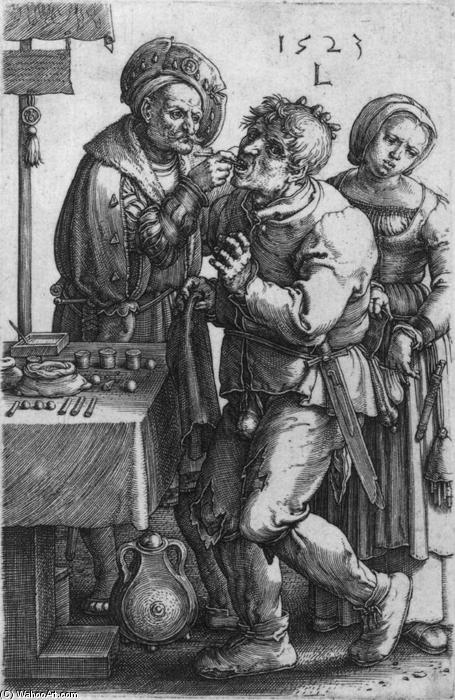
Lucas van Leyden’s “The Dentist,” created in 1523 during the High Renaissance, transcends mere depiction; it's a meticulously crafted tableau that speaks volumes about the intellectual and artistic currents of its time. More than just illustrating a commonplace medical procedure—the examination of a patient by a dentist—the engraving offers a profound meditation on observation, precision, and the burgeoning humanist spirit that characterized Northern European art.
- Subject Matter: The scene portrays a dentist attending to his patient, accompanied by a woman who appears to be observing. This juxtaposition highlights the importance of both practical skill and empathetic understanding within the medical profession during the Renaissance.
- Style & Technique: Van Leyden’s masterful use of engraving exemplifies the Northern Renaissance aesthetic—characterized by meticulous detail and realism achieved through hatching, cross-hatching, and fine linework. The artist skillfully renders textures, capturing the folds of clothing and the surfaces of instruments with remarkable accuracy.
- Composition & Perspective: Vertically oriented, the image draws the eye upwards towards the dentist’s gaze, emphasizing his focus on diagnosis. Subtle linear perspective creates a sense of depth, grounding the figures within a believable space—though the vanishing point remains understated, reflecting the stylistic preferences of the era.
- Color Palette & Lighting: Entirely monochrome, “The Dentist” employs shades of gray to maximize contrast and illuminate form. The diffused light source casts shadows that define anatomical contours, conveying a sense of realism and capturing the atmosphere of a clinical setting.
- Symbolism & Emotional Impact: Beyond its technical prowess, the engraving carries symbolic weight. The woman’s presence suggests contemplation and concern—a counterpoint to the dentist's professional dedication. Furthermore, the inclusion of a bird perched atop an object introduces an element of unexpected detail, perhaps symbolizing vigilance or highlighting the artist’s awareness of visual harmony.
The engraving’s enduring appeal lies in its ability to capture not only the scientific realities of 16th-century dentistry but also the humanist values that underpinned artistic innovation. It stands as a testament to Lucas van Leyden's skill and vision—a captivating glimpse into a pivotal moment in European art history.
Additional Research: Explore further insights into Van Leyden’s oeuvre through resources like The Met and The National Gallery of Art for detailed information on his artistic achievements.