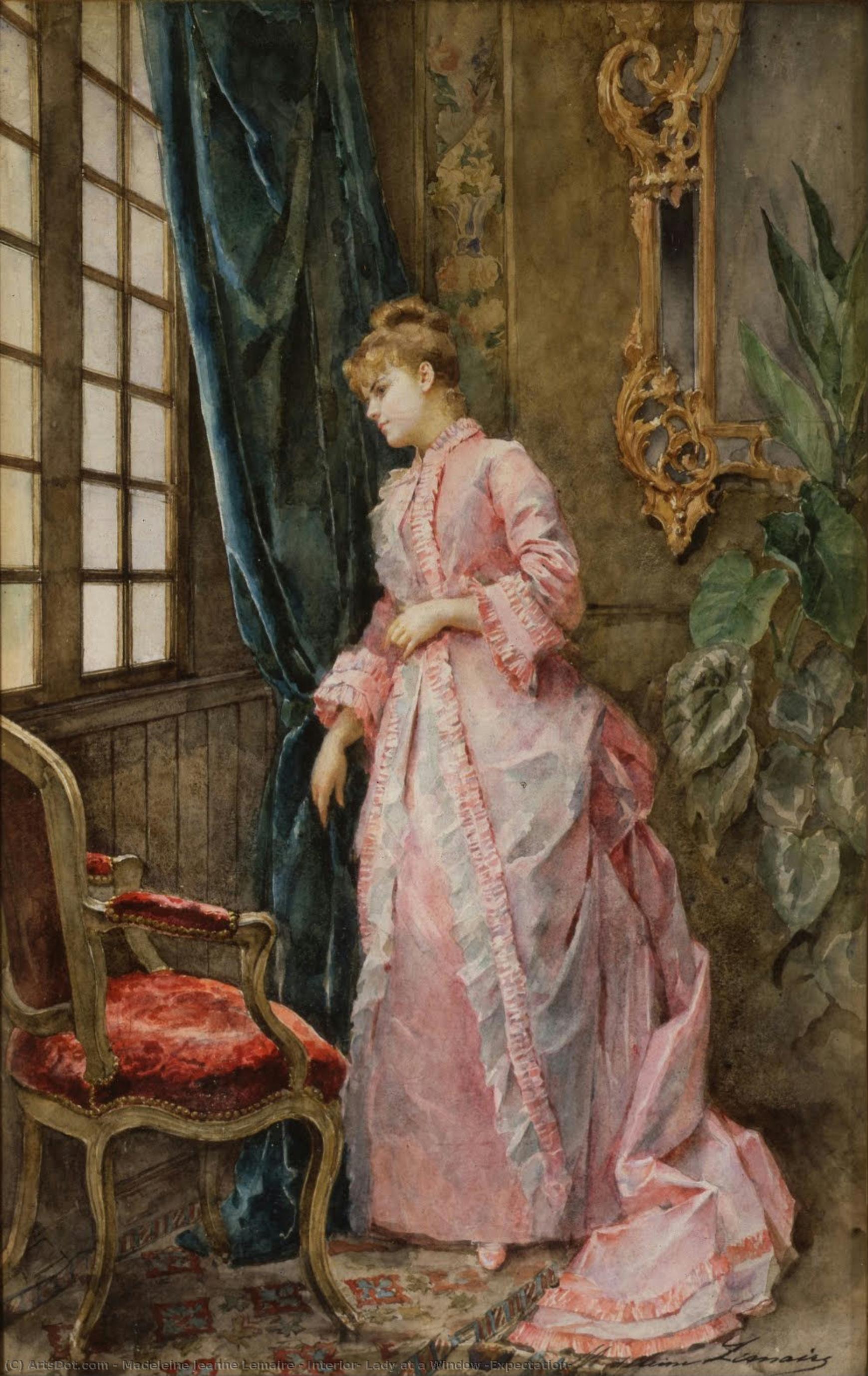
Madeleine Lemaire’s “Interior: Lady at a Window” – A Portrait of Anticipation and Parisian Elegance
Madeleine Jeanne Lemaire (1845-1928), a French watercolorist whose life intersected with the vibrant intellectual currents of Belle Époque Paris, remains an artist whose work speaks volumes about her era. Though biographical details surrounding her formative years are scarce – she appears to have honed her artistic skills largely independently – her contribution to Parisian art and society is undeniable, cemented by her role as a salonnière and her enduring legacy in the form of “Interior: Lady at a Window,” a piece that captures not just a visual likeness but also the spirit of refined contemplation.
A Delicate Watercolor Technique
Lemaire’s artistic style was characterized by meticulous watercolor painting, renowned for its subtle tonal gradations and luminous washes. Unlike bolder Impressionist approaches, her technique prioritized capturing fleeting moments of light and atmosphere with remarkable precision. She skillfully employed layering techniques—applying thin glazes over underlying washes—to achieve depth and luminosity, a hallmark of academic watercolorism prevalent during her time. The resulting images possess an ethereal quality, reflecting the artist’s sensitivity to nuance and detail.
The Salon Debut and Parisian Society
Her debut at the Salon in 1864 marked the beginning of Lemaire's artistic career and established her presence within the influential circles of Parisian art world. The Salon was the premier exhibition for artists seeking recognition, and Lemaire’s work garnered considerable acclaim. More importantly, she cultivated connections with prominent figures like Marcel Proust and Reynaldo Hahn, facilitating intellectual dialogues that shaped the cultural landscape of Belle Époque Paris.
A Window into Victorian Sentimentality
"Interior: Lady at a Window" exemplifies the prevailing aesthetic sensibilities of its time—Victorian sentimentality blended with an appreciation for beauty and elegance. The composition focuses on a young woman gazing out of a window, conveying a palpable sense of expectation or curiosity. The room itself is furnished in opulent style, featuring comfortable couches and a vase strategically placed to create visual harmony. These elements speak to the Victorian preoccupation with domestic tranquility and idealized femininity.
Symbolism Beyond Surface Beauty
Beyond its decorative appeal, “Interior: Lady at a Window” carries symbolic weight. The window serves as a conduit for contemplation, representing both observation of the external world and introspection within oneself. The woman’s posture—looking outward yet seemingly absorbed in thought—suggests a yearning for something beyond immediate surroundings. Color palettes are muted but harmonious, reflecting the restrained elegance favored by Lemaire and her contemporaries.
A Legacy Preserved
Currently housed in Henry Clay Frick’s bedroom, “Interior: Lady at a Window” stands as a testament to Lemaire's artistic vision and enduring influence. Its meticulous watercolor technique, coupled with its evocative depiction of Victorian ideals, continues to fascinate art historians and collectors alike. Reproductions offer an opportunity to appreciate the beauty and subtlety of this remarkable artwork—a window into a bygone era and a celebration of feminine contemplation.