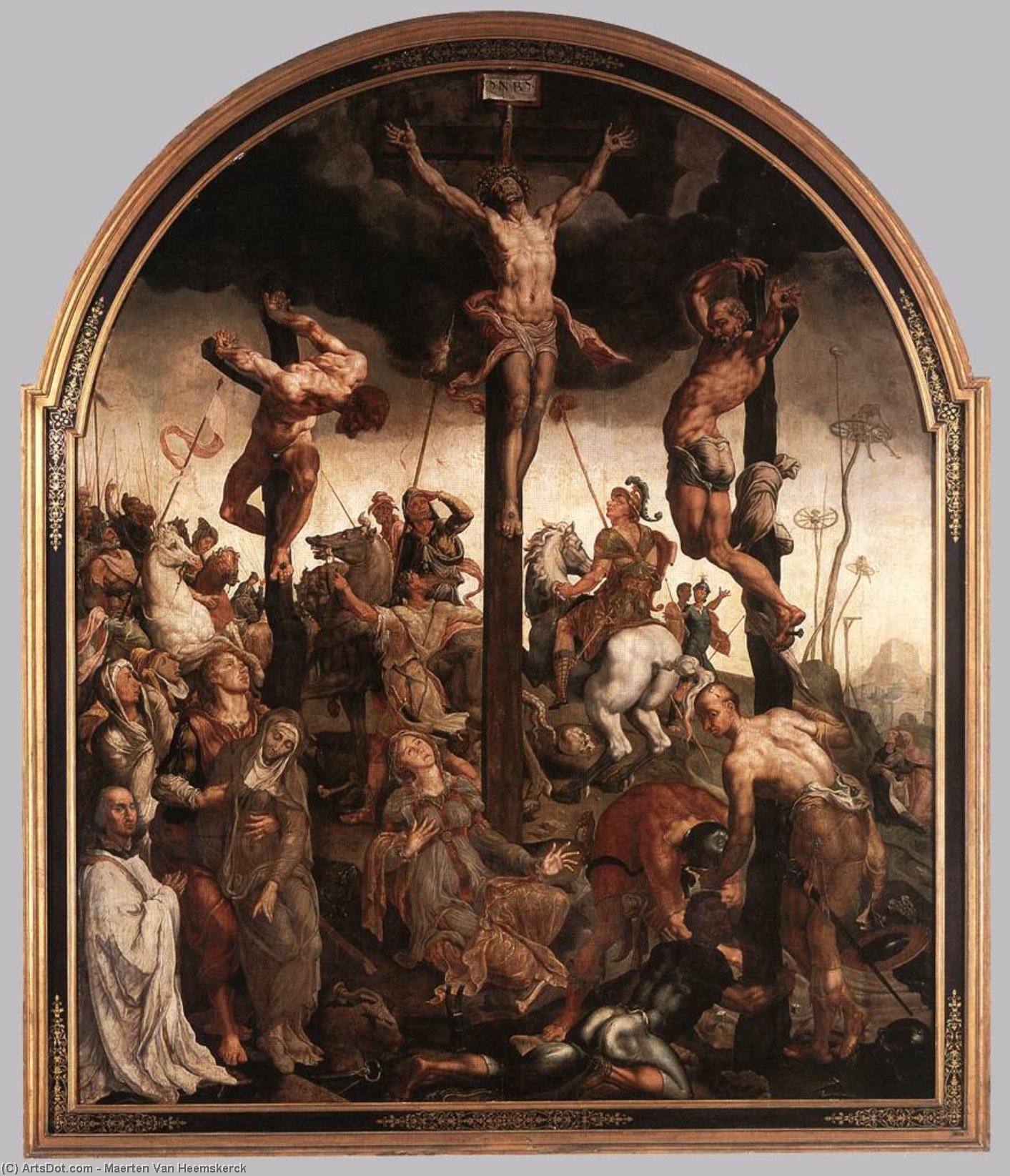
A Vision of Divine Sorrow: The Crucifixion by Maerten van Heemskerck
In the profound stillness of 1543, Maerten van Heemskerck captured one of the most harrowing and transformative moments in human history. The Crucifixion is not merely a depiction of a biblical event; it is a sweeping, cinematic exploration of grief, devotion, and the chaotic intersection of the divine and the earthly. At the heart of this monumental composition stands the figure of Jesus Christ, suspended upon the cross, serving as the singular anchor for an ocean of human emotion. The scale of the work, measuring an imposing 334 x 270 cm, demands the viewer's presence, pulling them into a sacred space where the boundaries between the observer and the observed begin to dissolve.
The mastery of Heemskerck lies in his ability to weave a complex tapestry of figures that breathe life into the historical narrative. Surrounding the central cross is a dense, intricate assembly of at least thirteen distinct individuals, each contributing a unique layer to the painting's emotional depth. Some figures are lost in the quiet, inward agony of mourning, their postures slumped under the weight of loss, while others appear as mere observers, caught in the peripheral drama of the event. The inclusion of animals—a horse and a dog—adds a poignant, grounded realism to the scene, suggesting that even the natural world is an uncomprehending witness to this cosmic tragedy. This layering of characters creates a sense of profound movement, guiding the eye from the foreground's intimate sorrows to the distant, atmospheric background.
Technically, the painting reflects the sophisticated synthesis of Northern and Italian influences that defined Heemskerck’s illustrious career. Having studied under Jan van Scorel, the artist infused his Dutch roots with a classical, sculptural sensibility. This is evident in the way the figures possess a certain monumental weight, almost as if they were carved from stone, yet they are rendered with a delicate, muted palette that lends the work an aged, timeless quality. The colors are somber and earthy, eschewing bright distractions to focus the viewer's attention on the play of light and shadow across the tormented flesh and heavy drapery. This technique creates a chiaroscuro effect that heightens the dramatic tension, making the shadows feel as heavy as the grief itself.
For the discerning collector or interior designer, The Crucifixion offers more than just historical significance; it provides a profound focal point for spaces that demand gravitas and intellectual depth. As a high-quality reproduction, this piece serves as an exquisite centerpiece for a gallery-style room or a sophisticated study. It invites contemplation and conversation, acting as a window into the Renaissance soul. The painting’s ability to evoke empathy through its masterful composition makes it an enduring choice for those who seek art that does not merely decorate a wall, but enriches the very atmosphere of a home with its timeless, spiritual resonance.