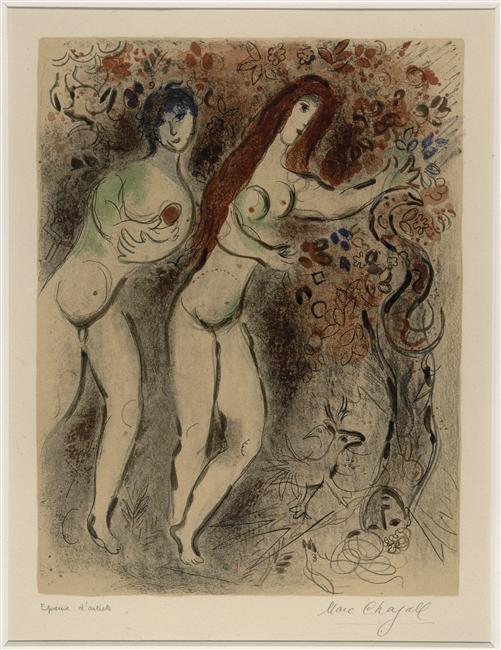
Marc Chagall’s ‘Adam and Eve with the forbidden fruit’ presents a naive, primitivist depiction of the biblical scene in vibrant reds and greens, capturing a dreamlike quality. This 1960 painting showcases Chagall's signature style and offers a unique opportunity to own a piece of art history.
A Dreamscape of Innocence: Marc Chagall’s ‘Adam and Eve with the Forbidden Fruit’
This exquisite hand-painted reproduction captures the essence of Marc Chagall's iconic 1960 depiction of Adam and Eve, a work that transcends mere biblical illustration to become a profound meditation on human experience. Measuring 52 x 38 cm, this piece immediately draws the viewer into a world imbued with a naive charm, yet underpinned by a powerful primitivist sensibility. The vibrant palette – dominated by rich reds and verdant greens – evokes a sense of both warmth and primal energy, mirroring the scene’s central drama.
The Naive Vision of a Master
Chagall's artistic journey was profoundly shaped by his upbringing in Liozna, Belarus, a town steeped in folklore and religious tradition. This influence is strikingly evident in this painting. The figures are rendered with an almost childlike simplicity, eschewing academic realism for a direct, emotionally charged approach. This ‘naive’ style, combined with elements of primitivism – particularly reminiscent of early 20th-century explorations of non-Western art – creates a captivating tension between innocence and transgression. The birds scattered throughout the composition further enhance this feeling, symbolizing freedom, spirituality, and perhaps even a watchful divine presence.
Symbolism and Narrative
The scene depicts Adam and Eve in the immediate aftermath of their disobedience, holding the forbidden fruit – a potent symbol of knowledge, temptation, and humanity’s fall from grace. The woman's arm around the other’s waist suggests intimacy and shared experience, while the apples themselves are not merely objects but represent the consequences of choice. Chagall masterfully avoids explicit judgment; instead, he presents a raw, honest portrayal of this pivotal moment in human history. The composition itself is deliberately open to interpretation, inviting viewers to contemplate the complexities of morality, desire, and the enduring power of myth.
Historical Context and Artistic Technique
Created in 1960, this painting reflects Chagall’s mature style – a culmination of decades spent exploring his personal mythology. He employed a technique characterized by bold brushstrokes, flattened perspectives, and an emphasis on color as a primary expressive tool. The use of tempera paint contributes to the work's luminous quality and durability, ensuring its vibrancy for generations to come. This reproduction faithfully recreates Chagall’s original vision, offering a tangible connection to one of the 20th century’s most beloved artists.