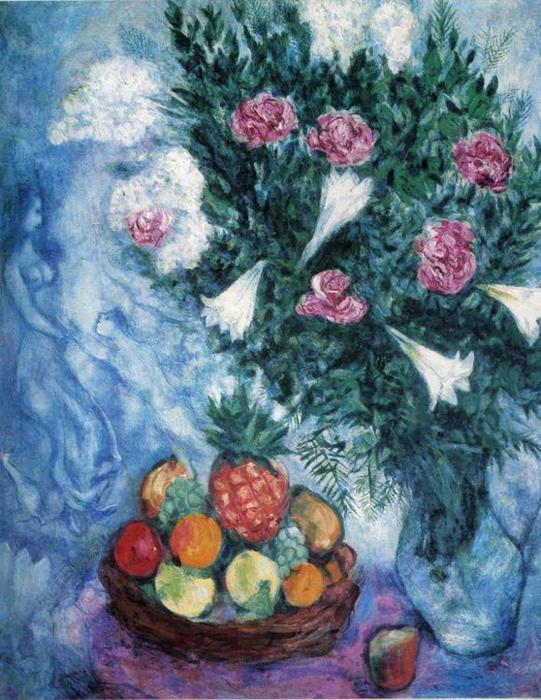
“Fruits and Flowers” was created in 1929 by Marc Chagall in Surrealism style. Find more prominent pieces of still life at Wikiart.org – best visual art database.
Surrealist masterpiece featuring a vase brimming with pink roses and green foliage alongside apples and oranges, capturing Chagall’s dreamlike vision.
A Symphony of Color and Memory: Exploring Marc Chagall’s “Fruits and Flowers”
Marc Chagall's "Fruits and Flowers," painted in 1929 during his formative years as a Surrealist artist, transcends mere representation; it embodies the poet laureate’s signature blend of dreamlike imagery and deeply rooted Jewish folklore. Created shortly after the Vitebsk Art School Revolt—a pivotal moment in Belarusian Jewish history where Chagall and fellow artists defiantly rejected Soviet censorship—the painting serves as both an autobiographical reflection and a powerful statement about artistic freedom.
- Subject Matter: The centerpiece of the composition is a vase brimming with vibrant pink roses, alongside apples and oranges – fruits that hold significant symbolic weight within Jewish tradition representing fertility and abundance.
- Style: Chagall’s Surrealist style distinguishes itself through its rejection of rational perspective. Figures appear to float effortlessly against fantastical landscapes, creating an atmosphere of disorientation and wonder—a deliberate tactic designed to bypass conscious thought and tap into the subconscious.
The artist employed a technique characterized by thick impasto – applying paint in layers with considerable texture – which lends physicality to the ethereal forms. This bold approach is evident throughout the canvas, particularly in the depiction of the roses themselves, where the pigment clings to the surface creating palpable depth and luminosity. Chagall’s masterful use of color—primarily reds, yellows, and blues—further amplifies the painting's emotional impact, conveying a sense of joyous exuberance tempered by melancholic contemplation.
Symbolism: Echoes of Vitebsk and Jewish Heritage
Beyond its formal qualities, “Fruits and Flowers” is laden with symbolism reflecting Chagall’s personal experiences and cultural heritage. The roses symbolize love, beauty, and remembrance—themes recurrent in his oeuvre. Their placement within the vase suggests a deliberate arrangement intended to evoke feelings of nostalgia for Vitebsk and its vibrant Jewish community. Furthermore, the inclusion of apples and oranges reinforces the notion of prosperity and fulfillment – concepts central to Jewish religious beliefs.
Historical Context: Resistance Against Censorship
Painted against the backdrop of escalating Soviet repression in Belarus—where Chagall’s artistic vision clashed with ideological dogma—the painting represents a defiant assertion of creative autonomy. The Vitebsk Art School Revolt underscored the importance of preserving cultural identity and resisting attempts to impose uniformity upon artistic expression.
Emotional Impact: A Window into Chagall's Soul
Ultimately, “Fruits and Flowers” resonates with viewers on an emotional level—capturing a fleeting moment of beauty amidst uncertainty. The painting’s luminous colors and dreamlike forms invite contemplation, prompting us to consider the role of memory and imagination in shaping our understanding of the world. It stands as a testament to Chagall's enduring ability to convey profound feelings through deceptively simple visual elements – an achievement that cements his place among the most influential artists of the 20th century.