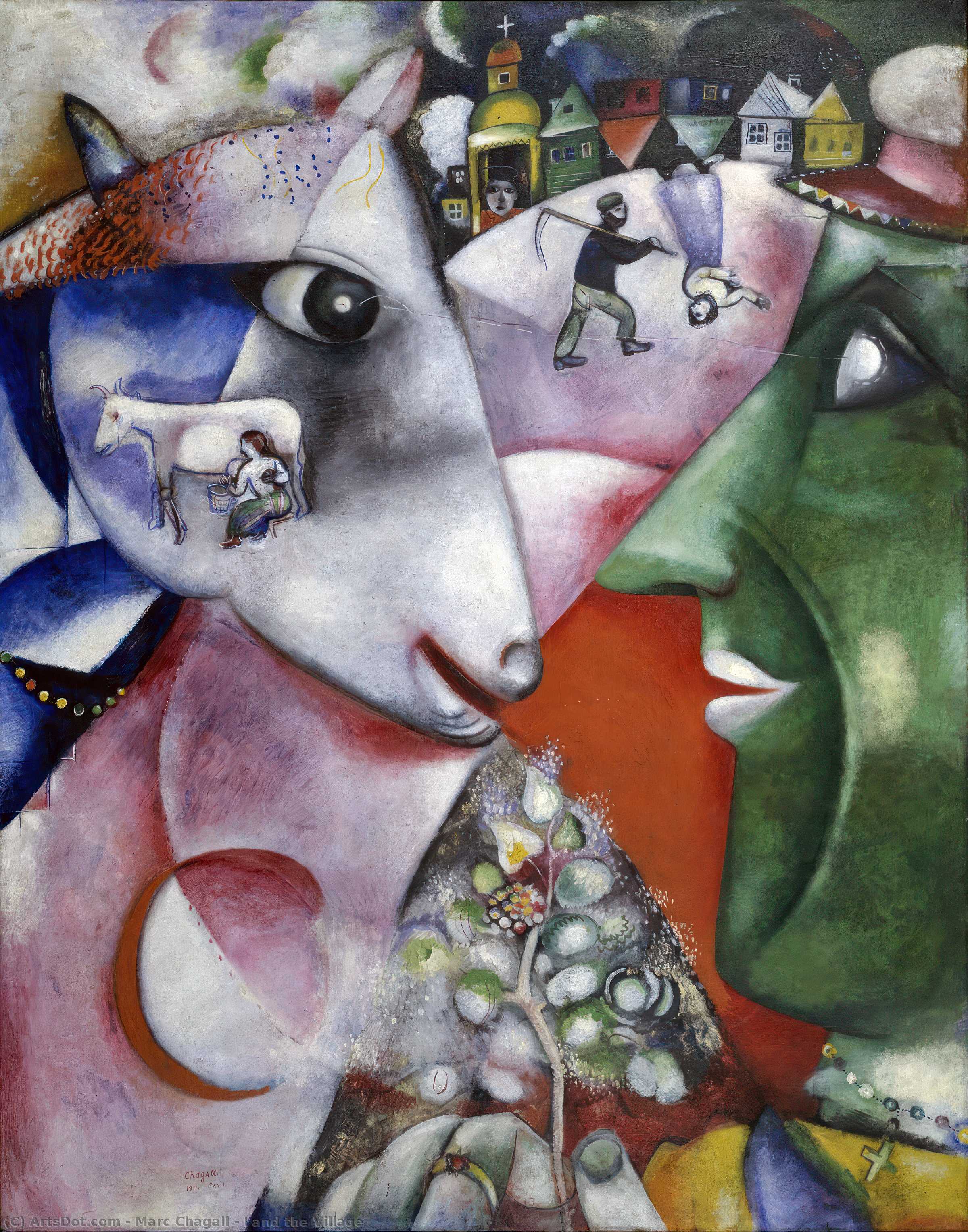
A Window into Memory: Exploring Chagall’s 1911 Masterpiece
Created in 1911, this captivating oil on canvas is a cornerstone of Marc Chagall's early oeuvre and a pivotal work within the development of modern art. Measuring 191 x 150 cm, it’s a substantial piece that commands attention, drawing viewers into a world steeped in personal memory and universal symbolism.
Subject & Narrative Roots
The artwork is a complex tapestry woven from Chagall's childhood recollections of Vitebsk, Belarus. It isn’t a literal depiction but rather an emotional reconstruction – a dreamscape populated by fragmented figures and scenes. Dominating the composition are two striking faces in profile, rendered in contrasting hues of blue-grey and green. Within and around these visages unfold vignettes of village life: a man leading a horse, a figure with a cow, buildings topped with a church steeple, and rolling hills. These elements aren’t simply *present*; they're interwoven, suggesting the fluidity of memory and the interconnectedness of experience.
Style & Artistic Influences
This painting exemplifies Chagall’s unique synthesis of artistic movements. While exhibiting Cubist structural principles – particularly in its fragmented forms and flattened perspective – it transcends strict categorization. Elements of Fauvism are evident in the bold, expressive color palette, while a distinctly Symbolist sensibility imbues the work with layers of meaning beyond the purely representational. It’s a testament to Chagall's ability to absorb influences and forge his own deeply personal artistic language.
Technique & Materiality
Chagall masterfully employs oil paint, layering washes of color over a sketched underpainting. The texture is varied – smooth in some areas, impasto-like in others – creating a tactile quality that enhances the visual richness. His fluid brushwork and minimal use of hard outlines contribute to the dreamlike atmosphere, allowing forms to blend and merge seamlessly. The luminous effect achieved through his color application gives the painting an ethereal glow.
Symbolism & Interpretation
The symbolism within this work is rich and open to interpretation. The horse frequently represents the artist himself or embodies vitality and freedom. The cow evokes rural life, sustenance, and maternal comfort. The faces are perhaps portraits of loved ones, archetypes, or facets of Chagall’s own identity. The prominent eye within the blue face suggests observation, awareness, and a window into the soul. The overall composition speaks to themes of belonging, displacement, and the enduring power of memory.
Emotional Resonance & Historical Context
More than just a visual experience, this painting evokes a powerful emotional response. It’s imbued with a sense of nostalgia, longing, and perhaps a touch of melancholy, despite its vibrant palette. Created on the cusp of significant historical upheaval, it reflects a moment of transition – a yearning for a disappearing world. It stands as a poignant expression of Chagall's personal history and a universal exploration of identity, memory, and belonging.
Owning a reproduction of this iconic work allows you to bring a piece of art history into your space, offering a captivating focal point that sparks conversation and inspires contemplation. Its unique blend of color, form, and symbolism makes it an ideal addition to both contemporary and traditional interiors.