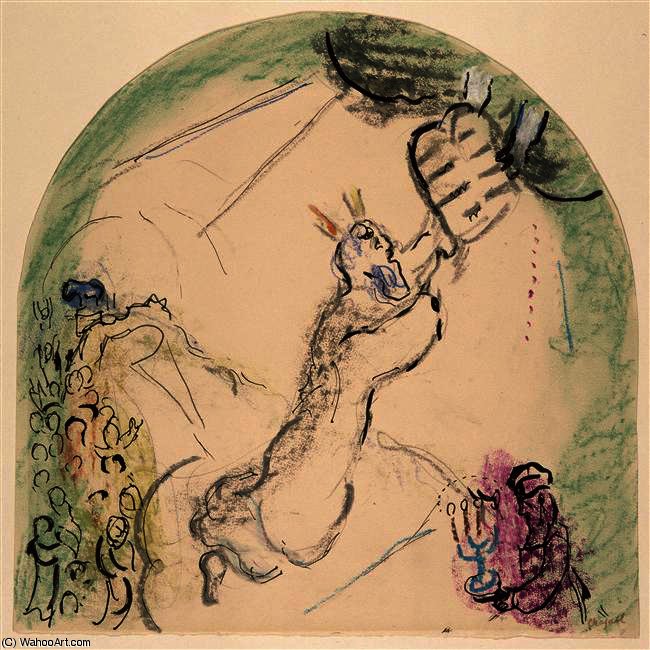
A Vision of Divine Law: Marc Chagall’s *Moses Receiving the Tablets of Law*
Marc Chagall, a master of color and narrative, imbues the biblical story of Moses receiving the Ten Commandments with his signature blend of dreamlike imagery and profound spirituality in this 1963 painting. Measuring 33 x 33 cm, this work is not merely an illustration of scripture; it’s a deeply personal expression of faith, heritage, and artistic innovation.
Stylistic Synthesis: Naive Art & Beyond
Chagall's style defies easy categorization, but *Moses Receiving the Tablets of Law* exemplifies his unique approach often described as Naive Art or Primitivism. This isn’t naiveté in the sense of lacking skill – Chagall was a highly accomplished artist – but rather a deliberate embrace of simplicity, flattened perspective, and vibrant, non-naturalistic color. He draws inspiration from folk art traditions, particularly those of his native Belarus, combined with influences from Cubism and Symbolism. The result is a visual language that feels both ancient and utterly modern.
It’s a style that prioritizes emotional resonance over strict representational accuracy.
Composition & Symbolic Language
The composition centers on Moses, depicted as an almost ethereal figure holding the tablets aloft. He stands against a backdrop of swirling forms and figures – some clearly defined, others dissolving into abstract shapes. The predominant use of greens, punctuated by bursts of red, creates a dynamic tension between tranquility and passion.
- The Tablets: Representing divine law and the covenant between God and humanity.
- Moses’s Figure: His elongated form suggests both strength and humility, embodying his role as an intermediary.
- Surrounding Figures: These can be interpreted as representing the Israelites awaiting the Law, or perhaps even ancestral spirits witnessing this pivotal moment. Their ambiguous forms contribute to the painting's dreamlike quality.
- Color Palette: Green often symbolizes hope and renewal, while red signifies passion, energy, and divine presence.
Historical & Personal Context
Born into a Jewish family in Belarus, Chagall’s artistic vision was deeply informed by his cultural heritage. The imagery of the Bible, particularly stories like that of Moses, resonated powerfully with him throughout his life. Created during a period of post-war reflection and renewed interest in spirituality, *Moses Receiving the Tablets of Law* can be seen as a testament to the enduring power of faith and tradition. Chagall’s work often served as a bridge between his Jewish identity and the broader artistic currents of the 20th century.
Emotional Impact & Lasting Legacy
This painting evokes a sense of awe, reverence, and mystical wonder. It's not a literal depiction of the biblical event but rather an *emotional interpretation* – a visual poem about faith, law, and the human connection to the divine. Chagall’s unique style continues to inspire artists and captivate audiences worldwide. His ability to blend personal experience with universal themes ensures his place as one of the most important figures in modern art.
Bring Chagall Home: Reproductions Available
Experience the beauty and power of *Moses Receiving the Tablets of Law* in your own space. High-quality, handmade oil painting reproductions are available, meticulously crafted to capture the essence of Chagall’s original masterpiece. These reproductions offer an accessible way to appreciate and enjoy this iconic work of art.