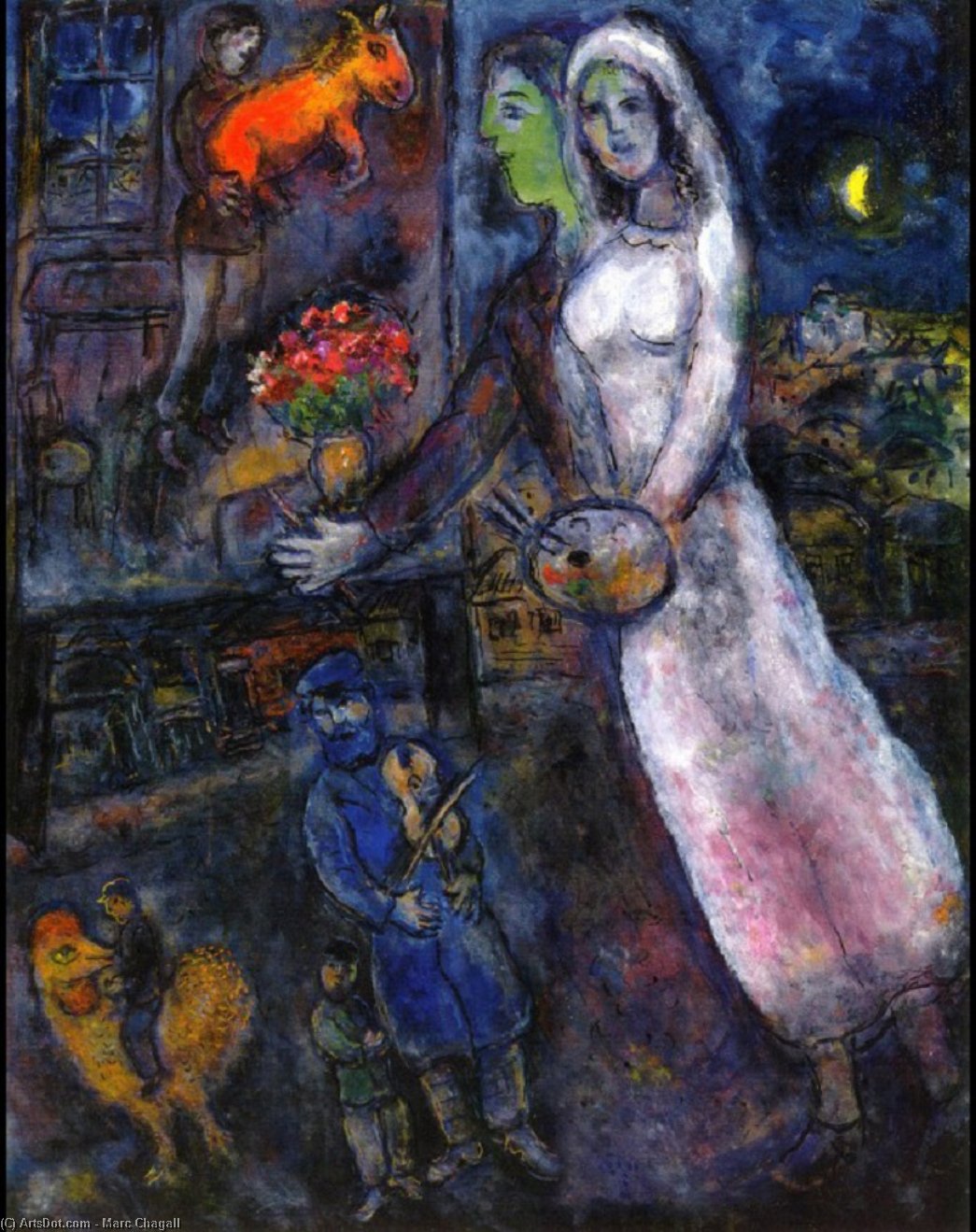
Newlyweds and Violinist
Marc Chagall's
Newlyweds and Violinist, created in 1956, is a quintessential representation of his unique blend of Naive Art and Primitivism. This captivating oil on canvas painting measures 100 x 81 cm and is a testament to Chagall's ability to weave together elements of fantasy, love, and music.
Naive Art and Primitivism
Chagall’s work falls under the Naïve Art movement, also known as Primitivism. This style is characterized by its simplicity, directness, and a sense of innocence. Artists associated with this movement often lack formal training in art, which allows for a more intuitive and spontaneous approach to creativity. Chagall, however, was a trained artist who adopted the Naïve Art style to convey his deep emotional connections and dreamlike visions.
Composition and Symbolism
In
Newlyweds and Violinist, the central figures are a bride and groom standing together in front of a violinist. The bride is adorned in a white dress, while the groom stands beside her with his arm around her waist. They hold hands, symbolizing their union and love. The presence of the violinist adds a musical element, often associated with joy and celebration. The painting also features several other figures, including one person on the left side and two more towards the right. A horse is visible in the background, adding an interesting element to the scene. Various objects such as a vase near the center, a clock hanging above the couple, and a bowl placed on the ground add depth and detail to the composition.
Artistic Style
Chagall’s use of vibrant colors and dreamlike imagery is characteristic of his style. The painting exudes a sense of happiness and joy, capturing the essence of a wedding celebration. The Naïve Art style allows for a more expressive and emotive portrayal of the scene, making it relatable and engaging.
Conclusion
Marc Chagall's The Gladiolas,
Moses with the Burning Bush are high-quality reproductions of his paintings available at ArtsDot. To learn more about Marc Chagall and his contributions to modern art, visit
Marc Chagall's page on ArtsDot. For a deeper understanding of the Naïve Art movement, refer to
The Naïve Art (Primitivism) Art Movement on ArtsDot.