A Visionary Encounter with the Red Jew
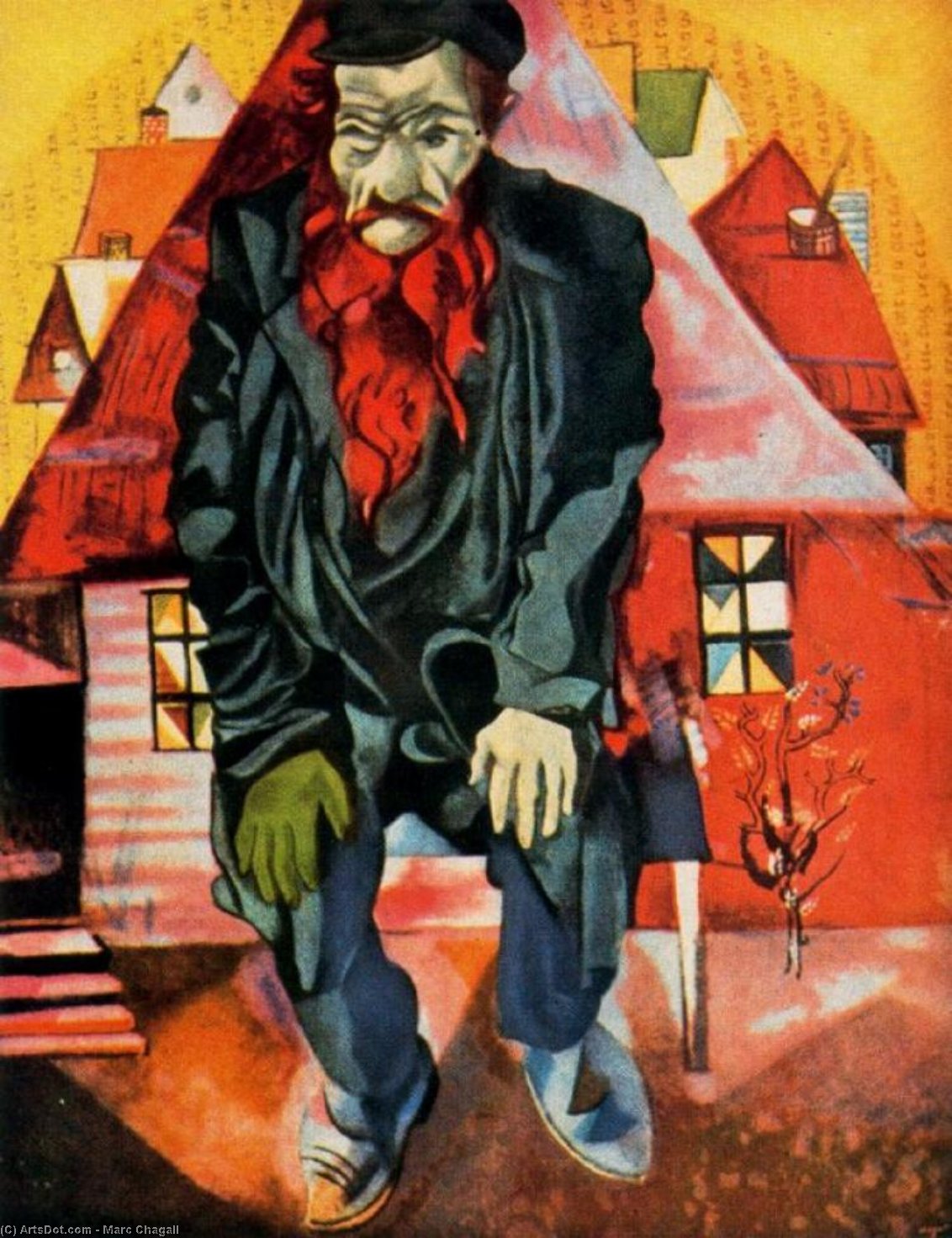
In the profound stillness of Marc Chagall’s 1915 masterpiece, Red Jew, we are invited into a realm where reality and dream coalesce. This striking portrait serves as a window into the artist's formative years, capturing a moment that feels both deeply personal and universally resonant. At first glance, the viewer is arrested by the central figure: a man clad in a somber black suit and hat, whose presence is anchored by a beard of startling, fiery red. This splash of crimson does not merely provide a focal point; it breathes life into the canvas, acting as a pulse of vitality against the more muted, structured elements of the composition. As the eye wanders, one notices the subtle presence of a secondary figure and the architectural hints of a house in the background, creating a sense of a lived-in, albeit fractured, world.
The technique employed by Chagall in this period reflects a masterful command of Cubist principles, yet it is infused with a lyrical softness that prevents the geometry from feeling cold or clinical. Rather than relying on harsh, rigid lines, Chagall utilizes layered thin washes of color to build an ethereal luminosity. This method allows light to seem as though it is emanating from within the canvas itself, blurring the boundaries between the subject and his environment. The way the hues are meticulously blended creates a dreamlike atmosphere, where the planes of the man's face and the structure of the background appear to vibrate with a quiet, spiritual energy.
The Echoes of Vitebsk and Cultural Identity
To truly appreciate Red Jew, one must look toward the turbulent landscape of Vitebsk, the artist’s beloved birthplace. Painted during a period of immense historical upheaval—marked by the tensions of World War I and the looming shadows of the Bolshevik revolution—the painting carries the weight of a world in transition. Chagall’s work is inseparable from the cultural duality of his upbringing, where the traditions of Russian Orthodoxy met the vibrant, rhythmic life of Jewish marketplaces. This piece acts as a vessel for those memories, capturing the essence of an identity that was being reshaped by political and social displacement.
The symbolism embedded within the portrait transcends simple representation. The man in the black suit is more than a single individual; he embodies the collective spirit of the Jewish community during a time of profound uncertainty. His vibrant red beard serves as a powerful metaphor for passion, resilience, and an unyielding defiance against the encroaching darkness of war and occupation. Through this use of folklore-inspired imagery, Chagall transforms a portrait into a narrative of survival and cultural preservation, making the artwork a poignant tribute to the endurance of the human spirit amidst the chaos of history.
An Essential Addition for Discerning Collections
For the art collector or interior designer, Red Jew offers an unparalleled opportunity to introduce a piece of profound emotional depth into a curated space. The painting’s unique ability to balance somber, historical gravity with a whimsical, luminous beauty makes it a versatile centerpiece. It possesses the rare quality of commanding attention through its bold color accents while simultaneously providing a contemplative, quiet energy that complements sophisticated modern or classical interiors.
Owning a high-quality reproduction of this Chagall masterpiece allows for the preservation of this historical and emotional legacy within one's own home. Whether placed in a gallery-style study or as a conversation starter in a contemporary living area, the painting serves as a constant reminder of the power of imagination to transcend even the most turbulent realities. It is not merely a decoration, but an invitation to dream, to remember, and to find beauty in the fractured planes of our shared human experience.