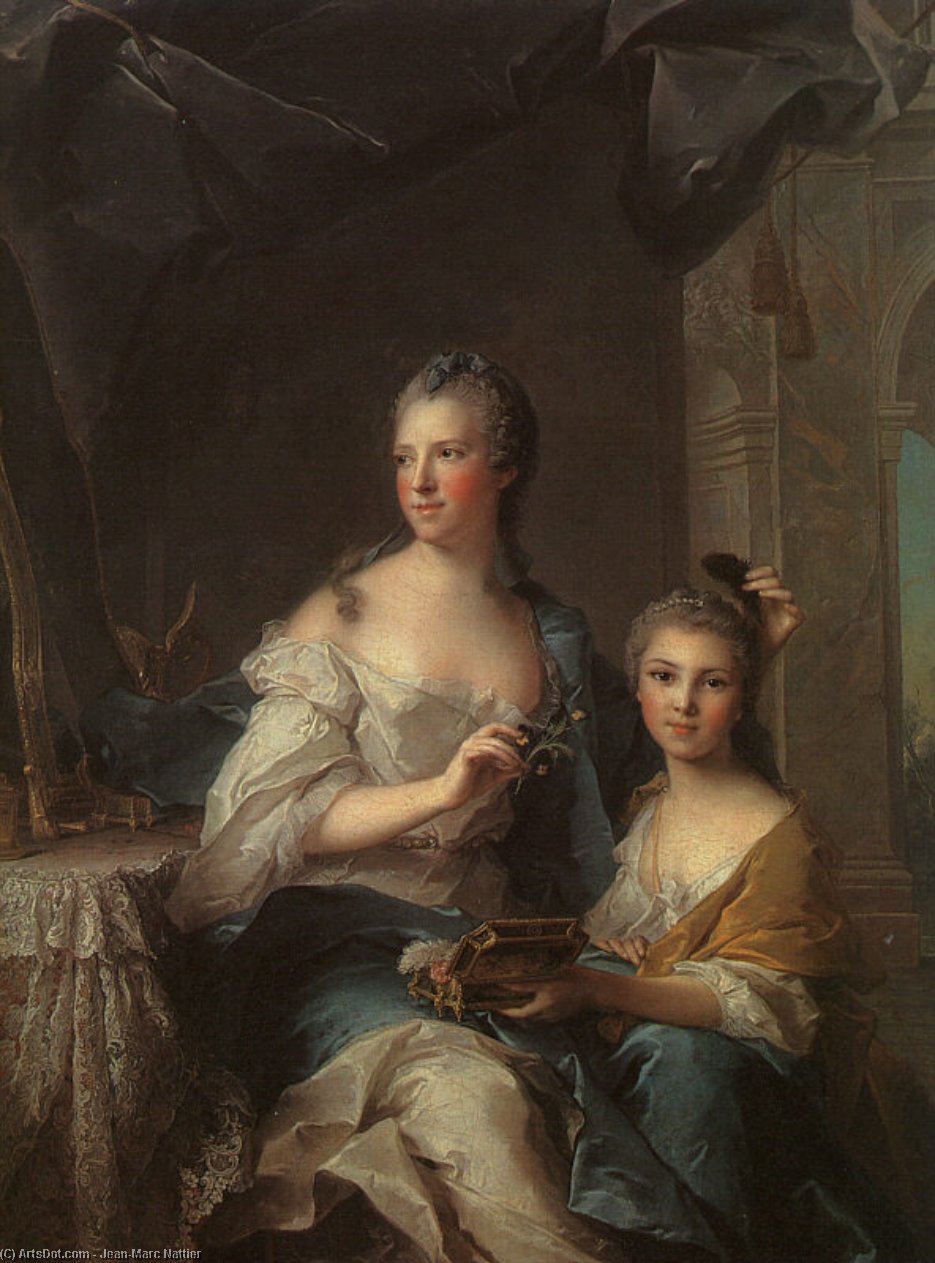
A Glimpse of Parisian Elegance: Madame Marsollier and Her Daughter by Jean-Marc Nattier
Jean-Marc Nattier’s “Madame Marsollier and her Daughter,” painted in 1749, is more than just a portrait; it's a meticulously crafted tableau vivant – a snapshot of refined Parisian society during the reign of Louis XV. This exquisite work, now housed within the Metropolitan Museum of Art in New York, offers a rare glimpse into the world of aristocratic leisure and familial connection, rendered with Nattier’s signature blend of Rococo grace and classical restraint.
The painting depicts Madame Marsollier, a woman renowned for her beauty and social standing, seated comfortably in an ornate chair. Beside her stands her daughter, a youthful figure radiating quiet dignity. The setting is subtly luxurious – a richly upholstered armchair, a scattering of books suggesting intellectual pursuits, and a delicate bowl hinting at conversation and refreshment. Nattier’s genius lies not merely in his technical skill but in his ability to imbue the scene with an atmosphere of understated elegance and intimate warmth.
The Rococo Master: Nattier's Technique and Style
Jean-Marc Nattier was a pivotal figure in 18th-century French art, largely celebrated for his portraits of the ladies of the court. His style is characterized by an almost photographic realism combined with a distinctly Rococo sensibility – a delicate balance between naturalism and artificiality. He employed a technique known as “peinture de genre,” blending portraiture with elements of everyday life to create scenes that felt both intimate and grand. Notice how Nattier masterfully uses light and shadow, creating a soft, diffused glow that illuminates the figures and enhances their beauty. The delicate brushstrokes contribute to the painting’s overall sense of fluidity and movement.
Nattier's background as the son of a portrait painter and the daughter of a miniaturist undoubtedly shaped his artistic development. He began his training by meticulously copying masterpieces at the Luxembourg Gallery, honing his skills in capturing likenesses and understanding composition. This rigorous practice instilled in him an appreciation for detail and a deep understanding of classical principles.
Symbolism and Social Context
Beyond its aesthetic beauty, “Madame Marsollier and her Daughter” offers valuable insights into the social customs and values of 18th-century France. The presence of books suggests a cultivated intellect and an appreciation for learning – qualities highly valued in aristocratic women. The bowl, often filled with delicacies or refreshments, symbolizes hospitality and the importance of social interaction. The arrangement of the figures within the room reflects a carefully constructed hierarchy, emphasizing Madame Marsollier’s position as the matriarch and her daughter's role as her heir.
Furthermore, the painting speaks to the evolving role of women in society during this period. While constrained by social expectations, aristocratic women like Madame Marsollier were afforded a degree of privilege and influence that allowed them to engage in intellectual pursuits and cultivate refined tastes. Nattier’s portrayal captures both their beauty and their status within the complex social fabric of the time.
A Timeless Masterpiece: Reproduction and Legacy
Today, “Madame Marsollier and her Daughter” remains a beloved example of Rococo portraiture, admired for its exquisite detail, graceful composition, and evocative atmosphere. ArtsDot offers meticulously hand-painted reproductions that faithfully capture the essence of this iconic work, allowing art lovers to experience its beauty firsthand. Each reproduction is created by skilled European artists using traditional techniques and high-quality materials, ensuring a faithful representation of Nattier’s original masterpiece.
Whether you are an avid collector, an interior designer seeking to infuse your space with elegance, or simply someone who appreciates the beauty of art history, a reproduction of “Madame Marsollier and her Daughter” is a timeless addition to any collection. It's a window into a bygone era – a testament to the artistry and sophistication of Jean-Marc Nattier and the enduring allure of Parisian grace.