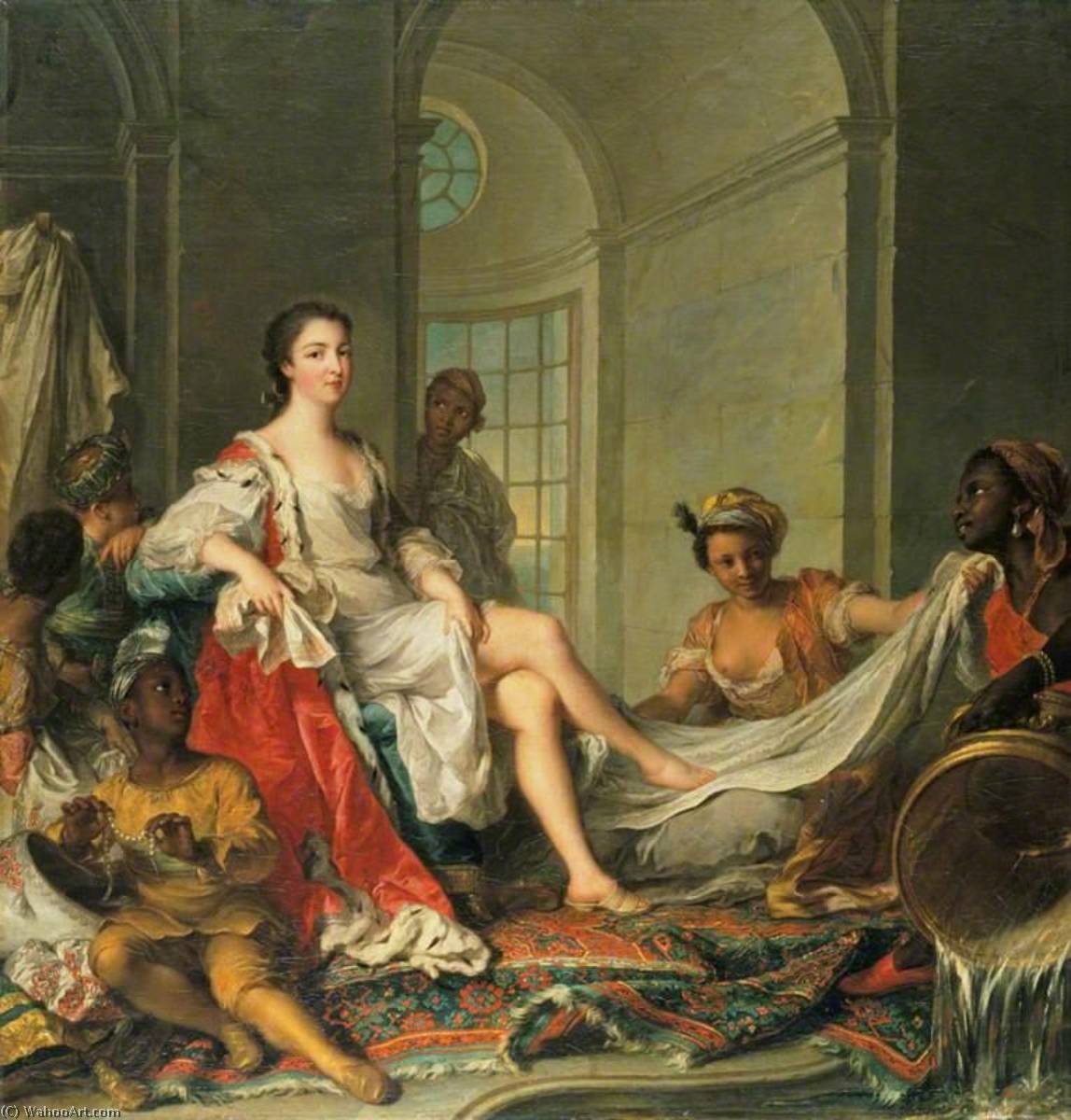
A Glimpse into Rococo Grandeur: Mademoiselle de Clermont 'en sultane'
To stand before this portrait is to step directly into the opulent, sun-drenched drawing rooms of 18th-century Parisian high society. Mademoiselle de Clermont 'en sultane' by Marc Nattier captures more than just a likeness; it arrests a moment of exquisite leisure and sophisticated gathering. The composition immediately draws the eye to the central figure, Mademoiselle de Clermont, seated with an air of languid grace. Her posture, with legs elegantly crossed, speaks volumes about the refined sensibilities of her era. The vibrant red sash around her waist serves not merely as decoration, but as a focal point, injecting a necessary pulse of color into the otherwise warm, diffused palette of the scene.
The Allure of Rococo Intimacy and Light
Technically, Nattier masterfully employs the hallmarks of the Rococo period. The natural light streaming in from an unseen window bathes the entire scene in a golden, almost palpable warmth. This handling of illumination is key; it softens the edges, lending an air of dreamlike intimacy to what was once a public display of wealth and connection. Surrounding Mademoiselle are several figures—some standing, others seated on the plush bedding—creating a tableau vivant of social interaction. The inclusion of men in formal attire, notably those wearing ties, grounds the scene in a specific social reality, suggesting a confluence of aristocratic femininity and masculine formality.
Symbolism of Status and Social Fabric
The very setting speaks to status. This is not a private moment; it is a curated event designed for observation. The richness implied by the textiles, the arrangement of people, and the sheer scale of the gathering all point toward an elite circle enjoying their company. Symbolically, the portrait celebrates the performance of femininity within aristocratic life—the controlled elegance, the studied ease. While the subject herself embodies exotic allure with her 'sultane' designation, the surrounding figures anchor her within a recognizable, if highly stylized, social structure. It is a study in curated perfection.
A Timeless Echo for Modern Interiors
For the contemporary collector or interior designer, this piece offers an unparalleled infusion of historical romance and sophisticated color theory. Reproducing the depth and luminosity of Nattier’s brushwork allows one to bring the gentle drama of the 1730s into a modern space. Imagine this painting anchoring a salon or a grand reception room; its warm glow complements both antique furnishings and contemporary design elements alike. It is an artwork that whispers tales of powdered wigs, whispered secrets, and unparalleled elegance, transforming any wall into a portal to gilded history.