A Breath of Rebellion: The Essence of Duchamp’s Vision
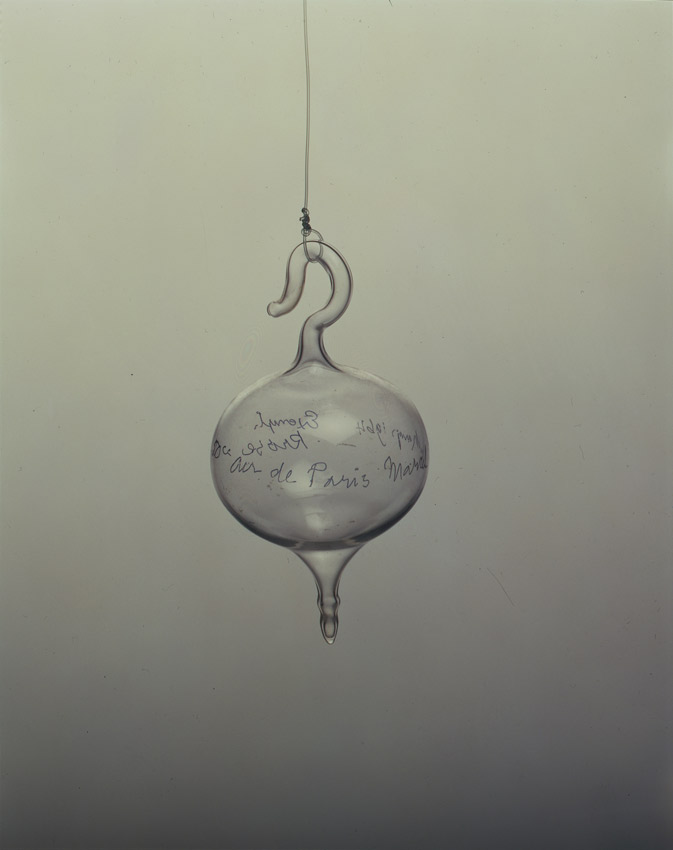
In the quiet, suspended stillness of Marcel Duchamp’s "50 cc of Paris Air," one finds not just an object, but a profound philosophical provocation. Created in 1919, during the turbulent and disillusioned aftermath of World War I, this work serves as a cornerstone of the Dadaist movement. At first glance, the piece presents a striking simplicity: a delicate vessel, seemingly weightless, captured in a moment of ethereal suspension. Yet, beneath this minimalist exterior lies an audacious challenge to the very definition of art. Duchamp, a master of conceptual subversion, utilized the "ready-made" technique to strip away the necessity of traditional craftsmanship, instead inviting the viewer to find profound meaning within the mundane and the invisible.
The visual impact of the work is deeply rooted in its stark, monochrome aesthetic. The interplay of light and shadow across the vessel creates a sense of ghostly presence, as if the object itself is a memory or a fleeting thought. For the discerning collector or interior designer, this piece offers a sophisticated focal point that transcends mere decoration. It brings an intellectual gravity to any space, acting as a conversation starter that bridges the gap between historical avant-garde rebellion and modern minimalist elegance. To possess a reproduction of such a seminal work is to invite the spirit of radical inquiry into one's personal sanctuary.
The Poetry of the Invisible: Symbolism and Technique
To understand "50 cc of Paris Air" is to engage with the concept of the intangible. The title itself suggests a measurement of something that cannot be held—the very atmosphere of a city, the essence of a moment in time. By capturing air within a physical container, Duchamp plays with the paradox of making the ephemeral permanent. This act of "bottling" the atmosphere of Paris serves as a poignant meditation on existence and the fleeting nature of life. The cryptic instruction often associated with his work—"Do not forget to breathe"—resonates with a haunting emotional depth, reminding us of our shared human vulnerability amidst the chaos of a changing world.
Technically, the piece relies on the power of suggestion. While the physical medium may be a simple ceramic or glass vessel, the true "material" is the idea itself. Duchamp’s brilliance lay in his ability to use found objects to bypass what he called "retinal art"—art intended only to please the eye—and instead target the intellect. This approach creates an emotional resonance that is both unsettling and deeply moving. It forces a confrontation with the void, encouraging a contemplative state of mind. For those seeking to curate an environment of depth and intellectual rigor, this artwork provides a masterclass in how simplicity can harbor immense complexity.
A Legacy for the Modern Collector
The historical significance of Duchamp’s contribution to the 20th century cannot be overstated. As a pioneer who dismantled established hierarchies, his influence flows through every contemporary movement, from Pop Art to Minimalism. "50 cc of Paris Air" remains a vital piece of this legacy, embodying the transition from the physical mastery of the Renaissance to the conceptual freedom of the modern era. It is a work that celebrates the beauty of the thought process and the courage required to redefine reality.
Integrating a high-quality reproduction of this Dadaist masterpiece into a curated collection allows for a unique blend of historical reverence and contemporary style. Whether placed in a minimalist gallery setting or as a sophisticated accent in a modern living space, the work commands attention through its quiet strength. It is an invitation to look closer, to breathe deeper, and to appreciate the profound art that exists in the spaces between the visible and the unseen.