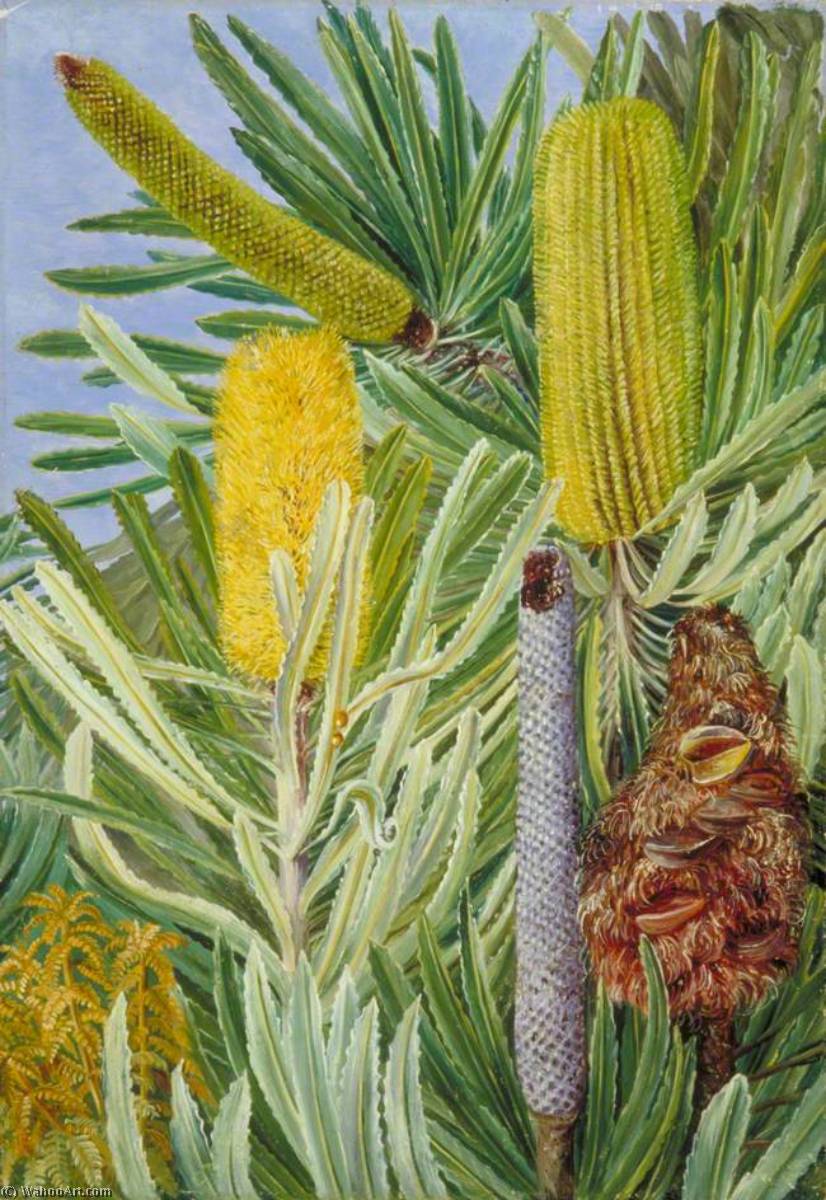
A West Australian Banksia – A Victorian Explorer’s Ode to Nature
“A West Australian Banksia” by Marianne North is more than just a botanical painting; it's a vibrant testament to a woman’s unwavering spirit of adventure and her profound connection with the natural world. Painted in 1880, during a period when women were largely confined to domestic roles, North defied convention, embarking on an extraordinary global journey dedicated entirely to documenting the flora of distant lands. This particular work captures the essence of the Banksia attenuata, a striking tree endemic to southwestern Australia, rendered with a meticulous eye and infused with a palpable sense of wonder.
North’s artistic style is distinctly Victorian, characterized by its rich color palette, detailed observation, and a romantic sensibility. She eschewed the prevailing academic realism of the time, favoring instead a looser, more expressive brushstroke that captures the dynamism of life within the plant itself. The painting isn't merely a representation of the Banksia; it’s an evocation of its habitat – the dappled sunlight filtering through the foliage, the subtle textures of the bark, and the vibrant energy of the flowering spikes. Her technique is masterful in conveying both the scientific accuracy demanded by her botanical pursuits and the emotional resonance she sought to capture.
The Explorer's Journey: Context and Inspiration
Marianne North’s life was a remarkable odyssey fueled by an insatiable curiosity and a deep respect for the natural world. Born in Hastings, England, her early artistic aspirations were sidelined by illness, leading her instead to pursue painting flowers as a means of creative expression. However, she soon realized that simply depicting beauty wasn't enough; she yearned to *understand* it – to witness its origins and document its intricacies firsthand. This desire propelled her on an extraordinary series of expeditions across continents, from the steamy jungles of Brazil to the snow-capped peaks of Tibet, always with her easel and paints in tow.
Her travels were not merely recreational; they were meticulously researched scientific endeavors. North painstakingly documented each plant she encountered, creating detailed watercolor illustrations accompanied by insightful observations on their habitat, growth patterns, and ecological significance. She collaborated closely with botanists like Joseph Dalton Hooker at Kew Gardens, contributing significantly to the advancement of botanical knowledge. The Banksia painting itself reflects this dual commitment – a beautiful work of art informed by rigorous scientific observation.
Symbolism and Emotional Resonance
Beyond its technical merits, “A West Australian Banksia” resonates with profound symbolic meaning. The Banksia attenuata, with its distinctive candlestick-shaped flower spikes, represents resilience and adaptability—qualities that mirrored North’s own unwavering determination in the face of societal expectations. The painting's vibrant yellows and greens evoke a sense of vitality and abundance, celebrating the beauty and power of nature. Furthermore, it speaks to the Victorian fascination with exoticism and the romantic ideal of the explorer venturing into uncharted territories.
There’s an undeniable emotional depth within the work. North wasn’t simply recording a plant; she was conveying her awe and admiration for its intricate beauty. The painting invites us to step into her world, to share in her sense of wonder, and to appreciate the delicate balance of life within this remarkable Australian ecosystem. It's a reminder that art can be both informative and deeply moving, capable of transporting us across continents and connecting us with the natural world on a profound level.
Collecting and Displaying – A Reproduction’s Value
Reproductions of Marianne North’s paintings offer an accessible way to bring this extraordinary artwork into your home or office. ArtsDot.com offers high-quality giclée prints that faithfully capture the richness of color, detail, and texture of the original. These reproductions are ideal for interior designers seeking to infuse a space with a touch of Victorian elegance and botanical inspiration, as well as collectors who appreciate the legacy of this pioneering artist.
Consider framing your reproduction in a classic style – perhaps a simple wooden frame or a more ornate gilded design – to complement its historical context. “A West Australian Banksia” will serve not only as a beautiful piece of art but also as a poignant reminder of Marianne North’s extraordinary life and her enduring contribution to the world of botanical illustration.