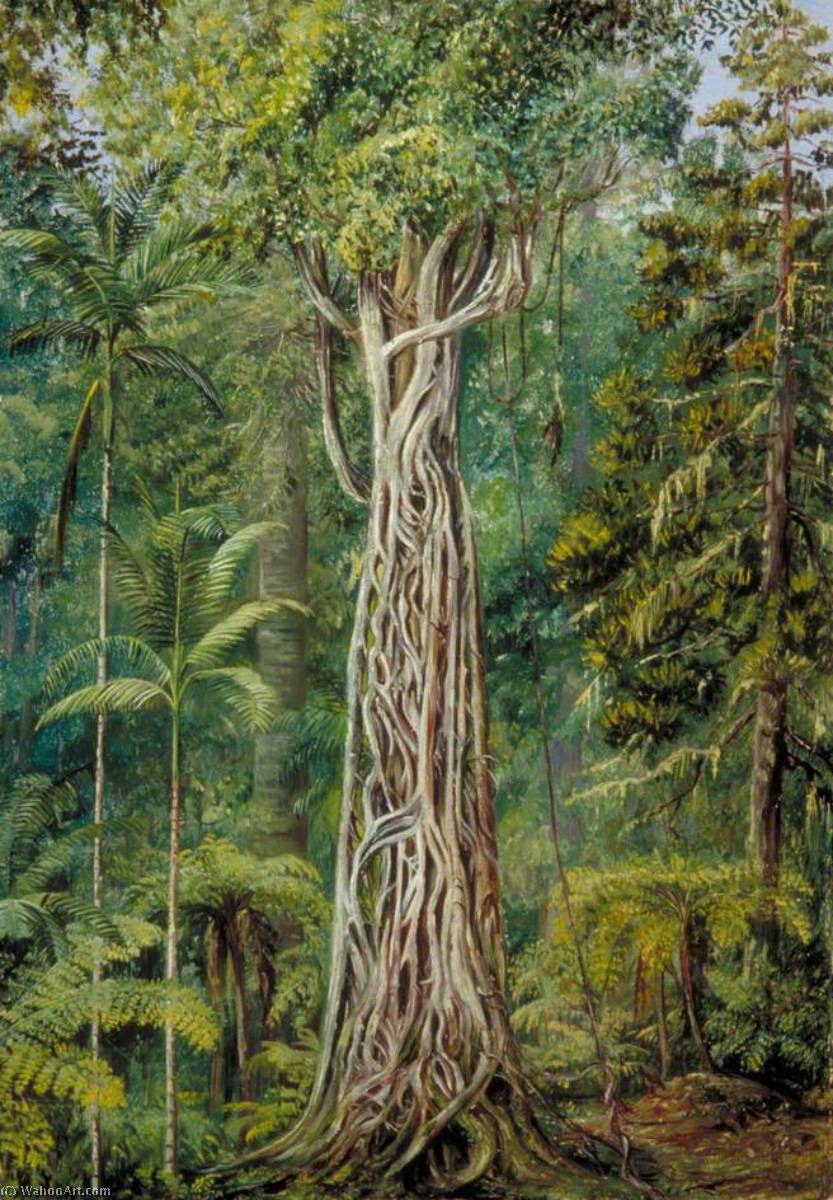
A Verdant Strangling: Marianne North’s “Poison Tree Strangled by a Fig”
Marianne North's "Poison Tree Strangled by a Fig, Queensland," painted in 1880, is more than just a botanical illustration; it’s a hauntingly beautiful meditation on the relentless power of nature and the delicate balance between life and decay. This remarkable work, now housed within the Marianne North Gallery at Kew Gardens, offers a glimpse into the Victorian adventurer's meticulous eye and her profound connection to the natural world – a world she relentlessly documented through vibrant oil paintings during a period when women were largely excluded from scientific exploration.
The scene unfolds within a dense Queensland rainforest, dominated by an imposing fig tree. This isn’t a simple depiction of foliage; North masterfully captures the unsettling drama of a “strangler fig,” a plant species notorious for its parasitic growth. The larger fig, a mature specimen, has enveloped and begun to consume a younger, slender tree – a process known as strangulation. The intertwined roots, thick and gnarled, create a complex network of textures, suggesting both the struggle for survival and the inevitable triumph of nature’s relentless drive. Notice how North doesn't shy away from depicting the decay; patches of brown and grey reveal the slow disintegration of the host tree, subtly hinting at mortality within this vibrant tableau.
The Victorian Naturalist: Marianne North’s Methodology
Marianne North was a singular figure in 19th-century art. Rejecting the conventional role assigned to women of her era, she embarked on an extraordinary journey of self-funded exploration and artistic dedication. Driven by a deep fascination with botany and a desire to document the world’s flora, she traveled extensively across continents – from the Amazon rainforest to the remote landscapes of Japan – meticulously painting hundreds of plant species in situ. Her approach was remarkably unconventional for her time; she eschewed formal scientific training, relying instead on keen observation, artistic skill, and an unwavering commitment to capturing the essence of each plant within its natural habitat.
North’s technique is characterized by a remarkable level of detail and a masterful use of color. Working primarily in oil paints on cardboard – a practical choice for her extensive travels – she achieved a luminous quality that brought her subjects to life. Her brushstrokes are both precise and expressive, conveying not just the physical form of the plants but also their texture, light, and atmosphere. The rich greens, browns, and yellows create a sense of depth and complexity, drawing the viewer into the heart of the rainforest.
Symbolism and Interpretation
The “Poison Tree Strangled by a Fig” is laden with symbolic meaning. On one level, it represents the relentless cycle of life and death, growth and decay – a fundamental principle of nature that North so passionately documented. The strangler fig itself embodies this dynamic, demonstrating how seemingly destructive forces can ultimately contribute to the flourishing of an ecosystem. However, the image also carries a darker resonance, hinting at themes of predation, vulnerability, and the potential for imbalance within the natural world.
Furthermore, some art historians interpret the painting as a metaphor for colonialism and its impact on indigenous landscapes. The aggressive growth of the fig tree can be seen as an allegory for the encroachment of European influence upon native territories – a subtle but powerful commentary on the disruption of established ecosystems. The Queensland setting itself adds to this interpretation, reminding us of the vastness and untamed beauty of Australia’s interior.
A Legacy in Color: Reproduction and Display
"Poison Tree Strangled by a Fig, Queensland" is a captivating work that continues to resonate with viewers today. ArtsDot offers high-quality reproductions of this iconic painting, meticulously crafted to capture the original's vibrant colors and intricate details. Whether displayed as a statement piece in a contemporary interior or studied alongside historical botanical illustrations, this artwork invites contemplation on the wonders and complexities of the natural world.
Available in various sizes – from compact digital mockups for preliminary approval to large-format prints suitable for gallery walls – ArtsDot ensures that this remarkable painting can be enjoyed by art lovers worldwide. Each reproduction is produced using archival-quality materials, guaranteeing its longevity and preserving the beauty of North’s artistic vision for generations to come.