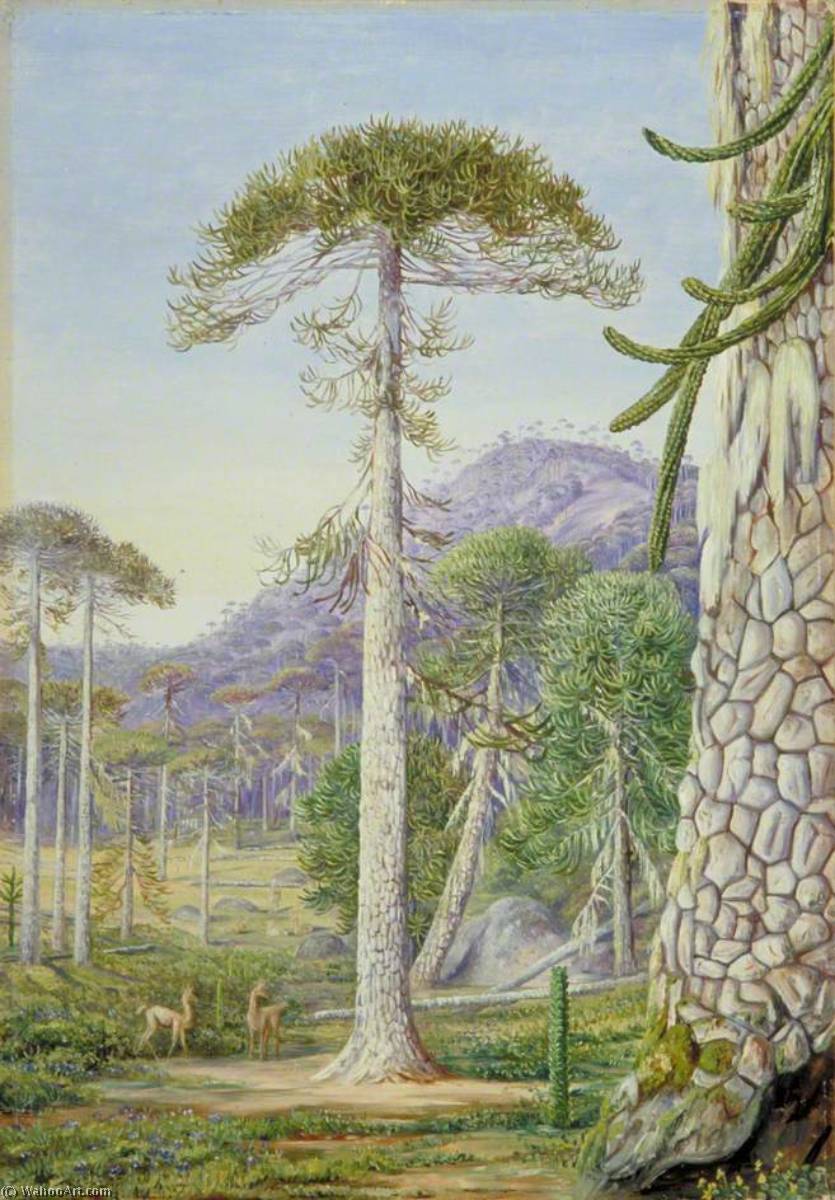
A Window Into a Wild World: Marianne North’s “Puzzle Monkey Trees and Guanacos”
Marianne North's "Puzzle Monkey Trees and Guanacos," painted in 1880, isn’t merely a depiction of a South American forest; it’s an immersive experience, a vibrant testament to the Victorian explorer-artist’s relentless curiosity and profound connection with the natural world. This oil on board masterpiece, now housed within the Marianne North Gallery at the Royal Botanic Gardens, Kew, offers a glimpse into a meticulously observed landscape teeming with life – a carefully constructed puzzle of flora, fauna, and indigenous culture. The painting immediately draws the eye to the central tree, a colossal specimen dominating the composition, its branches reaching skyward like grasping fingers. Surrounding it are a diverse array of trees, each rendered with remarkable detail, hinting at the incredible botanical richness of the region.
North’s artistic approach was revolutionary for her time. Rather than simply capturing a scene, she embarked on extensive expeditions to remote corners of the globe, meticulously documenting plant life through countless sketches and watercolors. “Puzzle Monkey Trees and Guanacos” represents one of her most ambitious oil paintings, reflecting this dedication. The technique is characterized by loose, expressive brushstrokes—a deliberate departure from the rigid academic styles prevalent in Victorian art. She employed a broken color technique, layering thin washes of paint to create luminous effects and capture the dappled light filtering through the dense foliage. This approach imbues the painting with an almost palpable sense of atmosphere, transporting the viewer directly into the heart of the forest.
The Guanacos and Their Significance
The presence of guanacos – graceful, camelid-like animals native to South America – adds a layer of narrative depth. These elegant creatures, depicted in a moment of serene contemplation amidst the trees, are not simply decorative elements; they represent an integral part of the ecosystem. North’s detailed observation of their behavior and habitat underscores her commitment to scientific accuracy. The guanacos themselves hold symbolic weight within indigenous cultures, often associated with fertility, abundance, and connection to the land. Their inclusion subtly acknowledges the perspective of the people who have lived in harmony with this environment for centuries.
A Victorian Explorer’s Vision
Marianne North was more than just a painter; she was an intrepid explorer, botanist, and writer. Her travels took her to some of the most remote and challenging environments on Earth – from the Amazon rainforest to the Himalayas – where she painstakingly documented thousands of plant species. “Puzzle Monkey Trees and Guanacos” embodies her pioneering spirit, reflecting her desire to understand and celebrate the beauty and diversity of the natural world. The painting was created during a period of intense scientific exploration and colonial expansion, yet North’s work stands apart through its genuine respect for indigenous cultures and its unwavering commitment to accurate botanical representation.
Emotional Resonance and Lasting Legacy
Beyond its technical brilliance and historical significance, “Puzzle Monkey Trees and Guanacos” possesses a powerful emotional resonance. The painting evokes a sense of tranquility and wonder, inviting the viewer to lose themselves in the lushness of the forest. There’s an underlying current of quiet contemplation—a feeling that this is not just a landscape, but a living, breathing entity. Marianne North's legacy extends far beyond her stunning artwork; she established the Marianne North Gallery at Kew Gardens, a unique space dedicated to showcasing her extensive collection and promoting botanical art. Today, her paintings continue to inspire awe and appreciation for the natural world, reminding us of the importance of conservation and the enduring power of artistic observation.