Marianne North's Vision of Tropical Majesty
Marianne North (1830–1890) wasn’t merely an artist; she was a pioneer, charting unexplored territories and documenting the breathtaking beauty of the natural world with unparalleled dedication. Her legacy resides not just in her stunning paintings but also in her unwavering commitment to scientific observation interwoven with artistic expression—a rare combination that cemented her place as one of Victorian Britain's most remarkable botanical illustrators.
- A Life Dedicated to Exploration: Born into a privileged family in Hastings, North defied societal expectations for women of her time. Driven by an innate curiosity and fueled by the encouragement of Frederic Edwin Church—a fellow artist captivated by the grandeur of American landscapes—she embarked on expeditions across continents, from Canada and Japan to Borneo and Egypt. These journeys weren’t simply vacations; they were meticulously planned scientific endeavors aimed at capturing the essence of diverse ecosystems.
- Botanical Artistry: North's artistic style leaned heavily toward realism infused with an illustrative quality characteristic of 19th-century botanical art. She employed watercolor pigments on paper, layering washes to build up color and form—a technique that prioritized accuracy alongside aesthetic appeal. Her meticulous attention to detail ensured that every petal, leaf, and stem was rendered faithfully, conveying not just visual splendor but also a profound understanding of plant anatomy.
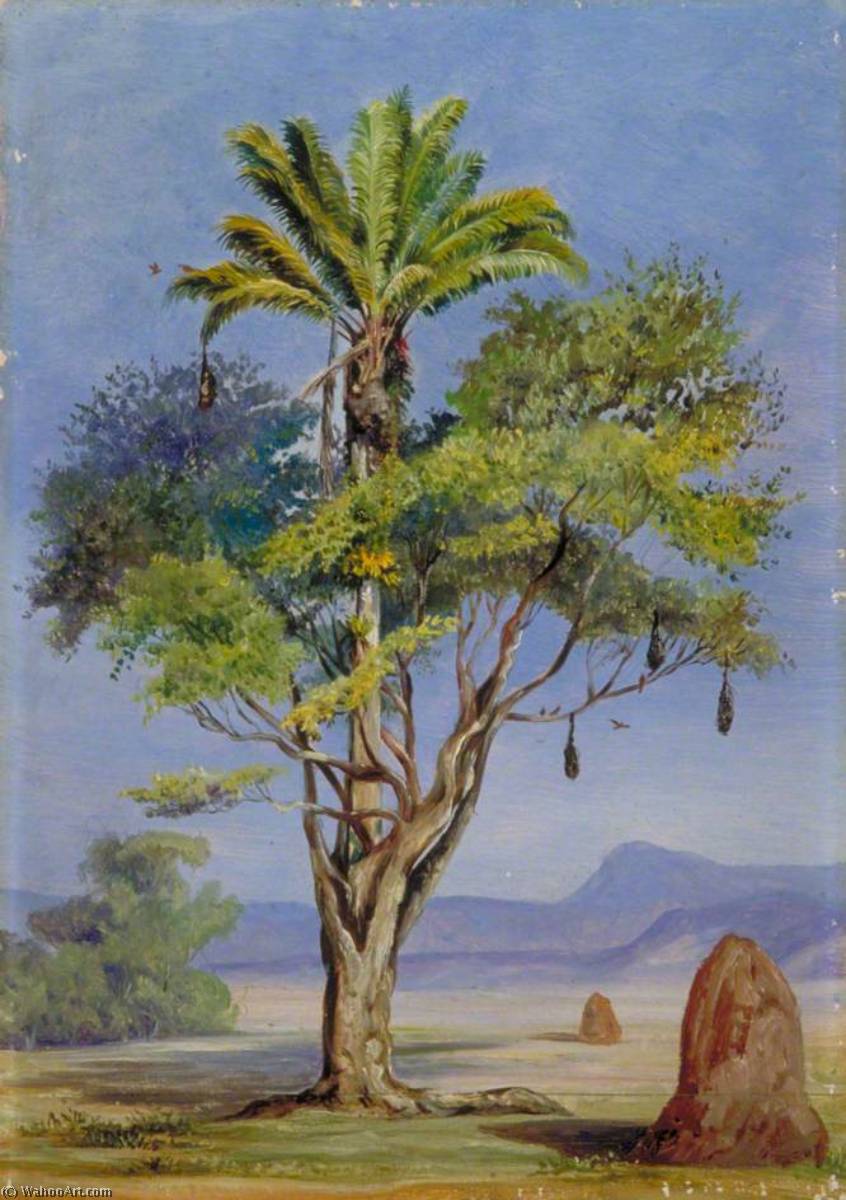
- “Scotchman Hugging a Creole”: This particular painting, “Scotchman Hugging a Creole,” exemplifies North’s artistic vision. Executed around 1873, it depicts a lush tropical landscape dominated by a colossal palm tree—a symbol of resilience and vitality—against a backdrop of rolling hills merging into hazy blue mountains.
The composition is vertically oriented, emphasizing the towering height of the palm tree and drawing the viewer’s gaze upwards. Foreground rocks provide grounding elements, while hanging sacks – likely representing provisions or offerings – subtly hint at human interaction with this untouched wilderness. Atmospheric perspective skillfully conveys distance, deepening the sense of tranquility and remoteness.
Beyond its visual beauty, “Scotchman Hugging a Creole” speaks to themes of conservation and wonder. North’s work reflects the Victorian fascination with scientific discovery alongside an ardent appreciation for the natural world—a sentiment that resonates powerfully today as we grapple with issues of biodiversity loss and climate change. Her meticulous rendering captures not just what was seen but also what was felt: a reverence for the sublime grandeur of nature.
The painting’s soft textures, created through delicate brushstrokes, contribute to its emotional impact—inviting contemplation and fostering an appreciation for the intricate beauty hidden within seemingly simple landscapes. It stands as a testament to Marianne North's extraordinary ability to transform observation into art, preserving a moment in time and conveying a timeless message of respect for our planet’s irreplaceable ecosystems.