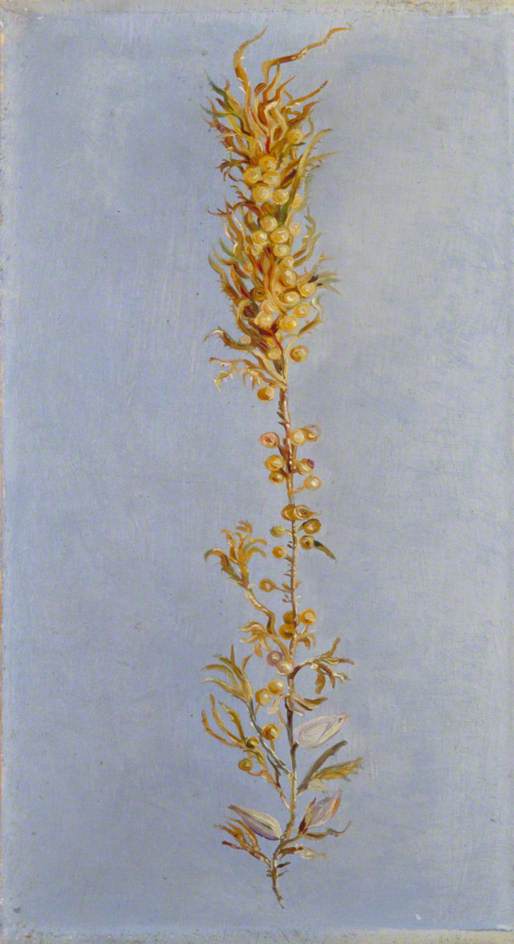
A vibrant oil painting by Victorian-era botanist Marianne North captures the exquisite detail of a yellow flower against a blue backdrop, showcasing her unique artistic style and adventurous spirit – discover this captivating artwork and bring its beauty into your home.
A Moment of Tropical Bloom: Marianne North’s ‘Study of Gulf Weed’
This exquisite study, measuring 26 x 12 cm, offers an intimate glimpse into the world of Marianne North, a truly remarkable figure of the Victorian era. Painted in 1870, ‘Study of Gulf Weed’ is more than just a botanical illustration; it's a testament to a life dedicated to fearless exploration and artistic passion. Created during a period when women were largely confined to domestic roles, North defied convention, embarking on an extraordinary global journey that transformed her into one of the most celebrated flower painters of her time.
- Subject Matter: The painting focuses intently on a vibrant yellow flower – identified as Gulf Weed – set against a calming blue background. This deliberate juxtaposition highlights the flower’s inherent beauty and draws the viewer's eye to its intricate details.
- Technique: Executed in oil paint, North’s masterful brushwork reveals a rich texture and depth, characteristic of her meticulous approach. The close-up perspective allows for an almost tactile appreciation of the flower’s velvety petals and delicate veins.
The Adventurous Spirit of Marianne North
Marianne North's life story is intrinsically linked to this artwork. Born in Hastings, England, in 1830, she initially pursued musical studies but faced health challenges that led her to discover a profound connection with the natural world through flower painting. This wasn’t simply a hobby; it was a radical act of self-determination. Driven by an insatiable curiosity and a desire for firsthand observation, North spent over three decades traveling extensively across Africa, South America, and Asia – often enduring arduous conditions and significant personal risk – to document the flora of these exotic regions. Her expeditions were not merely artistic pursuits; they were scientific endeavors, fueled by her meticulous botanical observations.
Symbolism and Victorian Context
The painting resonates deeply within the context of the Victorian era’s fascination with both natural history and exotic landscapes. The vibrant yellow flower – a color often associated with joy, optimism, and enlightenment – stands in stark contrast to the cool blue background, perhaps representing the serenity and vastness of the natural world. North's work reflects the Victorian spirit of exploration and scientific inquiry, aligning with the era’s growing interest in documenting and understanding the planet’s biodiversity. The fact that this piece was displayed at the Marianne North Gallery further underscores its significance within her legacy.
Emotional Impact and Artistic Value
'Study of Gulf Weed' possesses a quiet power, inviting contemplation and admiration for the beauty of the natural world. It is a poignant reminder of Marianne North’s unwavering spirit and dedication to her art. This hand-painted reproduction captures not only the visual details of the original but also the emotional resonance of North’s extraordinary life – a story of courage, independence, and an enduring love for the wonders of the botanical realm. Its small size belies the immense scope of its creator's journey and the profound impact of her work.