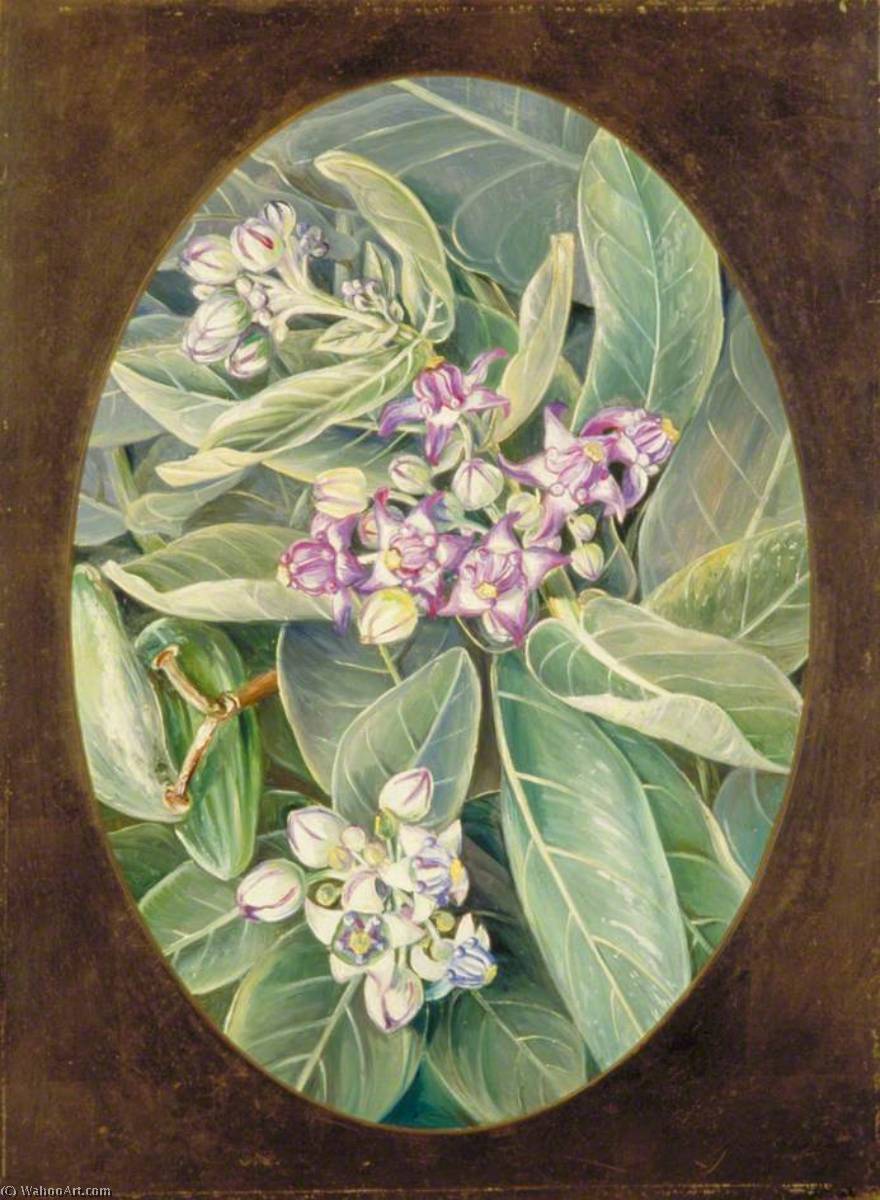
Admire Marianne North's stunning botanical painting 'The Akunda or Muda', showcasing vibrant purple flowers and lush green foliage. Explore Kew Gardens' gallery dedicated to her extraordinary legacy.
Discover Marianne North (1830-1890), a Victorian explorer & botanical artist who painted exotic flora worldwide. Her gallery at Kew Gardens showcases over 800 vibrant paintings – a testament to her adventurous spirit!
Discover the captivating world of Victorian botanical artist Marianne North at Kew Gardens! Explore over 800 vibrant paintings from her global travels, showcasing exotic plants and challenging artistic conventions.
The Akunda or Muda: A Botanical Symphony by Marianne North
Marianne North’s “The Akunda or Muda” isn't merely a painting; it’s a window into Victorian scientific curiosity blended seamlessly with artistic passion—a testament to a woman who defied societal expectations and dedicated her life to capturing the sublime beauty of the natural world. Completed around 1878, this oil on board masterpiece resides within the Marianne North Gallery in Richmond, Virginia, offering visitors an unparalleled opportunity to immerse themselves in the artist’s extraordinary vision.
Subject Matter & Composition
The painting depicts a vibrant plant specimen—likely a species endemic to Africa—characterized by striking purple flowers and lush green foliage. Its circular frame evokes the grandeur of a porthole or window, immediately establishing a connection between the viewer and the distant landscape depicted within. North’s meticulous attention to detail isn't simply decorative; it reflects her unwavering commitment to botanical accuracy – a cornerstone of Victorian scientific endeavor. The plant dominates the composition, its blossoms clustered at the apex, radiating outwards in an elegant spiral that draws the eye upwards. This deliberate arrangement underscores the artist’s fascination with patterns and forms found within nature.
Style & Technique: Realism Elevated
North's artistic style is firmly rooted in realism, yet transcends mere representation. She eschewed idealized depictions favored by many of her contemporaries, opting instead for a nuanced portrayal that captures the subtle textures and variations of color present in the plant itself. Her brushstrokes are confident and deliberate, conveying both precision and expressive energy. The artist skillfully employs chiaroscuro—the interplay of light and shadow—to sculpt the form of the plant and its surroundings, creating depth and dimensionality that invite contemplation. This technique elevates the painting beyond a simple botanical illustration, transforming it into an emotive experience for the observer.
Historical Context & Victorian Scientific Spirit
“The Akunda or Muda” emerged during the height of the Victorian era—a period marked by fervent exploration, scientific discovery, and a burgeoning appreciation for the natural world. Marianne North’s work embodies the spirit of this time, reflecting the influence of luminaries like Charles Darwin and Joseph Dalton Hooker who championed empirical observation as a path to understanding God's creation. The painting speaks to the Victorian fascination with exotic flora—species brought back from distant lands during expeditions—and serves as a visual record of scientific exploration. Furthermore, North’s decision to donate her extensive collection of paintings to Kew Gardens cemented her legacy as an advocate for botanical art and its role in furthering scientific knowledge.
Symbolism & Emotional Impact
Beyond its technical brilliance, “The Akunda or Muda” resonates with deeper symbolic meanings. The purple hue of the flowers—often associated with royalty, spirituality, and transformation—suggests a reverence for beauty and wonder. Simultaneously, the plant’s resilience—its ability to thrive in challenging environments—represents perseverance and adaptability. Viewing this artwork evokes feelings of tranquility, admiration, and connection to the natural world—a reminder that even within scientific precision lies an undeniable capacity for artistic expression and emotional resonance. It's a painting that invites us to pause, observe, and contemplate the extraordinary beauty hidden within the simplest forms of life.