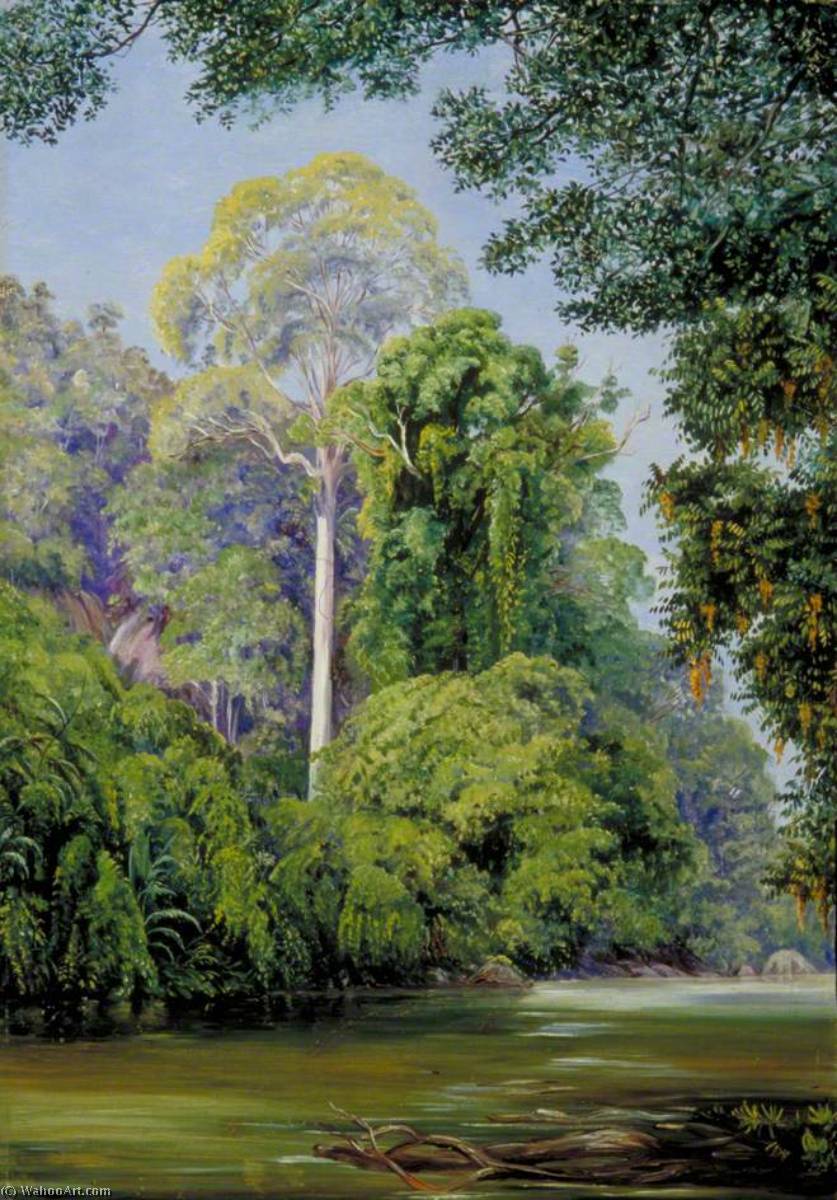
A Window into the Heart of Borneo: Marianne North’s “The Tapang Tree”
Marianne North’s “The Tapang Tree, Sarawak, Borneo,” painted in 1876, isn’t merely a depiction of a rainforest scene; it's an immersive experience, a meticulously crafted portal into the soul of Borneo. This remarkable work transcends simple botanical illustration, offering instead a profound meditation on nature’s grandeur and the Victorian fascination with the exotic. Painted during a period of intense exploration and scientific discovery, North’s painting reflects both the romantic ideals of the era – a yearning for the unknown and a belief in the inherent beauty of the natural world – and her own unwavering dedication to documenting its wonders.
The scene unfolds within a dense, almost claustrophobic jungle interior. Towering trees, their branches interwoven like grasping fingers, dominate the composition, creating a sense of both awe and slight unease. Sunlight filters through the canopy in dappled patterns, illuminating patches of vibrant foliage – ferns, orchids, and flowering vines – rendered with astonishing detail. A small river snakes its way through the undergrowth, reflecting the sky above and adding a vital element of movement to the otherwise static scene. The inclusion of a lone boat on the water hints at human presence within this wild landscape, subtly reminding us of our place as observers in nature’s domain.
The Artist: Marianne North – A Pioneer of Botanical Art
To fully appreciate “The Tapang Tree,” one must understand the extraordinary life of its creator. Marianne North (1830-1890) was a truly unique figure, a Victorian adventurer who defied societal expectations to become one of the most prolific botanical artists of her time. Rejecting the conventional role assigned to women of her era, she embarked on a remarkable series of expeditions across the globe – from the Himalayas to the Amazon – meticulously documenting and painting hundreds of plant species. Her travels were financed by the sale of her paintings, allowing her to pursue her passion without relying on patronage or marriage. North’s work wasn't simply about recording botanical specimens; she sought to capture their essence, their textures, and their relationship to their environment, creating vibrant and emotionally resonant images.
North’s artistic approach was revolutionary for its time. She eschewed the formal academic style prevalent in botanical illustration, favoring a looser, more painterly technique that prioritized atmosphere and feeling. Her use of color is particularly striking – rich, saturated hues that evoke the humid warmth of the rainforest. She employed a technique of layering glazes to build up depth and luminosity, creating an almost three-dimensional effect. The painting’s composition, with its dramatic lighting and dynamic arrangement of elements, further enhances this sense of immediacy and immersion.
Symbolism and Context: Borneo in the 19th Century
“The Tapang Tree” is deeply rooted in the context of 19th-century exploration and colonialism. Borneo, then a territory divided between British and Dutch interests, was undergoing rapid change as European powers sought to exploit its natural resources – particularly timber and oil. North’s work reflects both the excitement and the anxieties associated with this period of expansion. The painting can be interpreted as a celebration of Borneo's biodiversity, but also as a subtle commentary on the potential consequences of unchecked exploitation. The “Tapang Tree” itself (likely a species of *Hopea*), is a significant element – its name referencing the resinous sap used for waterproofing and traditional crafts, symbolizing the island’s rich cultural heritage.
Furthermore, North's meticulous documentation aligns with the broader scientific movement of the time. Botanists were increasingly interested in classifying and cataloging plant species, driven by a desire to understand the natural world and its interconnectedness. North’s paintings served not only as artistic expressions but also as valuable scientific records, contributing significantly to our knowledge of Borneo's flora.
A Legacy of Beauty: Reproductions and Inspiration
Today, “The Tapang Tree” stands as a testament to Marianne North’s extraordinary vision and artistic skill. High-quality reproductions capture the painting’s vibrant colors and intricate details, allowing viewers to experience its beauty and wonder firsthand. Whether displayed in a private home or a public gallery, this artwork evokes a sense of connection with nature, reminding us of the importance of conservation and the enduring power of art to inspire awe and appreciation.