A Victorian Explorer's Vibrant Vision
Marianne North’s “Unidentified Plants,” painted in 1880, isn’t merely a botanical illustration; it’s a vibrant testament to a woman’s audacious spirit and her profound connection with the natural world. Born into privilege in Hastings, England, Marianne defied societal expectations of her time, embarking on a decades-long journey that took her across continents – from the humid jungles of Borneo to the sun-drenched landscapes of Brazil, and even to the remote corners of Australia. This particular painting captures a moment within that extraordinary odyssey, a snapshot of botanical discovery rendered with an almost feverish intensity of color and detail.
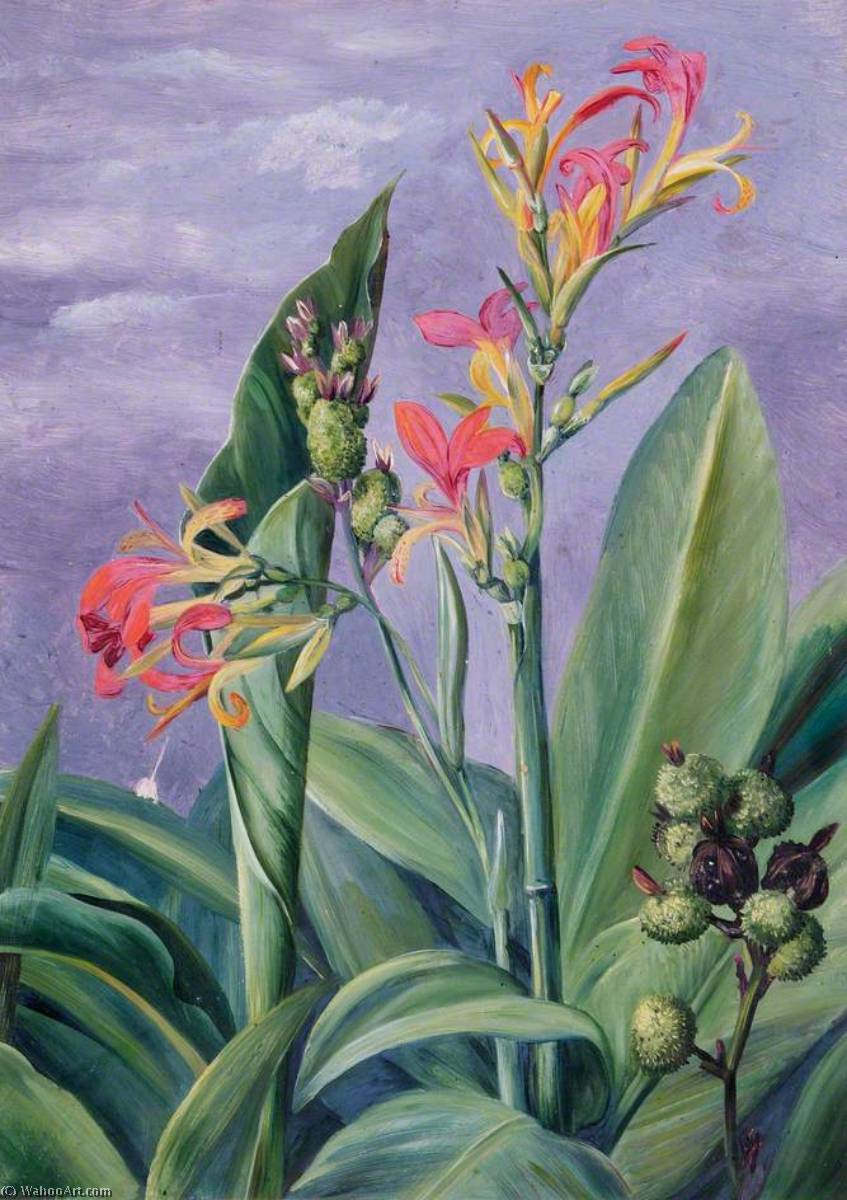
The scene unfolds as a rich tapestry of life – two prominent flowers dominate the composition, their stems reaching upwards like elegant dancers, while a multitude of smaller buds, berries, and leaves create a sense of abundant growth. Notice the meticulous rendering of each leaf’s texture, the delicate veins visible beneath the surface, and the subtle variations in color that suggest the plant's individual character. This isn’t a sterile scientific depiction; it’s an immersive experience, inviting the viewer to step into the heart of this vibrant ecosystem.
The Artistry of a Pioneer
North’s technique is remarkably distinctive. Trained initially as a vocalist, she turned to painting flowers after her voice failed, and quickly developed a unique style that blended elements of Pre-Raphaelite romanticism with the precision demanded by botanical illustration. She eschewed the conventional watercolor palettes favored by many of her contemporaries, opting instead for bold, saturated oils on cardboard – a medium that allowed her to achieve an unparalleled luminosity and depth of color. The brushstrokes are loose and expressive, conveying not just the appearance of the plants but also their vitality and energy.
Crucially, North wasn’t simply copying what she saw; she was actively engaged in scientific observation. She meticulously documented each specimen, often collecting seeds and pressing them for later study. Her travels were driven by a genuine desire to expand Western knowledge of the plant kingdom, and her paintings served as invaluable records of flora previously unknown to European science. The inclusion of smaller details – insects, fungi, even the subtle patterns on bark – speaks to this holistic approach, illustrating the interconnectedness of all living things.
Symbolism and a Woman’s Journey
“Unidentified Plants” is more than just a record of botanical diversity; it's also a reflection of Marianne North’s personal journey. Her decision to travel alone, unsupported by a husband or male companion, was radical for the Victorian era. She deliberately chose a life of independence and adventure, challenging societal norms and forging her own path. The painting can be interpreted as a symbol of this defiant spirit – a celebration of female agency and intellectual curiosity.
Furthermore, the vibrant colors and lush foliage evoke a sense of exoticism and wonder, mirroring North’s own fascination with distant lands and unfamiliar cultures. The composition itself is carefully balanced, drawing the eye across the image and creating a feeling of harmonious abundance. The soft blue background provides a calming contrast to the riot of color in the foreground, suggesting both the vastness of the natural world and the artist's ability to capture its essence.
A Legacy Preserved
Today, “Unidentified Plants” resides within the Royal Botanic Gardens, Kew, housed in Marianne North’s own gallery – a testament to her extraordinary life and legacy. Reproductions of this captivating artwork continue to inspire collectors and interior designers alike, offering a glimpse into a bygone era of scientific exploration and artistic innovation. Its vibrant colors and intricate details bring a touch of the exotic to any space, while its story serves as a reminder of a remarkable woman who dared to defy convention and pursue her passions with unwavering determination.