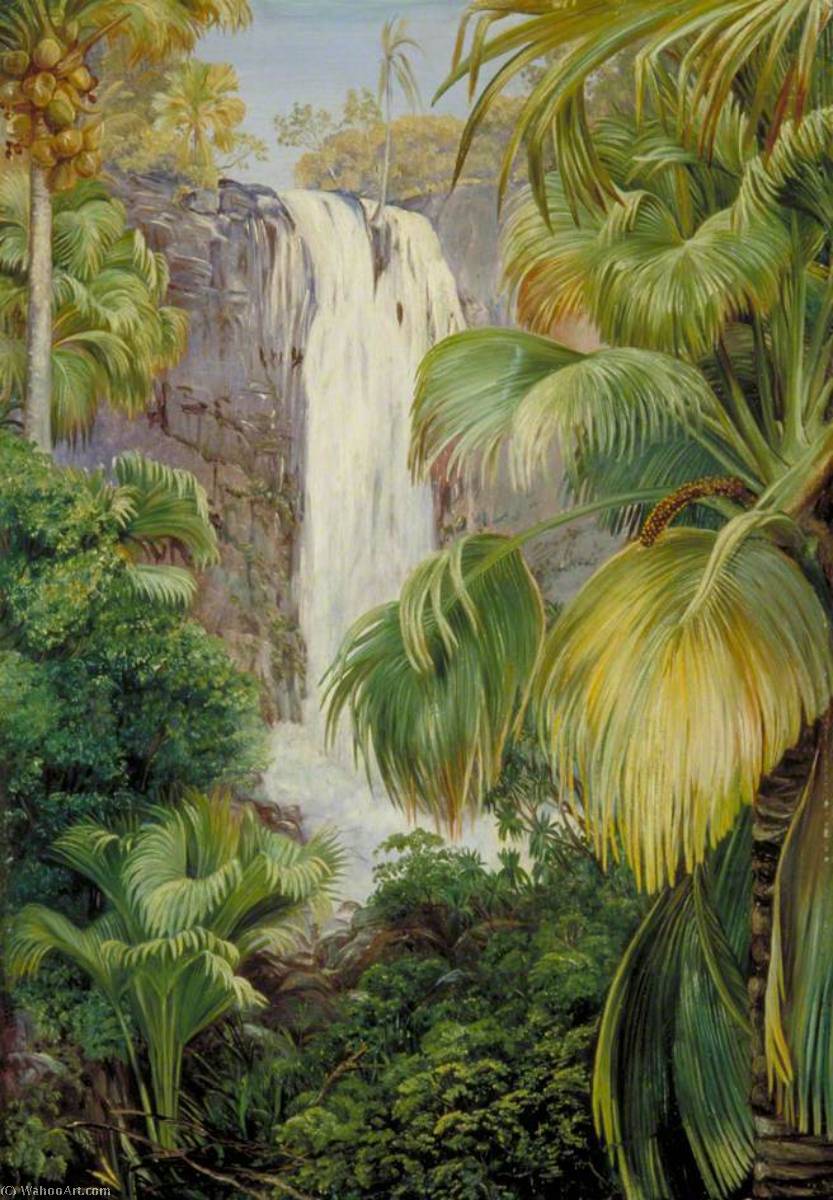
A Victorian Explorer's Ode to Paradise Lost – Marianne North’s “Waterfall in the Gorge of the Coco de Mer”
Marianne North (1830–1890), a woman remarkably ahead of her time, defied societal expectations and embarked on an extraordinary journey fueled by both scientific curiosity and artistic passion. Born into a comfortable English family, she eschewed the conventional path laid out for women of her era, choosing instead to immerse herself in the pursuit of knowledge and beauty—a decision that would ultimately yield one of the most stunning collections of botanical paintings ever assembled.
"Waterfall in the Gorge of the Coco de Mer," painted circa 1883, exemplifies North’s singular approach. It's not merely a depiction of a tropical landscape; it’s an embodiment of Victorian Romanticism’s fascination with untamed wilderness and its yearning for sublime grandeur. Located at Kew Gardens—where she established her own gallery showcasing over 800 canvases—the painting captures the dramatic cascade of a waterfall plunging into a verdant gorge dominated by the Coco de Mer palm, endemic to Praslin Island in Seychelles.
Style & Technique: Impressionistic Detail
North’s artistic style leans heavily toward Impressionism, albeit infused with meticulous observation. Unlike many Impressionists who prioritized capturing fleeting moments of light and atmosphere, North painstakingly rendered every leaf, petal, and ripple of water. Her technique involved layering thin glazes of pigment—primarily greens, blues, and browns—to build up depth and luminosity. This painstaking process resulted in canvases that shimmer with an almost palpable vibrancy, conveying not just what the eye sees but also what it feels.
Historical Context: Victorian Science Meets Artistic Vision
The painting emerged during a period of significant scientific advancement – Darwin’s theory of evolution was reshaping understandings of the natural world. Simultaneously, Romanticism championed emotion and imagination as pathways to spiritual insight. North skillfully blended these influences, elevating botanical illustration beyond mere documentation into an expressive art form. Her work challenged prevailing artistic conventions by prioritizing accuracy alongside aesthetic beauty—a testament to her conviction that scientific observation could inspire profound artistic creativity.
Symbolism: Echoes of Eden
"Waterfall in the Gorge of the Coco de Mer" resonates with biblical symbolism, referencing the Garden of Eden – a paradise lost. The waterfall represents the flow of life and renewal, while the lush foliage symbolizes abundance and fertility. However, North’s portrayal isn't simply idyllic; there’s an underlying tension between beauty and decay. The weathered trunks of trees hint at the passage of time and the inevitable forces shaping the natural world—a subtle reminder that even paradise is subject to change.
Emotional Impact: Tranquility Amidst Complexity
Despite its intricate detail, “Waterfall in the Gorge of the Coco de Mer” possesses a remarkable serenity. The artist’s masterful use of color and composition draws the viewer into a contemplative space—one where the grandeur of nature inspires awe and invites reflection. It's a painting that speaks to our innate desire for connection with the natural world, capturing not just its visual splendor but also its profound emotional resonance. A reproduction of this masterpiece would undoubtedly bring a touch of Victorian Romanticism’s spirit into any interior design scheme.