The Genesis of a Visionary: Marianne von Werefkin and “Evening in Murnau”
Marianne von Werefkin, a name often relegated to the footnotes of Expressionist history, nevertheless stands as a pivotal figure in the movement’s early development. Born Mariamna Wladimirowna Werewkina in Tula, Russia, in 1860, her artistic journey was one defined by relentless exploration, profound personal sacrifice, and an unwavering dedication to capturing the inner world through vibrant color and emotive form. Her life unfolded against a backdrop of immense social upheaval – the waning days of Tsarist Russia, followed by the turbulent years of the early 20th century – shaping her artistic vision into something uniquely powerful and deeply felt. “Evening in Murnau,” painted in 1910, isn’t merely a landscape; it's a distilled essence of Werefkin’s soul, a testament to her evolving style and a window into the emotional currents that defined her work.

A Symphony of Color and Light: Artistic Technique
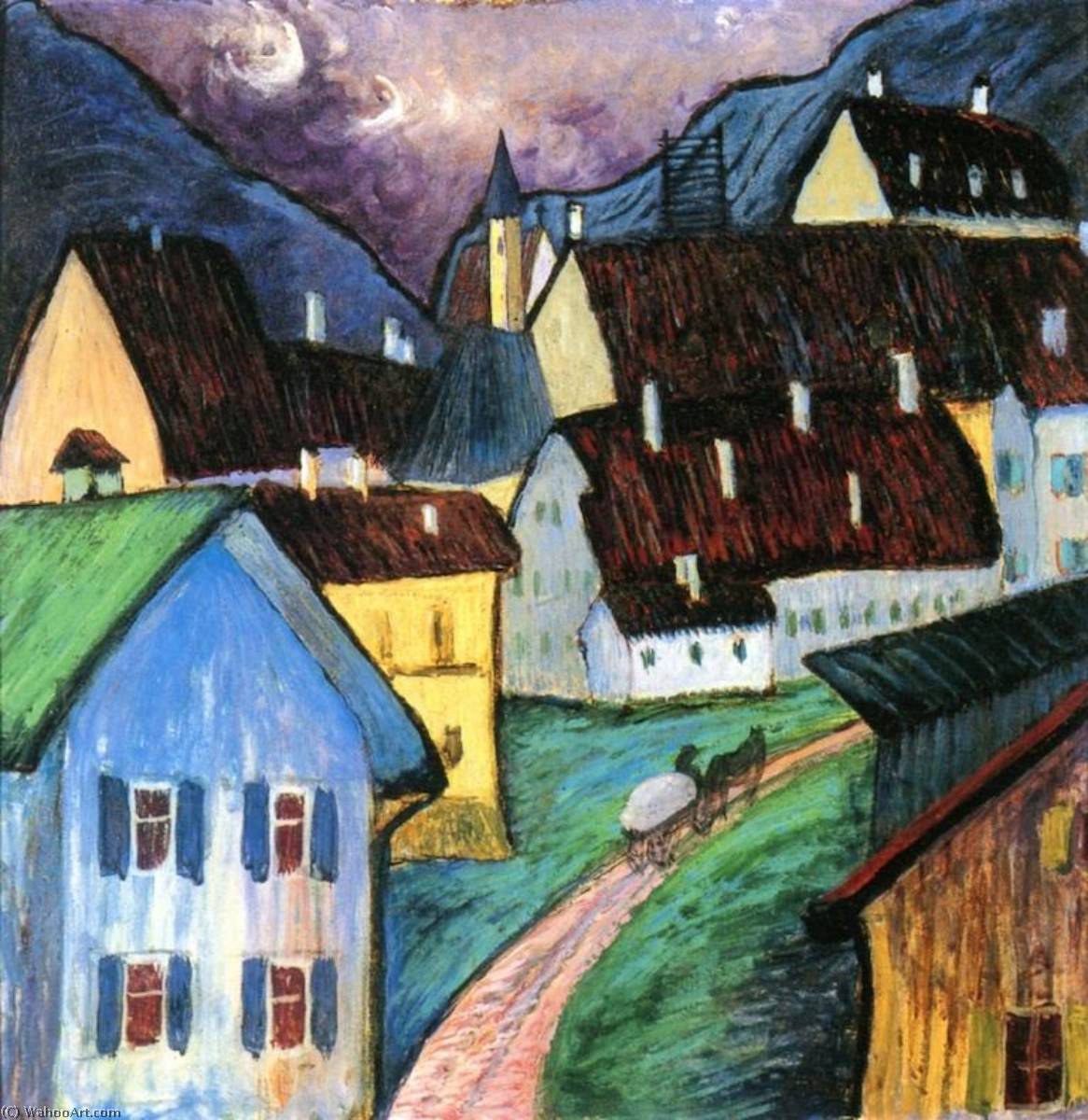
“Evening in Murnau” is a masterful example of Werefkin’s distinctive approach to tempera on cardboard. She eschewed the meticulous detail favored by some of her contemporaries, opting instead for bold, expressive brushstrokes and an almost Fauvist-like intensity of color. The village nestled within the hills isn't rendered with photographic accuracy; rather, it exists as a collection of luminous blocks – deep blues and purples dominate the sky, contrasting sharply with the fiery reds and yellows that blaze across the rooftops and buildings below. The use of complementary colors creates a dynamic tension, drawing the eye through the composition and imbuing the scene with an almost palpable energy. Notice how she employs thick impasto, building up layers of paint to create texture and depth, particularly in the suggestion of the distant mountains – these aren’t simply sketched in; they are sculpted with color and light, radiating a sense of immense scale and timelessness. The horse, centrally positioned, is rendered with simplified forms, contributing to the overall dreamlike quality of the scene.
The Echoes of Murnau: Historical Context and Symbolism
Painted in 1910, “Evening in Murnau” was created during a period of intense personal and artistic transformation for Werefkin. She had relocated to Murnau am Inn, Bavaria, seeking respite from the pressures of Munich and a connection with the landscape that profoundly influenced her work. The village itself held a particular significance – it became a recurring subject in her paintings, representing a sanctuary, a place of contemplation, and a reflection of her own inner state. The warm, inviting glow of the evening light suggests a sense of peace and tranquility, yet there’s also an underlying current of melancholy—a subtle hint of isolation and longing. The presence of the horse could be interpreted as a symbol of strength, endurance, or perhaps even vulnerability, depending on the viewer's perspective. The village nestled amongst the hills evokes a feeling of timelessness, a connection to rural life that resonated deeply with Werefkin’s own roots in Russia.
Beyond Representation: Emotional Resonance
“Evening in Murnau” is more than just a depiction of a Bavarian village; it's an exploration of the human condition. Werefkin wasn’t interested in simply replicating what she saw; she sought to convey *how* she felt, translating her inner experiences into visual form. The painting possesses a haunting beauty—a captivating blend of serenity and unease. It invites us to step into the scene, to feel the warmth of the evening sun on our skin, and to contemplate the mysteries of life and death. Reproductions capture this essence remarkably well, allowing viewers to experience Werefkin’s vision in their own homes. The vibrant colors and expressive brushstrokes create a powerful emotional impact, reminding us of the enduring power of art to connect us with something larger than ourselves.