A Tapestry of Line and Legacy
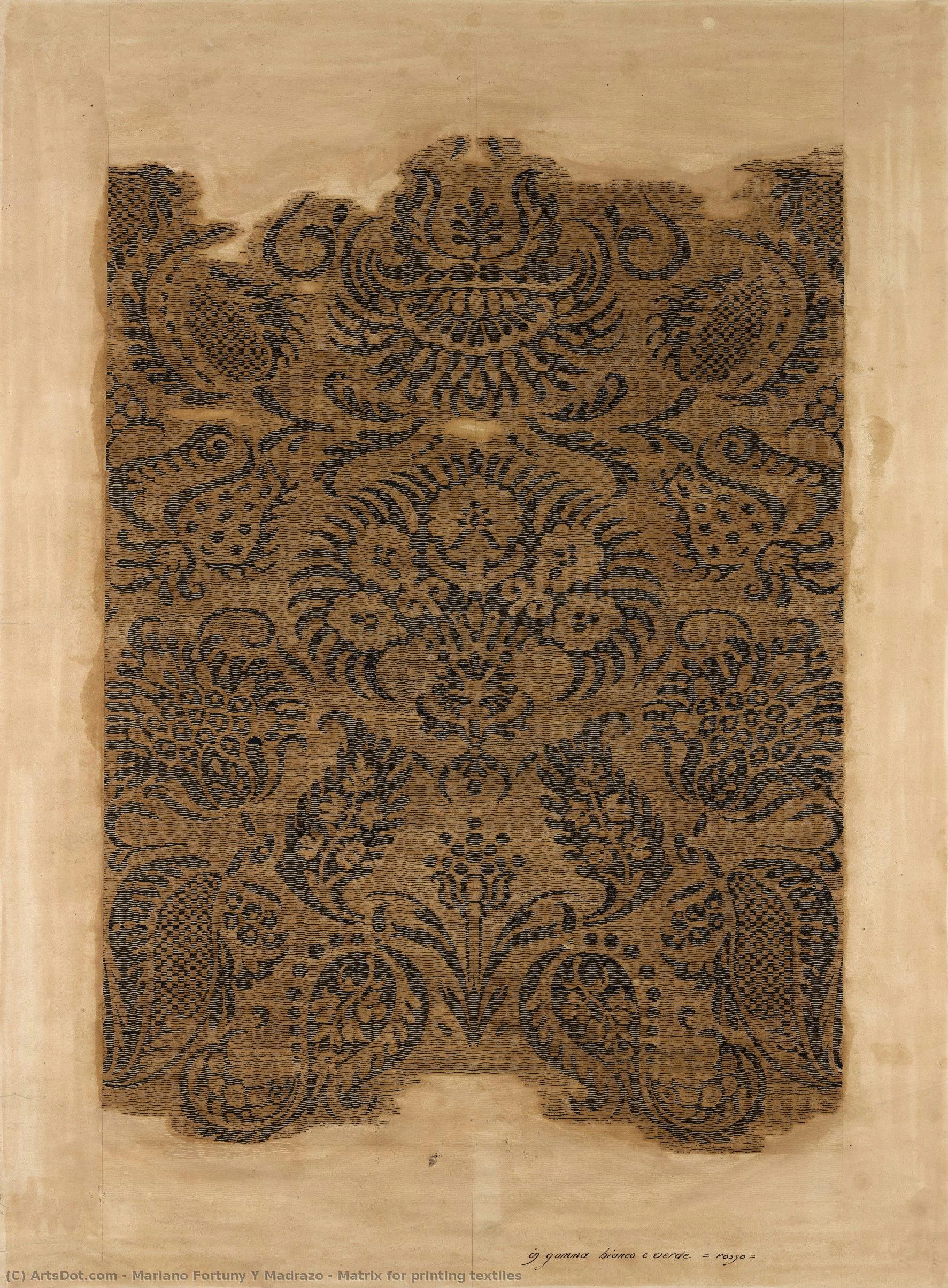
In the delicate intersection of fine art and industrial design lies Mariano Fortuny y Madrazo’s 1910 masterpiece, Matrix for printing textiles. This slender, elongated work, measuring a striking 7 x 63 cm, serves as a profound window into the mind of a true polymath. Created during a period when Fortuny was deeply immersed in the textures and traditions of Venice, this pencil drawing on paper transcends its utilitarian purpose as a template for fabric production. It is, instead, a rhythmic dance of graphite, where every stroke carries the weight of a legacy built upon both Spanish passion and Venetian elegance. The piece captures a moment of pure creative intention, frozen in time through a monochromatic lens that emphasizes the structural beauty of his vision.
The composition is an intricate ballet of organic forms and structured ornamentation. Within its narrow frame, one discovers a breathtakingly detailed floral motif that winds through the space like a living vine. Interspersed among these botanical elements are several birds, captured in mid-motion or poised in quiet contemplation, adding a sense of life and narrative depth to the pattern. The technique is remarkably precise; the use of pencil allows for a delicate variation in pressure, creating a play of light and shadow that gives the flat design a sculptural quality. For the discerning collector or interior designer, this work offers a masterclass in how repetitive patterns can achieve a sense of infinite movement and grace.
The Soul of Venetian Innovation
To understand the emotional resonance of this matrix, one must look to the life of Fortuny himself. Born in Granada but forever wedded to the light of Venice, Fortuny possessed a rare ability to bridge the gap between the ephemeral beauty of nature and the tangible world of decorative arts. This drawing is not merely a blueprint; it is an embodiment of his philosophy that art should permeate every aspect of daily life, from the walls of a palazzo to the very fabric worn against the skin. The historical context of 1910—a time of burgeoning modernism yet deep reverence for classical craftsmanship—is palpable in the way the design balances structured symmetry with the wild, unpredictable beauty of the natural world.
For those seeking to bring a sense of historical sophistication into a contemporary space, a high-quality reproduction of this work offers more than just decoration; it offers an atmosphere. The Matrix for printing textiles evokes a sense of timelessness and quiet luxury. Its elongated format makes it an ideal statement piece for narrow architectural features, providing a sophisticated focal point that invites the eye to wander through its intricate details. Whether placed in a curated gallery setting or used as a subtle accent in a modern interior, this work remains a testament to the enduring power of Fortuny’s vision—a vision where every line is a heartbeat and every pattern is a story waiting to be told.