The Genesis of a Color Field: Mark Rothko’s *Green and Tangerine on Red*
Mark Rothko's *Green and Tangerine on Red*, painted in 1956, isn’t merely a painting; it’s an immersion. Born Markus Yakovlevich Rothkowitz in Dvinsk, Latvia, in 1903, his early life was steeped in the anxieties of a Jewish family navigating a turbulent landscape—a formative experience that would profoundly shape his artistic vision. This sense of displacement and emotional depth became the bedrock of his work, seeking to distill human experience into its purest form. The painting emerged during a pivotal moment in Rothko’s career, aligning with his exploration of Color Field painting – a movement that rejected traditional representational art in favor of expansive fields of color designed to evoke profound emotional responses. It's a testament to the power of abstraction to bypass intellectual analysis and speak directly to the viewer’s soul.
A Symphony of Hue: Composition and Technique
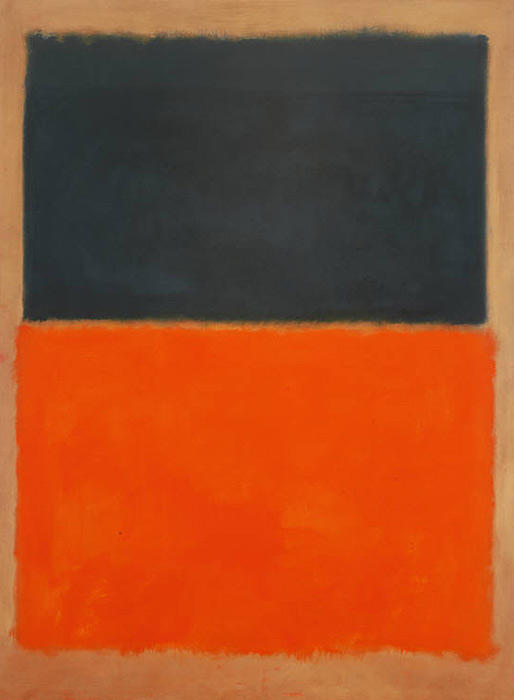
At first glance, *Green and Tangerine on Red* appears deceptively simple – two vast rectangles dominating the canvas. One, a deep, resonant green; the other, a vibrant tangerine, set against a field of crimson red. However, this apparent simplicity belies an intricate layering of techniques. Rothko didn’t employ brushstrokes in the traditional sense. Instead, he built up layers of translucent paint, often rubbing them together with rags to create subtle shifts in tone and luminosity. This process resulted in a remarkably smooth surface, almost velvety to the touch – a deliberate choice intended to dissolve the boundaries between the colors and create an illusion of depth and movement. The edges of these rectangles are deliberately soft and undefined, blurring the lines between form and color, contributing to the painting’s ethereal quality. The careful balance of hues—the coolness of green against the warmth of tangerine and the intensity of red—creates a dynamic tension that draws the eye across the canvas.
Decoding the Emotional Landscape
Rothko himself resisted categorization, refusing to label his work as “Color Field.” He insisted it was about capturing the essence of human experience – both its moments of joy and sorrow. *Green and Tangerine on Red* is often interpreted as a meditation on duality: the interplay between hope and despair, light and darkness. The vibrant orange rectangle can be seen as representing the brighter aspects of life—a fleeting moment of happiness or connection—while the darker green and red suggest the underlying anxieties and uncertainties that inevitably accompany existence. The painting’s power lies in its ability to evoke a visceral response – a feeling of melancholy, contemplation, or even transcendence. It's not about depicting a specific scene but rather conveying an intangible emotional state.
A Legacy Preserved: The Phillips Collection and Beyond
Currently residing at the Phillips Collection in Washington D.C., *Green and Tangerine on Red* stands as one of Rothko’s most iconic works, embodying his mature style and philosophical approach to art. The painting's journey reflects its enduring significance; it was initially intended for the Seagram Murals but ultimately rejected by Rothko due to concerns about its commercialization. It has since been exhibited globally, captivating audiences with its profound emotional resonance. Reproductions of this masterpiece are available through ArtsDot.com, offering a way to bring this powerful work into your own space and experience its evocative beauty firsthand. Its continued presence in museums and private collections ensures that Rothko’s legacy as one of the 20th century's most influential artists will endure for generations to come.