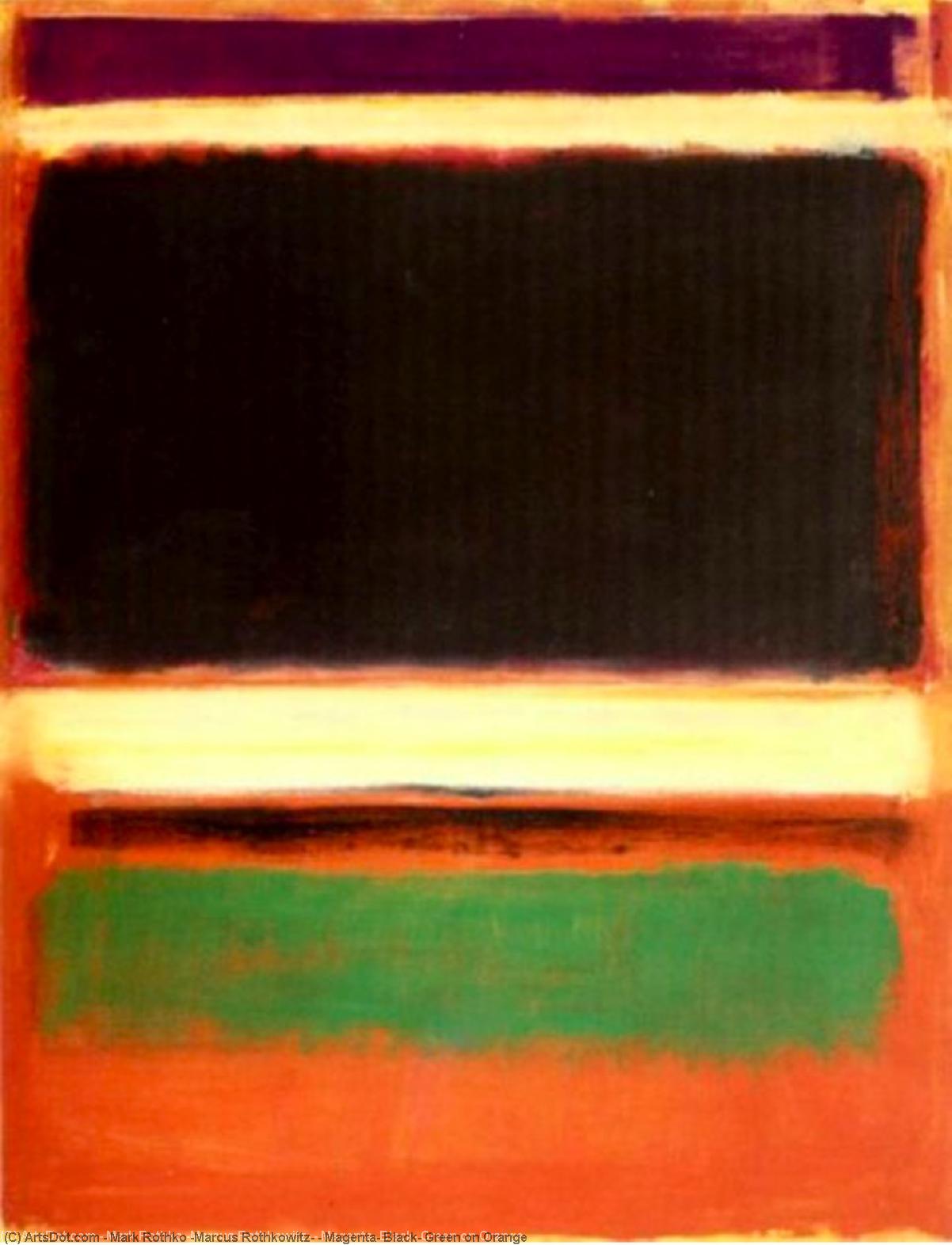
Magenta, Black, Green on Orange
Mark Rothko’s Magenta, Black, Green on Orange stands as a cornerstone of Color Field painting and Abstract Expressionism—a movement that irrevocably altered the landscape of 20th-century art.
Created in 1949, this monumental canvas embodies Rothko’s profound philosophical approach to artistic creation. More than just pigment on canvas; it's an attempt to convey fundamental human emotions – ecstasy and doom—as Rothko himself eloquently stated. The artist meticulously considered each hue, selecting them not merely for visual appeal but for their capacity to elicit a visceral response from the viewer.
Color Field Painting and Abstract Expressionism
Magenta, Black, Green on Orange exemplifies Color Field painting, which emerged in New York City during the 1940s and 1950s. Inspired by European modernism—particularly the canvases of Wassily Kandinsky—and closely allied with Abstract Expressionism, this style championed spontaneity and emotion over representational accuracy.
Early proponents like Jackson Pollock and Willem de Kooning rejected traditional artistic conventions, prioritizing gesture and process as expressions of inner turmoil. Rothko’s method mirrored theirs: he applied thin washes of color to the canvas in layers, allowing subtle variations in tone and texture to emerge organically.
Analysis of Magenta, Black, Green on Orange
The painting's striking composition features three rectangular blocks of magenta, black, and green—each hovering against a vibrant orange background. These forms are deliberately ambiguous, resisting precise definition and inviting contemplation. The subtle gradations within each rectangle create an illusion of depth and spatial tension.
Rothko’s masterful use of color is paramount to understanding the artwork's impact. The magenta and green rectangles seem to float effortlessly on the surface, while the black rectangle recedes into the background—a technique that Rothko termed “absorption.” This creates a mesmerizing interplay between luminous color and impenetrable darkness.
Handmade Oil Painting Reproductions
ArtsDot offers exceptional reproductions of Magenta, Black, Green on Orange—allowing art enthusiasts to experience Rothko’s vision in their own homes.
These reproductions are crafted by skilled artisans using archival-quality pigments and techniques that faithfully capture the original painting's nuances. They represent a beautiful opportunity to bring a masterpiece into your space.
- Rothko’s deliberate avoidance of recognizable imagery underscores his belief that art should transcend superficial appearances, tapping into universal human experience.
- The rectangular color forms—a hallmark of Rothko’s style—are designed to evoke feelings of serenity and contemplation.
As a testament to Rothko's innovative approach to art and his ability to communicate profound emotion through color and form, Magenta, Black, Green on Orange continues to inspire artists and captivate audiences worldwide.