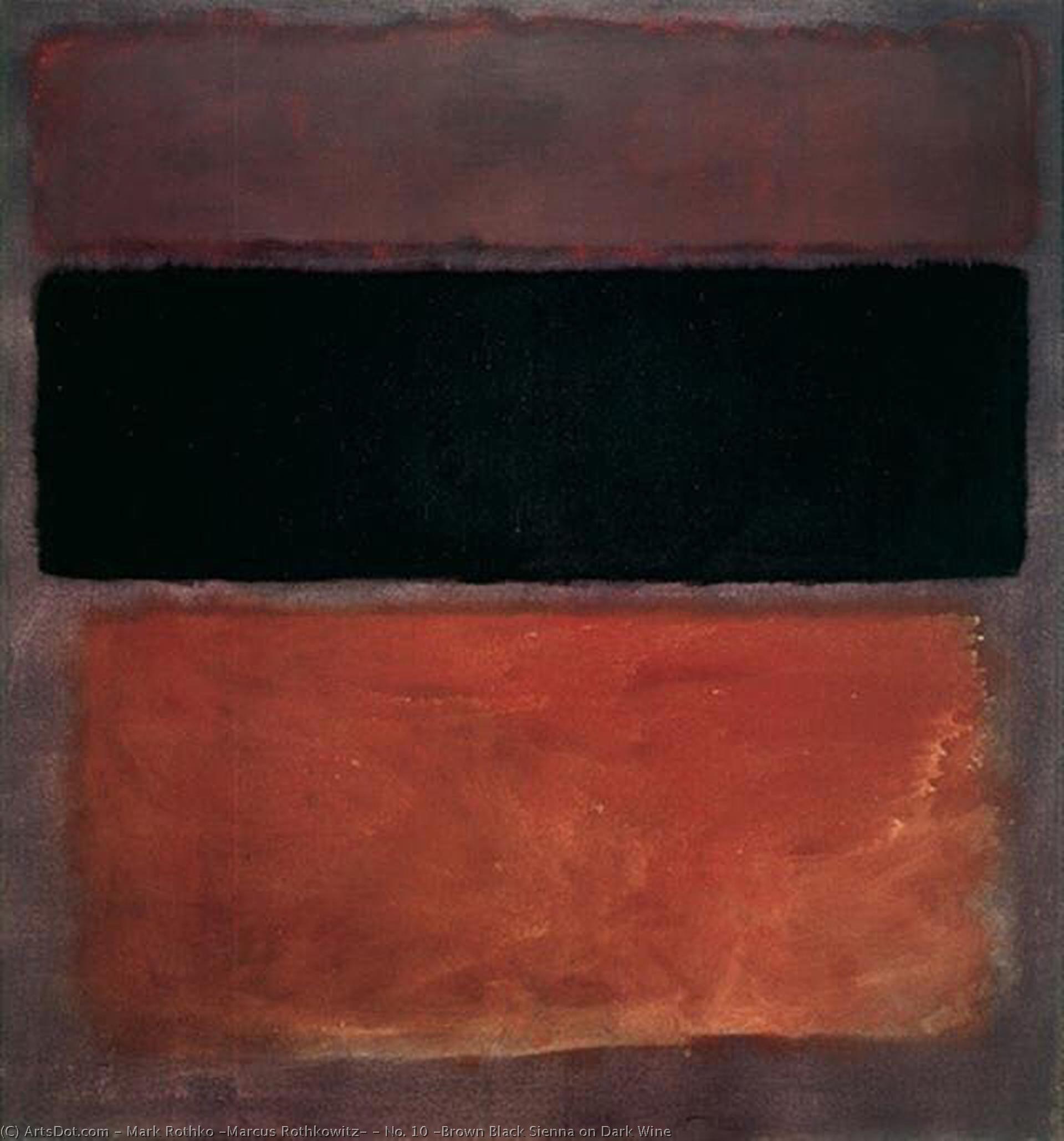
Explore Mark Rothko's masterpiece, No. 10 (Brown Black Sienna on Dark Wine), a seminal Abstract Expressionist painting celebrated for its meditative color fields and profound emotional resonance.
Explore Mark Rothko's (1903-1970) iconic Color Field paintings & Abstract Expressionism. Discover the emotional depth & lasting impact of this pivotal modern artist.
The Luminous Void: An Encounter with Rothko’s No. 10
To stand before Mark Rothko’s No. 10 (Brown Black Sienna on Dark Wine) is to step away from the frantic pace of the modern world and enter a space of profound, silent contemplation. Painted in 1958, this masterpiece does not merely sit upon the canvas; it breathes. The composition is defined by its verticality, where large, rectangular fields of color appear to hover and vibrate against a dark, atmospheric background. A deep, wine-colored red anchors the top and bottom of the frame, sandwiching a central band of textured black that seems to pull the viewer into an infinite depth. There is no subject in the traditional sense—no landscape to recognize or figure to admire—only the raw, unadulterated presence of color and light.
The Alchemy of Layered Emotion
The true magic of this work lies in Rothko’s meticulous technique, a process of building luminosity through thin, translucent washes of pigment. By layering shades of sienna, brown, and black, the artist achieves a velvety texture that catches the light in unexpected ways. The middle black rectangle, more heavily textured than its surrounding companions, suggests a weightiness, an anchor of shadow amidst the glowing reds. This interplay between the smooth, saturated edges and the more tactile, opaque center creates a sense of movement, as if the colors are slowly undulating. For the collector or interior designer, this piece offers a unique architectural quality; it possesses a gravity that can transform a room into a sanctuary, providing a focal point that is both commanding and deeply soothing.
A Window into the Sublime
Beyond its visual splendor, No. 10 serves as a vessel for the existential themes that defined the Abstract Expressionist movement. Rothko, an artist whose life was shaped by the complexities of displacement and loss, sought to use color as a language for the human condition—to capture grief, ecstasy, and the sublime. The earthy palette of sienna and dark wine evokes the primordial, connecting the viewer to something ancient and elemental. In an era of increasing fragmentation, this painting offers a rare moment of unity and spiritual resonance. It is more than a mere decoration; it is an invitation to immerse oneself in the infinite, making a high-quality reproduction not just an acquisition of art, but an acquisition of peace.