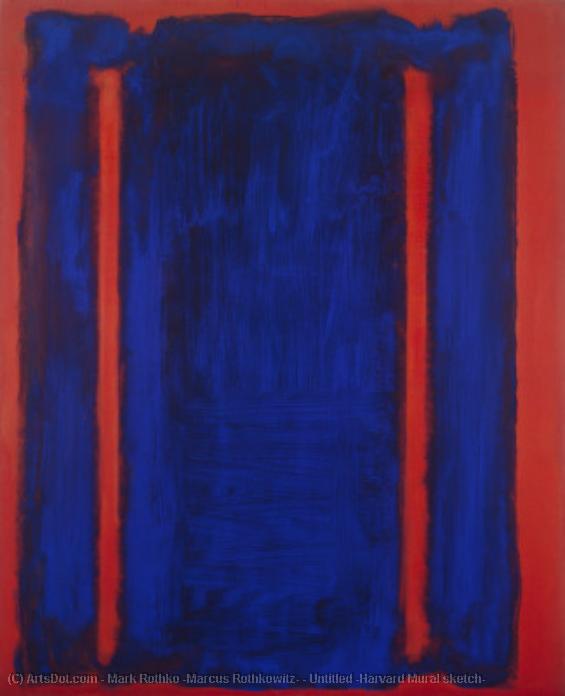
This untitled Harvard mural sketch embodies Mark Rothko's distinctive approach to abstraction, prioritizing form and line over color. Created in 1962 for a collaborative project with Harvard University, it’s a testament to his exploration of existential themes through simplified geometric shapes—a captivating glimpse into Rothko’s artistic vision.
Explore Mark Rothko's (1903-1970) iconic Color Field paintings & Abstract Expressionism. Discover the emotional depth & lasting impact of this pivotal modern artist.
A Crimson Doorway into Emotion: Examining Mark Rothko’s Untitled (Harvard Mural Sketch)
Mark Rothko's exploration of color and form transcends mere visual representation, delving into the realm of psychological experience. This unassuming sketch—designated “Untitled (Harvard Mural Sketch)”—offers a glimpse into the genesis of one of his most iconic murals, revealing a foundational preoccupation with distilling emotion onto canvas through reductive abstraction. Created in 1962 during a period marked by intense introspection and artistic experimentation, it exemplifies Rothko’s unwavering commitment to conveying profound feelings without resorting to figurative imagery.
The Essence of Minimalism: Line and Color's Dialogue
Rothko’s approach to painting is famously characterized as “minimalist,” prioritizing the elemental qualities of color and line over detailed depiction. As evidenced in this sketch, he eschews representational concerns entirely, opting instead for loose, gestural lines on cream paper—a deliberate choice designed to capture the immediacy of his creative process. The monochromatic palette—primarily shades of beige—serves as a grounding counterpoint to the vibrant hues that would dominate his monumental murals, highlighting the artist’s focus on capturing pure emotional resonance. This sketch isn't merely preparatory; it embodies Rothko’s core artistic philosophy – to reduce painting to its most fundamental elements and allow color to speak for itself.
Symbolism Rooted in Existential Concerns
The Harvard Mural project—a collaborative effort with Christopher Rothko and Kate Rothko Prizel—was conceived as a response to the anxieties of the Cold War era, reflecting broader meditations on mortality and human condition. Rothko’s sketches like “Untitled (Harvard Mural Sketch)” are imbued with symbolic significance, mirroring the artist's desire to confront viewers with uncomfortable truths about existence. The red door itself – a recurring motif in Rothko’s work – represents not just physical structure but also a gateway into contemplation and emotional vulnerability. Its stark simplicity underscores the idea that profound experience can be found within the most unassuming forms.
Technique: Layered Gesture and Subtle Texture
Rothko's technique involved applying paint in thin, overlapping layers—a process he termed “layered gesture.” This method allowed him to build up tonal variations gradually, creating a palpable sense of depth and texture without resorting to brushstrokes visible to the naked eye. The sketch captures this characteristic approach perfectly, demonstrating Rothko’s meticulous attention to detail as he honed his vision for the mural's final composition. The subtle sheen on the paper—a result of the artist’s layering technique—adds another dimension to the artwork, inviting viewers to consider not only color but also surface materiality.
A Legacy of Emotional Resonance
“Untitled (Harvard Mural Sketch)” stands as a testament to Mark Rothko's enduring influence on abstract expressionism and beyond. It serves as an invaluable insight into his creative process—a reminder that art’s power lies in its ability to evoke emotion and provoke contemplation. Reproductions of this sketch offer collectors and interior designers alike the opportunity to experience firsthand the profound beauty and intellectual depth of Rothko's vision, transporting them into a space defined by stillness, color, and an unwavering commitment to conveying the human spirit.