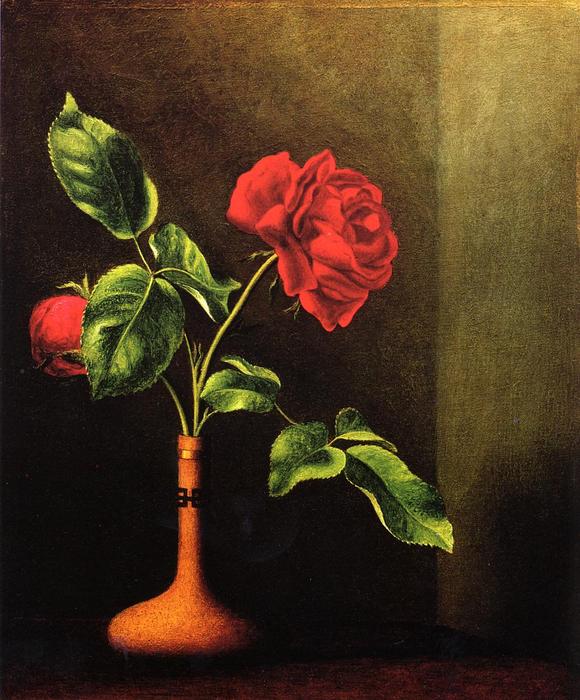
Still Life with Rose – A Luminist’s Quiet Vision
Martin Johnson Heade (1819–1904), born in the tranquil Pennsylvania countryside, remains a captivating figure in American art history—a painter whose luminous landscapes and intimate depictions of nature gradually emerged from relative obscurity to claim their rightful place among the nation’s most significant artistic achievements. His early life in Lumberville instilled within him a deep appreciation for the natural world, an affection nurtured by initial studies under local artists Edward and possibly Thomas Hicks. These foundational lessons provided Heade with the technical skills that would later blossom into a distinctive style, though his path to recognition was far from direct. Initially focused on portraiture, his early works demonstrate a competent hand but lack the singular vision that would define his mature oeuvre. A period of travel in Europe broadened his artistic horizons, exposing him to Impressionist influences and fostering a fascination with capturing fleeting moments of light and color—a preoccupation that would become central to his Luminist aesthetic.
- Subject Matter: Heade’s masterpiece, “Still Life With Rose,” presents a deceptively simple scene: a vase containing two exquisitely rendered red roses against a muted brown background. This deliberate choice of subject matter reflects the Luminist movement's core belief in portraying nature with uncompromising realism and capturing its serene beauty without embellishment.
- Style & Technique: Heade’s signature Luminist style prioritizes atmospheric perspective—a technique that skillfully diminishes detail as objects recede into the distance, creating a sense of depth and tranquility. The artist employs delicate brushstrokes to achieve this effect, blending pigments seamlessly to convey the subtle nuances of light and shadow on the vase and roses.
- Historical Context: Emerging in the mid-19th century, Luminism arose as a reaction against Romantic idealism, rejecting dramatic narratives and emotional intensity for an objective observation of the natural world. Heade’s work embodies this ethos, aligning with the broader artistic currents of his time—a period marked by scientific advancements and a growing interest in capturing the essence of American landscapes.
- Symbolism: Beyond its visual beauty, “Still Life With Rose” carries symbolic weight. The roses themselves represent purity and love—themes frequently explored in Victorian art—while the vase serves as a vessel for contemplation and stillness. Heade’s careful composition reinforces these ideas, inviting viewers to immerse themselves in the quiet grandeur of the natural world.
- Emotional Impact: Viewing “Still Life With Rose” evokes feelings of peace and serenity—a testament to Heade's ability to translate his profound connection with nature onto canvas. The painting’s muted palette and subtle tonal variations create an atmosphere of contemplative calm, transporting the viewer to a moment of quiet observation amidst the beauty of the American countryside.
### Additional Research:
Exploring Related Works by Martin Johnson Heade
Beyond “Still Life With Rose,” Heade produced numerous stunning landscapes that showcase his Luminist mastery. Notable pieces include “Sunset After a Storm in the Catskill Mountains” and “Cherokee Roses”—each demonstrating his unwavering commitment to capturing the sublime qualities of American wilderness with breathtaking precision. These paintings exemplify His artistic vision, which sought to elevate landscape art beyond mere depiction—aiming instead for an experience that would inspire awe and reverence for the natural world.
Comparative Analysis: Zurbarán’s Still Life Style
Francisco de Zurbarán's “Still Life With Lemons, Oranges and a Rose,” completed in 1633, represents a significant contrast to Heade’s Luminist approach. While Zurbarán utilized dramatic chiaroscuro—the interplay of light and dark—to heighten the emotional impact of his composition, Heade prioritized atmospheric perspective and subtle tonal gradations to convey tranquility and realism. Despite stylistic differences, both artists shared a fascination with capturing the beauty of everyday objects and elevating them into works of art—a testament to the enduring power of still life as a genre.
Resources for Further Exploration
For more information on Martin Johnson Heade and Luminism, consider visiting these resources:
Recommended Reproduction Options
High-quality reproductions of “Still Life With Rose” are available from reputable art dealers and online galleries. Consider framing the artwork in a neutral tone to complement its understated elegance—enhancing its visual impact and preserving its timeless beauty for generations to come.